I wrote a post titled Congratulations, Robot. You’ve Been Promoted! in which OpenAI declared that their AI coders were no longer junior engineers but mid-level engineers.
The post triggered the largest unsubscription rate in this blog’s history. It was a 4-sigma event.
A Nassim Taleb black swan, this was something that should happen once every 700 years of a blog author’s career.
Clearly, the post struck a nerve.
In a job market 13% smaller for recent grads than recent years, a subtle fear persists that positive developments in AI accuracy & performance accelerate job losses. Stanford’s research found :
“young workers (ages 22–25) in the most AI-exposed occupations, such as software developers & customer service reps, have experienced a 13% relative decline in employment since generative AI became widely used.”
The whispered question beneath all this data : are AI advances a zero-sum game for jobs? Are we in the modern era hearing the same refrain as Springsteen lamenting the impact of globalization on his hometown :
They’re closing down the textile mill across the railroad tracks. Foreman says “These jobs are going, boys, and they ain’t coming back”
Let’s go to the data.
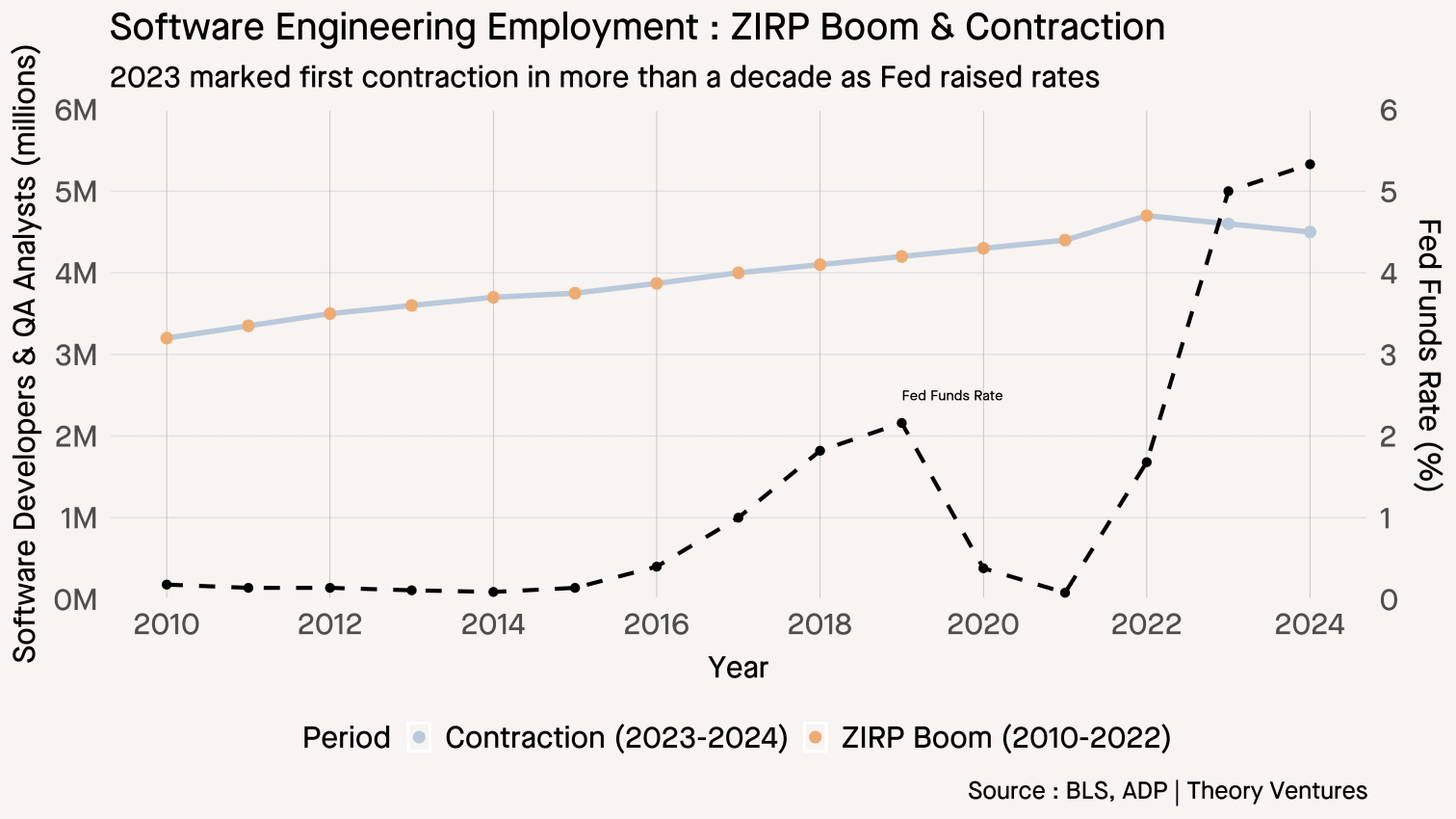
Software engineering employment grew steadily from 3.2m developers in 2010 to 4.7m in 2022 during the ZIRP (Zero Interest Rate Policy) era. The 2020-2022 period was the hottest tech jobs market of all time, with demand doubling since 2020.
Then the Fed raised rates aggressively, increasing the cost of capital, triggering a 4.3% contraction, hitting younger workers.
But data from layoffs suggest that this trend isn’t accelerating.
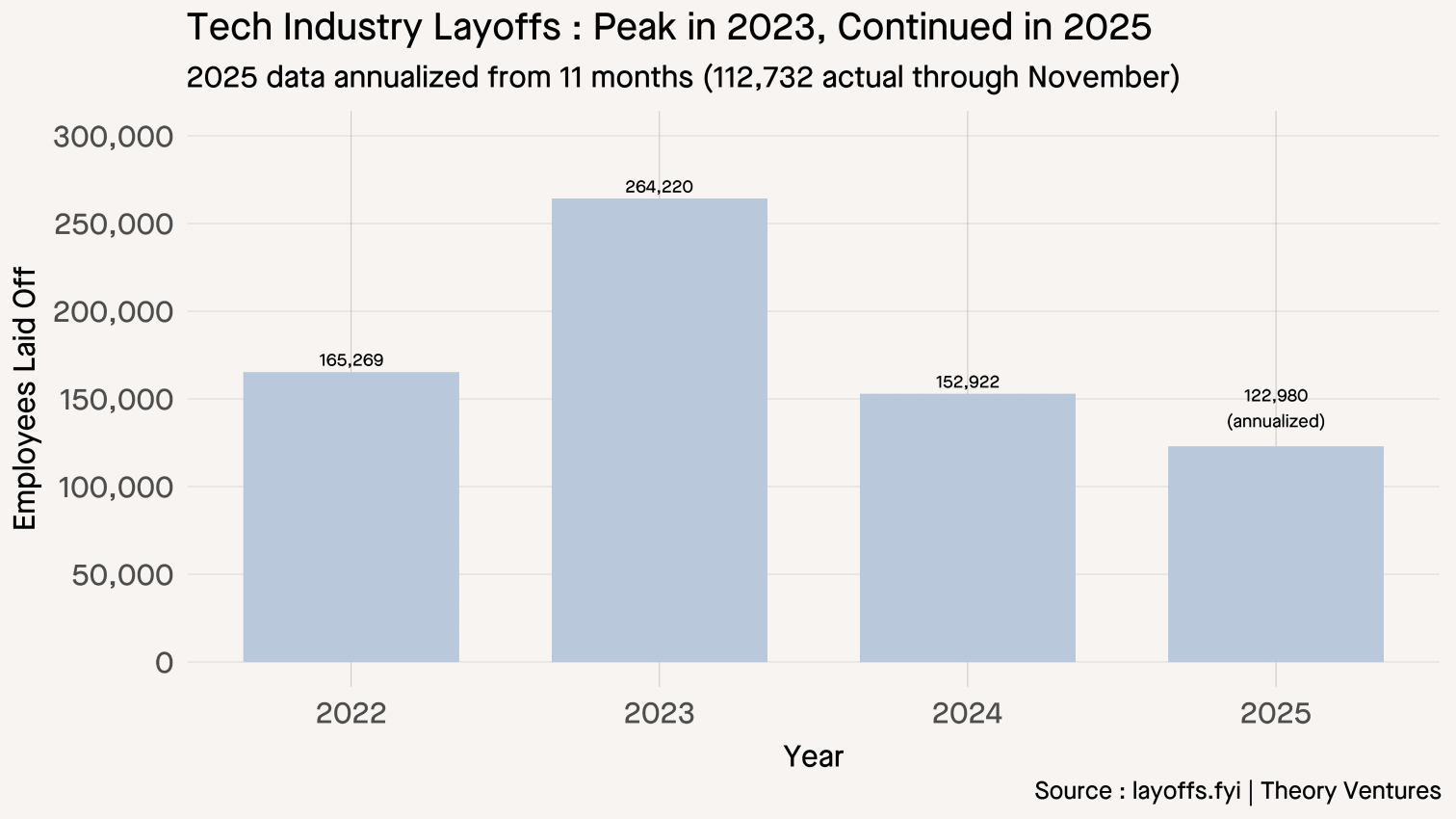
Tech companies laid off 264,220 employees in 2023. The 2025 data (annualized from 11 months through November) projects 122,890 layoffs for the full year. There’s no acceleration yet in the data.
The data doesn’t yet show what readers are clearly feeling : a trepidation that AI advances will accelerate job losses.