For the first time since the 2000s, technology companies are confronting the limits of their supply chain.
GPU rental prices for Nvidia’s Blackwell chips hit $4.08 per hour this week, up 48% from $2.75 just two months ago.1 CoreWeave raised prices 20% & extended minimum contracts from one year to three.1
“We’re making some very tough trades at the moment on things we’re not pursuing because we don’t have enough compute.” - Sarah Friar, OpenAI CFO1
This scarcity is already reshaping access. Anthropic has limited its newest model to roughly forty organizations.2 Access to the bleeding edge is becoming a gated privilege, for both capacity & security.
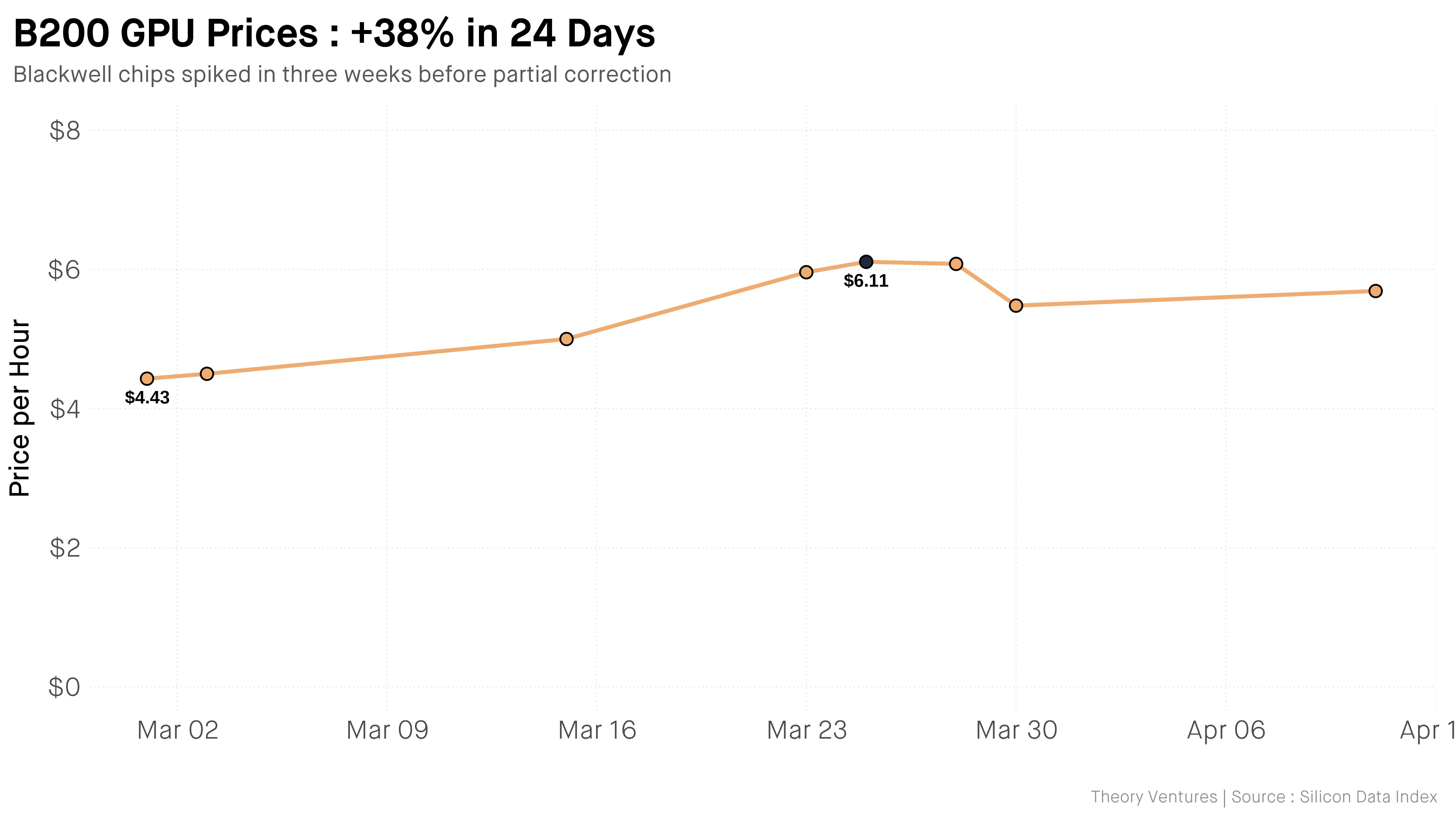
If the largest AI companies are having problems, startups face a tougher proposition. Five hallmarks define this era :
- Relationship Based Selling : State-of-the-art models may no longer be open to everyone as providers limit access to their most profitable or strategic customers.
- AI to the Highest Bidder : Even when they do become available, SOTA models may become prohibitively expensive. Companies that can raise large amounts of capital or generate strong profits will have an advantage.
- Available but Slow : Even if you can pay, there may not be guarantees the models will be fast.
- Inflationary Commodity : This imbalance will inevitably drive prices higher as demand compounds against a fixed supply. Procurement & margin management will become key disciplines in software companies.
- Forced Diversification : Developers will be forced to look elsewhere, from smaller models to on-premise deployments, until energy infrastructure & data center buildouts catch up, which could take years.
The age of abundant AI is over, & it will remain so for years.3