With Smart Software, Sell Ironman Not Robocop

image

When buying machine learning enabled software, it’s easier to sell like Ironman than Robocop; a product that complements and augments the user’s skills rather than a true replacement. As machine learning continues to become a key differentiator among SaaS products, a secular and positive trend, startups are learning how to sell the promise of the software better and better. These are some of the objections customers raise during those sales pitches.

Read more

The 12 Things I Know About You

image

I know 12 things about you.

  1. You have a great need for other people to like and admire you.
  2. You have a tendency to be critical of yourself.
  3. You have a great deal of unused capacity which you have not turned to your advantage.
  4. While you have some personality weaknesses, you are generally able to compensate for them.
  5. Disciplined and self-controlled outside, you tend to be worrisome and insecure inside.
  6. At times you have serious doubts as to whether you have made the right decision or done the right thing.
  7. You prefer a certain amount of change and variety and become dissatisfied when hemmed in by restrictions and limitations.
  8. You pride yourself as an independent thinker and do not accept others’ statements without satisfactory proof.
  9. You have found it unwise to be too frank in revealing yourself to others.
  10. At times you are extroverted, affable, sociable, while at other times you are introverted, wary, reserved.
  11. Some of your aspirations tend to be pretty unrealistic.
  12. Security is one of your major goals in life.

Was I right?

Read more

Chained Probabilities in Startup Business Models

image

In 1983, Lorne Whitehead, a physicist from the University of British Columbia proved he could knock down the Empire State Building with 29 dominos. A domino can knock over an other domino one-and-a-half times its size. Whitehead’s theory concretely demonstrates the power of a chain reaction.

Like a series of dominos, a startup’s success is a chain reaction. One small win leads to two other slightly bigger successes, which grow to four triumphs, then eight hits and so on until the company is a blockbuster. The first win might be witnessing a product capture the imagination of a random coffeedrinker at a local cafe. The second reaction might be closing the first paying customer. The third, hiring a top-notch executive.

Read more

The Question to Ask Before Starting a Company in 2016

My father keeps a copy of Michael Porter’s Competitive Strategy on his bookshelf. An imposing dark gray tome, Competitive Strategy is a business classic. I remember reading it sometime in high school, and not understanding very much of it. It was only six years later in a college macroeconomics class, my professor helped me understand the value of the Five Forces. For startups entering a period of increased capital cost, the wisdom of Porter’s Five Forces is more important to consider now than they have been in the past few years.

Read more

The New UI for SaaS - The Question

Quick. Casual. Human. Chat differs from other forms of communication. Because of these three attributes, chat seems to be reemerging as a potentially disruptive user interface for both consumers and business users.

The typical teenages emits more than 3000 text messages per month, not to mention messages on other networks. Most retailers provide customer support via chat. Hundreds of millions of people have tweeted. The combination of these three forces expose nearly everyone on the Internet to brief, useful messages every hour.

Read more

3 Questions for Startups to Answer for Themselves in a Volatile Fundraising Environment

image

65% of entrepreneurs believe that fundraising in 2016 will be more difficult than in 2015, according to First Round’s survey. The volatility in the stock market, the steady erosion of public multiples, and the broad decline of seed, venture and growth investment in Q4 2015 seem to portend a repricing of the startup market. In light of those changing circumstances, entrepreneurs should prepare a few different analyses for 2016.

Read more

When Data Confounds Our Intuition

Suppose you’ve been selected to participate in a game show. The game show host asks you to pick one of three doors. Behind one, the grand prize awaits. Behind the other two are goats. You choose Door 1. Then the hosts opens Door 3, revealing a goat. The host prompts you again, “Would you like to select Door 2?” Should you choose it?

This statistics question rose to fame in 1990 when Marilyn Vos Savant asked it in Parade Magazine. In the weeks that followed, Vos Savant received more than 10,000 letters pronouncing her wrong. One thousand of these letters had been penned by PhDs, and many bore the insignia of prestigious universities.

Read more

The Metric that Matters for Startups in 2016

image

2015 is the end of an era, the era of startup growth at any cost. In 2016, the question that will immediately follow, “What is your annual growth rate?” will be “What are your unit economics?” This change in investor mentality is catalyzed by the increasing cost of startup capital.

Starting in 2014, and perhaps even a bit before, startups have been able to raise capital at better terms than at any time since 2000. More money raised for less dilution. The greater competition among investors increases valuations relative to revenue pricing valuations further into the future.

Read more

The Downward Pressure of Public Markets on Startup Valuations

image

How have public SaaS companies fared in the public markets over the past few years? It’s been mixed. Over this three year period, 32 of 50 companies are worth more today than they were either at IPO or at their trading price three years ago. Of the remaining 18, 7 of those companies went public in 2015. It was a tough year for SaaS companies to go public.

image

Read more

The State of the Startup Fundraising Market in 2016

image

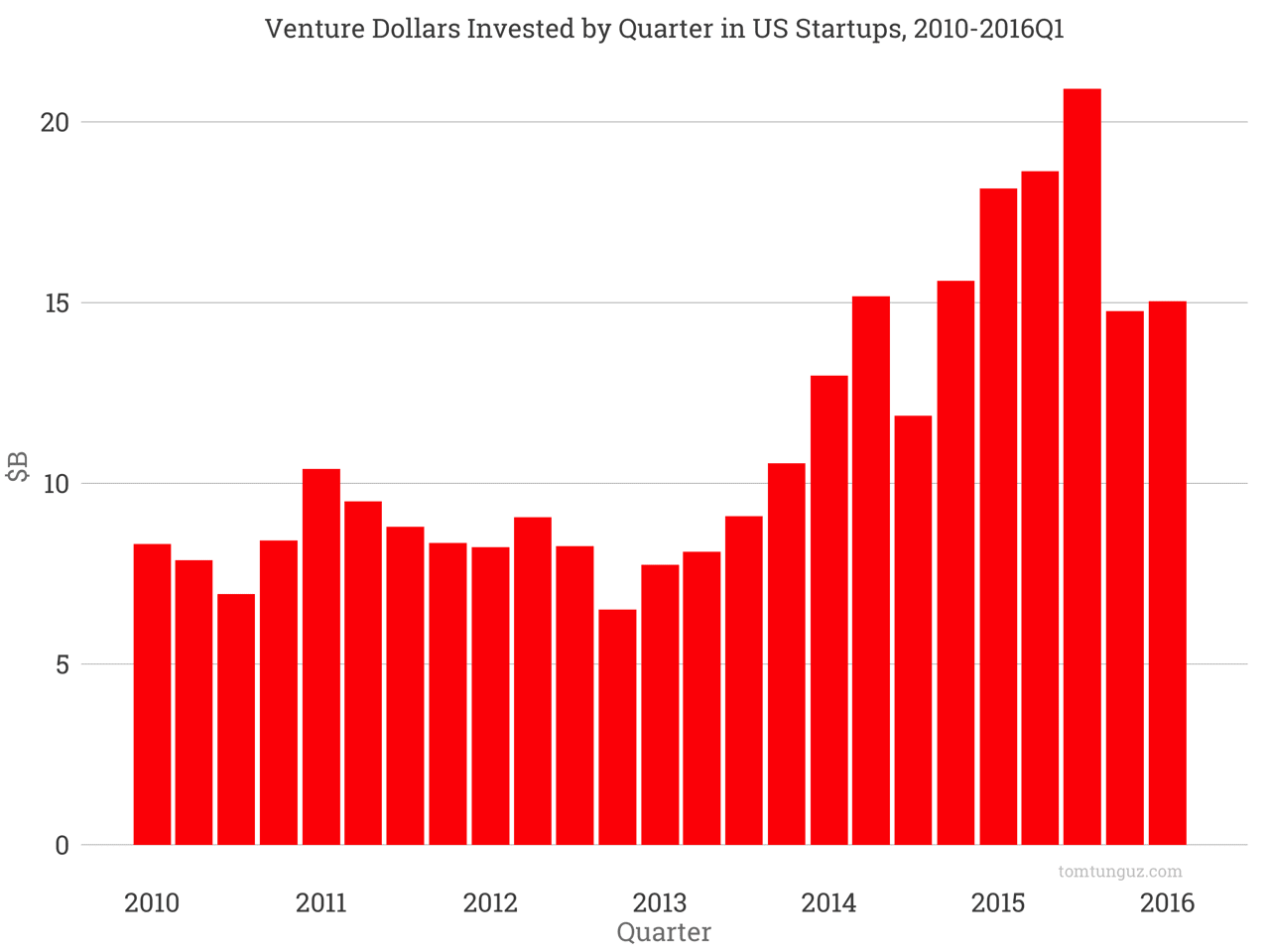
For all the talk about late stage rounds, megarounds and unicorns, early stage startups are benefitting disproportionately from near-record years of venture capital investment. Of the $42B invested in startups in 2015, 34% or about $14B was raised in series A and seed rounds. That figure is up from 18% in 2005. The 35% attained in 2013 share for early investment ties the 1996 record.

Both an increase in the number of investments and the average amount raised by early stage companies has contributed to this trend. On average, 25% more early stage startups raise capital in the last five years compared to 1995-2000. And when they raise, they raise at near record amounts.

Read more