The Other Payback Period that Matters in SaaS
image

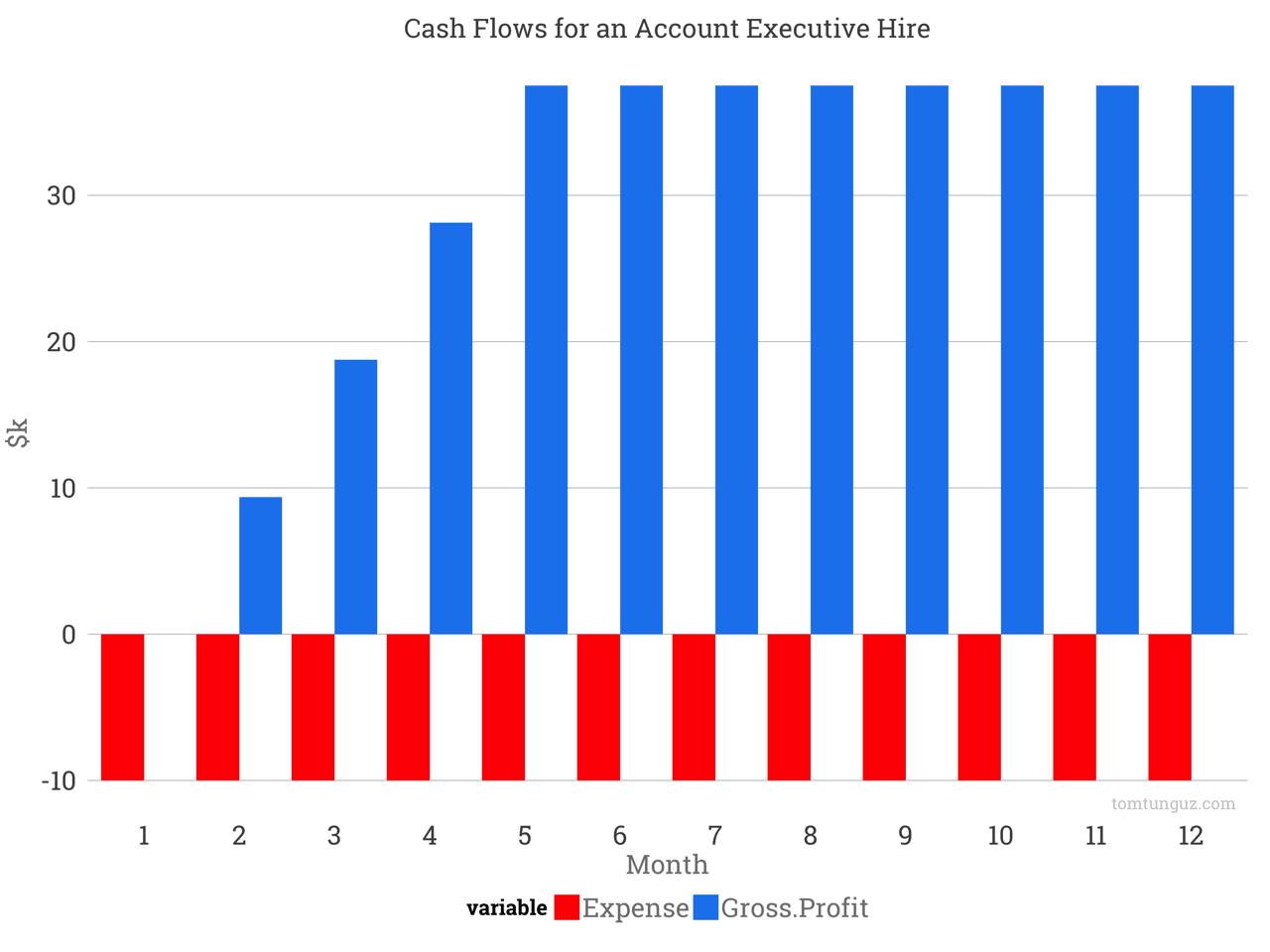
When we discuss payback periods in SaaS, we implicitly mean customer payback periods. How much time does it take for us to recoup the capital outlay we invest in acquiring a new customer? But, there’s a second and equally important payback period – the payback period on hiring a new account executive.

Let’s take a hypothetical SaaS startup that sells a $20k product at a 75% gross margin. Clients pay monthly and commissions are paid monthly. The company hires a new account executive in month 1. The AE has an on-target-earnings (OTE) of $60k base/$60k commission and a quota of $600k. The AE is given 5 months to ramp to full quota: 0% in the first month, 25% the second, 50% in the third, etc.


Read more

How to Become Profitable Faster in SaaS

As the fundraising environment changes, some SaaS companies will look to reach cash flow break even on their existing reserves. Founders may reduce staff, particularly in recruiting or new projects that the company prefers not to finance. But there are three other ways to become profitable that limit reductions in force, enable the company to continue to grow with greater efficiency and increase the value of the company in the process.

Read more

Mr. Market and the SaaS World

image

Mr. Market is a fictitious character imagined by legendary investor Benjamin Graham in The Intelligent Investor. Graham describes Mr. Market as emotional, irrational, moody - and is in the short run a voting machine, in the long run a weighing machine. It might sound like a children’s story, but Warren Buffett lauded the book as the greatest book ever written on investing. So, has is halving of SaaS multiples the work of irrational Mr. Market or a change from the voting machine to a weighing machine?

Read more

The 57% Drop in SaaS Valuations

image

What a difference a month makes. I wrote a post on January 10, 2016 called The Downward Pressure of Public Markets on Startup Valuations that depicted the slow decline of SaaS multiples in the public markets. Since then, multiples have compressed markedly.

The chart above shows the forward revenue to enterprise value multiple of all public SaaS companies. Remember the heyday in March 2014? We’re 57% below that high at 3.3x forward revenues. A month ago, the market traded these businesses at 4.2x, so a 21% fall in four weeks, punctuated by a 40%-50% decline in LinkedIn and Tableau* last Friday.

Read more

The Nature of Leverage in Fundraising Conversations Has Changed

Leverage. It’s the key to negotiating. Classic negotiating books like Getting to Yes define the BATNA, the Best Alternative to Negotiated Agreement. If you were to walk away from a conversation, what’s the next best choice? The BATNA singlehandedly creates leverage in negotiating.

Over the last few years, startup founders have exerted tremendous leverage in the fundraising market by taking advantage of the supply/demand imbalance. Too much capital chasing a sliver of exceptional startups. When demand exceeds supply, valuations and round sizes balloon. A fast-growing startup’s BATNA had been the other investor waiting in the lobby, term sheet in hand.

Read more

With Smart Software, Sell Ironman Not Robocop

image

When buying machine learning enabled software, it’s easier to sell like Ironman than Robocop; a product that complements and augments the user’s skills rather than a true replacement. As machine learning continues to become a key differentiator among SaaS products, a secular and positive trend, startups are learning how to sell the promise of the software better and better. These are some of the objections customers raise during those sales pitches.

Read more

The 12 Things I Know About You

image

I know 12 things about you.

  1. You have a great need for other people to like and admire you.
  2. You have a tendency to be critical of yourself.
  3. You have a great deal of unused capacity which you have not turned to your advantage.
  4. While you have some personality weaknesses, you are generally able to compensate for them.
  5. Disciplined and self-controlled outside, you tend to be worrisome and insecure inside.
  6. At times you have serious doubts as to whether you have made the right decision or done the right thing.
  7. You prefer a certain amount of change and variety and become dissatisfied when hemmed in by restrictions and limitations.
  8. You pride yourself as an independent thinker and do not accept others’ statements without satisfactory proof.
  9. You have found it unwise to be too frank in revealing yourself to others.
  10. At times you are extroverted, affable, sociable, while at other times you are introverted, wary, reserved.
  11. Some of your aspirations tend to be pretty unrealistic.
  12. Security is one of your major goals in life.

Was I right?

Read more

Chained Probabilities in Startup Business Models

image

In 1983, Lorne Whitehead, a physicist from the University of British Columbia proved he could knock down the Empire State Building with 29 dominos. A domino can knock over an other domino one-and-a-half times its size. Whitehead’s theory concretely demonstrates the power of a chain reaction.

Like a series of dominos, a startup’s success is a chain reaction. One small win leads to two other slightly bigger successes, which grow to four triumphs, then eight hits and so on until the company is a blockbuster. The first win might be witnessing a product capture the imagination of a random coffeedrinker at a local cafe. The second reaction might be closing the first paying customer. The third, hiring a top-notch executive.

Read more

The Question to Ask Before Starting a Company in 2016

My father keeps a copy of Michael Porter’s Competitive Strategy on his bookshelf. An imposing dark gray tome, Competitive Strategy is a business classic. I remember reading it sometime in high school, and not understanding very much of it. It was only six years later in a college macroeconomics class, my professor helped me understand the value of the Five Forces. For startups entering a period of increased capital cost, the wisdom of Porter’s Five Forces is more important to consider now than they have been in the past few years.

Read more

The New UI for SaaS - The Question

Quick. Casual. Human. Chat differs from other forms of communication. Because of these three attributes, chat seems to be reemerging as a potentially disruptive user interface for both consumers and business users.

The typical teenages emits more than 3000 text messages per month, not to mention messages on other networks. Most retailers provide customer support via chat. Hundreds of millions of people have tweeted. The combination of these three forces expose nearly everyone on the Internet to brief, useful messages every hour.

Read more