The Meteoric Acceleration in Series A Valuations

image

What a difference a few quarters make! In the past nine months, Series A valuations have skyrocketed. In fact, 2014 Series A pre-money valuations have surpassed median Series B valuations from 10 years ago, accounting for inflation. The same is true for Series B valuations exceeding Series C valuations. Cooley, a top tier startup law firm, reported this trend in their valuation quarterly report, which tracks these figures where they are counsel to either investors or founders.

Read more

The Stability of the Current Tech Market

image

It’s Q3 earnings season and about half of the major public tech companies and recent startup IPOs have reported their figures. I keep track of earnings to get a sense for how these companies perceive their markets. Meeting or exceeding earnings indicates companies can forecast their growth and demonstrates how predictable these businesses are. The more predictable, the more stable the business environment and consequently, the fund raising environment for startups.

Read more

One of the Best Business Opportunities in the Next Decade

The real promise of the Internet of Things isn’t simply linking millions of devices together, just like the real innovation of the web wasn’t networking a bunch of computers. Instead, the true and still unrealized potential of IoT is to transform business models; it’s enabling companies to sell products in entirely new and better ways that benefit both the company and the customer.

Around the turn of the millennium, startups began using the web browser to deliver their products to consumers and companies. Soon afterwards, instead of paying a one-time fixed price to use the software, customers subscribed to access the software. You can’t buy Quicken or Quickbooks on a CD for one fixed payment anymore. Now it’s a subscription.

Read more

Four Important Data Points on Measuring Your Startup's Customer Happiness

image

At some point, most startups will begin to measure their customers’ happiness. Customer satisfaction is an important predictor of loyalty and can foster fantastically efficient word-of-mouth growth. Many companies employ Net Promoter Score to quantify customer satisfaction. NPS measures the fraction of a customer base which are promoters and detractors of a company’s product. I’ve been told that NPS scores greater than 50 are impressive, but this is simply a rule of thumb. So what’s the right way to evaluate a company’s NPS report?

Read more

The Impact of Investor Geography on Your Seed, Series A and B Check Size

When we analyzed the impact of location on a startup’s ability to raise capital, we found no statistically significant difference. Startups in San Francisco, Seattle, Pittsburgh, Austin and many other cities all demonstrated similar ability to raise follow-on rounds. But is the same true for investors of various locations? Do investors across the US invest similarly across Seed, Series A and Series B?

They do not. In fact, there is a statistically significant difference in investment patterns of investors depending on their location. The table below contrasts the mean round sizes across Seed, Series A and Series B, by investor headquarters location across firms in California, Massachusetts and New York1.

Read more

Using Statements of Work to Accelerate Sales Cycle and Align Sales, Customer Success and Marketing

I met a really smart vice president of sales a few weeks ago working in a company with mid-market customer values in the $10-100k per year range. When I asked her about her sales process, she described how her team employs statements of work (SOW), which isn’t something I hear about very frequently in startups, despite the fact they are very powerful sales tools.

Statements of work describe the proposed working relationship between a vendor and customer. These are common in government contracts and in the advertising agency world where they are called creative briefs, among other places. But I don’t run across them very often in SaaS.

Read more

The Obscure Economic Idea Behind SaaS Pricing Challenges

image

Startups struggle to set the right price for their products because pricing dynamics in the field don’t obey the laws taught in the classroom. The standard supply and demand curves, drawn above, imply that as price increases demand decreases; that buyers act rationally and that this law is immutable. But this simply isn’t the case. Buyers in the market place violate the traditional supply and demand model all the time.

Read more

The 9 Marketing Disciplines of Great SaaS Companies

image

Bill Macaitis, the former CMO of Zendesk, articulates how a SaaS marketing team should operate better than anybody else I’ve met. At a recent Point9 conference, Bill outlined the 9 marketing disciplines of great SaaS companies and how they fit together to create a marketing powerhouse. I’ve copied my notes from Bill’s talk below.

Ops & Analytics Team
The operations and analytics teams is the first marketing team every SaaS company should build because this team erects the experimental infrastructure for determining which marketing tactics are viable. Over time, it also becomes the largest team.

Read more

Why Revenue Isn't the Most Important Financial Metric for Startups

image

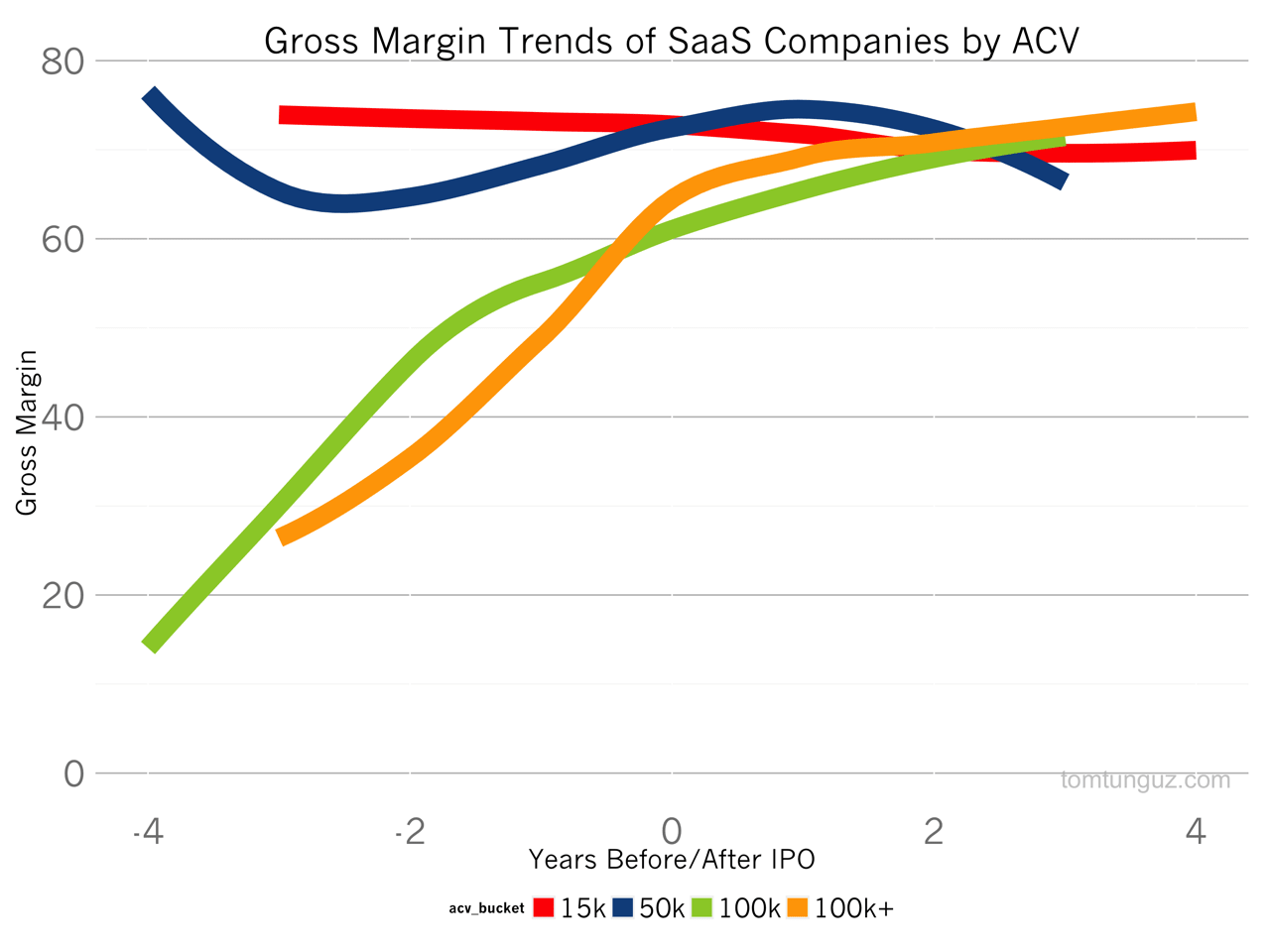
Of the ten most important metrics on a startup’s financial statements, revenue might seem to be the most important. But it isn’t. Gross margin matters more because it is directly tied to a company’s ability spend to grow and achieve profitability.

Imagine two startups, both selling products at $1M price points. The first has 5% gross margins and the second has 95% gross margins. The first company will be able to spend about $50k per sale on Sales & Marketing, Research & Development and general operational costs. The second company will deploy $950k across those departments.

Read more

The Fastest User Interface

image

In “Time to Hang Up on Voice,” Sam Lessin argues voice isn’t the interface of the future for three reasons. First, voice is hard to use in public places because background noise complicates interpretation, and because many people are in earshot, voice isn’t private. Second, speaking to computers is less efficient than typing or using gestures. Third, keyboards are better tools for editing text than voice.

But I think he’s wrong if for only one reason: speed. Let’s compare two people at the cutting edge of communication. Barbara Blackburn holds the world record for typing at 212 words per minute on a Dvorak keyboard, a layout optimized for efficiency. Steve Woodmore holds the world record for speaking at 637 words per minute. At the limit of human performance, the spoken word is three times faster than the typed word. For those not competing in Guinness World Record challenges, the median typing speed is about 30-40 words per minute and the median speaking speed is, again, three times that, about 120 words per minute. The ratio is relatively constant.

Read more