The Optimal Seed Round Construction to Maximize Series A Success

Is it better to raise your startup’s seed round from only angel investors, or is it better to include a VC or two? Several founders on the precipice of launching their seed fundraising processes have asked me this question.

It’s a very difficult one to answer hypothetically because there are many different variables to balance. For example, VCs may invest larger sums than angel investors. The imprimatur of a VC’s investment in a company might help convince potential customers and recruits. But some might argue their money brings potential signaling risk.

Read more

The Impact of VCs in Seed Rounds in Seven Charts

image

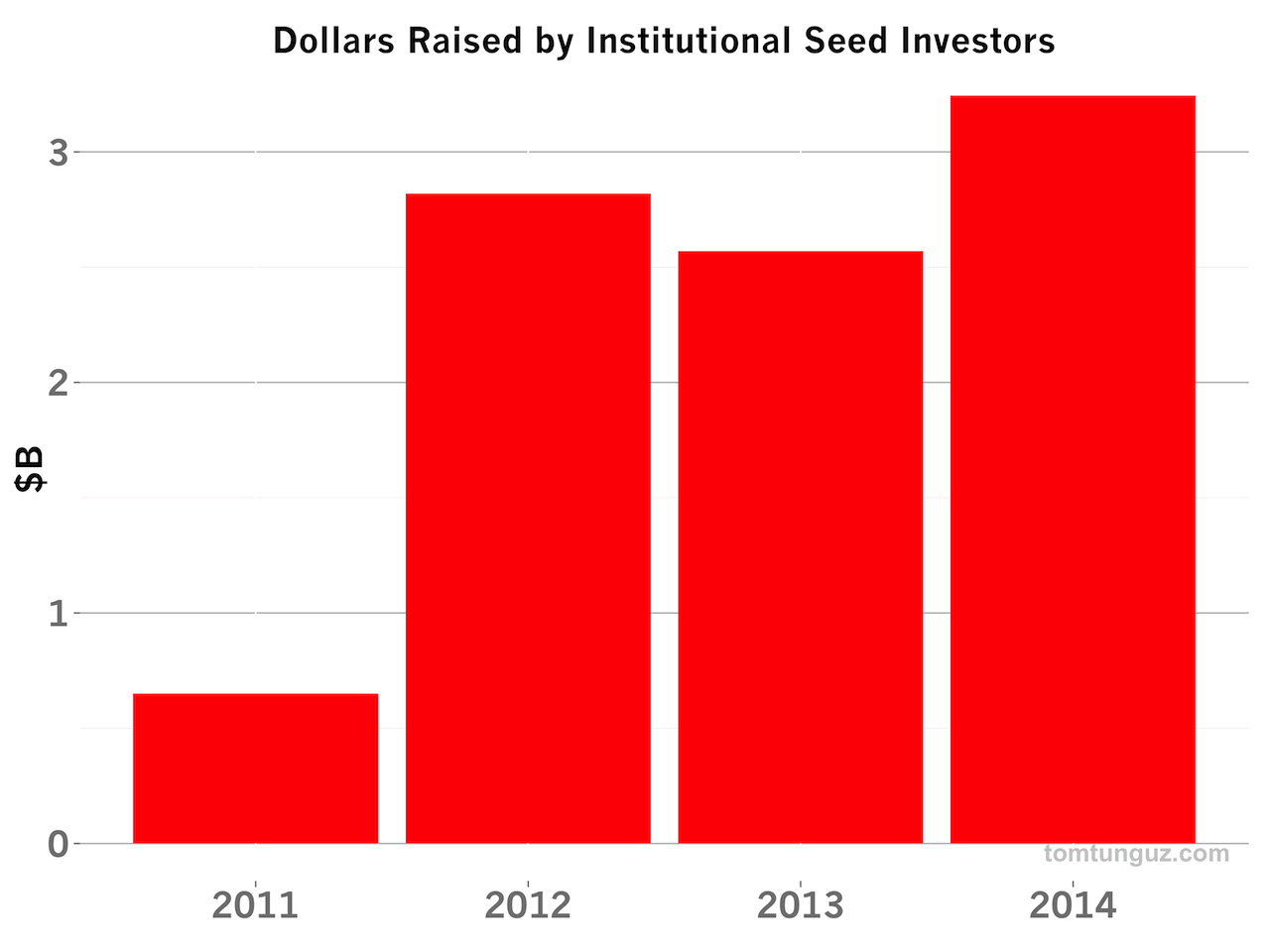
For the past several years, early stage VCs have entered the seed market with vigor. VC’s entry has resulted five different important trends in the past five years:

  1. The total dollars entering the seed market has increased by 132%.
  2. The mean seed round size has increased by 114% to $1.4M.
  3. VCs’ typical seed investment has grown by 50%.
  4. Mega-seeds, those seed investments over $2M, have reached historic highs exceeding 80 instances in 2013.
  5. The mean mega-seed round is $2.26M during the past five years but in 2013 that figure reached $2.8M, which implies mega-seeds have replaced traditional early Series A.

Though total number of seed investments increased by 30% comparing 2013 to 2011, but astoundingly, the total dollars entering the seed ecosystem has increased by 132%.

Read more

The Riskiest Investment a Startup Can Make

Marketing investments are unlike any other investment a startup. They are the least-tangible, least-measurable investments and that’s why they are perceived as the riskiest investments.

After raising a round of capital, a startup’s management team has a pool of capital to invest. They can choose from different projects: growing the engineering team to build products faster, spending more on infrastructure to speed page load times, moving to a bigger office, adding salespeople to prospect more customers. All of the aforementioned products have long-term value and the benefit of the investment can be seen immediately. New hires are in the office every day and will remain with the company for years. The speed benefits of faster infrastructure accrue to the company daily and a better product engenders a happier customer base.

Read more

The Hidden Costs of the Switching Products in the Consumer Web

image

HBS Professor Michael Porter created the Five Forces Framework in 1979 in a landmark book called Competitive Strategy. One of those forces, the threat of substitutes has intrigued me for quite a while because in the world of the Internet, the prevailing wisdom on switching costs argues they are trivial on the web. After all, how difficult is it to change from Google search to Bing search? This is the question Google wrestled with during its search share battle in the mid 00s.

Read more

Salesforce's Marketing Secret - The Fourth Marketing P

In his book Behind the Cloud: The Untold Story of How Salesforce went from Idea to Billion Dollar Company and Revolutionized an Industry, Marc Benioff shares the 111 plays he learned through Salesforce triumphant rise to the most valuable SaaS company in the world.

Play 15 is my favorite from the book. Benioff writes “position yourself either as the leader or against the leader in your industry.” Play 15 highilghts the most frequently forgotten of marketing’s four Ps, positioning. Positioning is easily forgotten because it’s the least tangible of the four. Price immediatly impacts revenue. Product, well, everyone has a point of view on product. Placement in today’s ecosystem means ad placements, most often. In performance marketing, the numbers speak for themselves.

Read more

The Common Characteristics of Successful Freemium Companies

Is there a common characteristic of successful freemium companies? Piotr asked this question earlier this week. This is the framework I’ve seen work well for freemium startups.

At its core, freemium is a novel marketing tactic that entices new users and ultimately potential customers to try a product and educate themselves about its benefits on their own. By shifting the education workload from a sales team to the customer, the cost of sales can decrease dramatically. So, freemium can be a huge strategic advantage in a competitive market because those companies that successfully implement freemium can scale faster and more efficiently than traditional sales-driven companies might.

Read more

The Impact of Varying Sales Hiring Strategies on SaaS Startups

image

What are the tradeoffs when considering different sales hiring plans and which is the right one for your startup? There are many different considerations in creating a sales hiring plan. Balancing them all can be tricky, but thinking through the trade-offs is important to scaling the business well.

First, let’s compare the financial impact of three different sales hiring strategies: six sales people hired at once, two sales people hired for each of three quarters and one sales person hired each month. In this hypothetical example, the sales people have a $350k annual quota, cost the startup $100k annually, and achieve their quota over six months with the following attainment percentages by month: 0%, 0%, 25%, 50%, 75%, 100%.

Read more

The Common Language of Great Teams

image Last week, Redpoint held our annual Founder Day gathering. At the event, I listened to the stories of Felix Baumgartner’s record breaking jump from 120,000 feet, heard about the astonishing comeback of the US America’s Cup team and took part in a creativity workshop led by a Stanford Design School professor. In short, the event revolved around doubt.

Baumgartner halted the Stratos Project twice during its seven year development. Quite naturally, he was terrified of the jump from space. Ten months before competition, Jimmy Spithill and his crew capsized and destroyed their $10M America’s Cup catamaran that had required twelve months to build. After overcoming that ordeal with round-the-clock shifts to build a new boat, the team found themselves down 1-8 in a race to nine points.

Read more

The Five Letters that Will Change the Data World: BYOBI

BYOBI is an acronym I first heard on a telephone call with a VP of Technology at a large corporation. The word is almost unknown today, but I think that it will be one of the largest trends to impact data in the next five years.

BYOBI means Bring Your Own Business Intelligence. This VP of Technology was struggling to enable the sales people, marketers, engineers and others within his business to access the data they needed. The monolithic solution that they had adopted, (I can’t remember if it was MicroStrategy or Cognos or BusinessObjects), satisfied the needs of the one department that had catalyzed the purchasing decision many years ago. Several years on, his team had become inundated with custom data requests that the tools failed to answer and petitions to purchase new types of software. Unfortunately, his data architecture just wouldn’t allow him to respond to those needs. The image below is a simplified schematic of his architecture.

Read more