How Mobile is Disrupting Even the Most Successful Internet Products

In 2008, iGoogle represented 20% of traffic to Google. Seven years later, the mobile phone is the home screen of choice for a billion people. iGoogle is dead. Mobile killed it.

The typical mobile phone user checks their phone 110 times per day. I suspect iGoogle’s most avid users visited about 10 times daily. By that math, mobile home screens generate an order of magnitude more engagement. If Google or any company wants to provide the home screen to those billion people, that home screen must be a mobile app.
Read more

The Most Important Feature In KitKat No One is Talking About

Quietly mentioned in yesterday’s press conference about Google’s Android update is a new feature that will change the way people use their mobile phones, search deep-linking. With KitKat, Google is applying its world-class crawling and search technology to the content and data within mobile applications.

Quoting from the Verge,

A search for a restaurant will offer a link directly to that restaurant page in the OpenTable app if you have it installed, allowing you to set up a reservation. Or a recipe search will bring you to the result directly inside of the AllRecipes app — rather than the mediocre mobile website.

Read more

The Three Churn Mitigation Strategies of SaaS Startups

Every SaaS business suffers from churn. If churn isn’t managed properly, the lost revenue from churned customers offsets new revenue and the business flat-lines or suffers negative revenue growth. I’ve seen startups employ three patterns for offsetting churn: acquiring new customers faster, upselling existing customers to buy more software, or structuring pricing to grow with customers.

Each strategy requires different levels of investment but achieves similar results. These strategies are often deployed in addition to a customer success team, which require their own investment.

Read more

Quick and Dirty Product/Market Fit Validation: Can You Hit Your Quota?

How do you validate an idea for a software startup before the product is built? Last week, a founder of a SaaS business and I were wrestling with this problem. It’s a question without a universal answer. After a while, we came up with quick and dirty rule of thumb for his business. Can he hit his quota?

Suppose this founder wasn’t the founder, but the first inside sales hire for the startup. His annual quota would be around $300k or about $25k per month. He would likely commit to a four month quota ramp, needing to reach of 25% of quota ($6k) in the first month, 50% in the second ($12k) and so on.

Read more

Dream Teams: The Characteristics Of Billion-Dollar Startup Founders

There’s a perptual and roaring debate in Startupland about the ideal founding team. Should the ideal team be entirely computer scientists? How important to success is having an MBA/business person? What about the stories of billionaire dropouts?

To answer that question, I’ve aggregated the academic backgrounds of 30 of the top startups of the past few years and analyzed the make up of each of those founding teams.

Above is a chart comparing the number of “billion” dollar startups by the total number of founders and the share of technical founders.

Read more

The Unexpected Compensation Trends of Post-Series A Startup Founder/CEOs

There’s an interesting phenomemon occurring in founder compensation for post-Series A companies: founding CEOs are swapping cash for larger equity stakes in their companies. Founding CEO salaries, post Series A, have fallen by about 24% while founder equity has increased by 32%.

This trend is broad. Each year, Redpoint portfolio companies participate in a compensation survey along with the portfolio companies of about 50 other firms, totaling about 800 startups. A third party pools the data to benchmark compensation trends across the executive functions in startups (CEO, VP of Product, VP of Marketing, VP of Sales, and so on) across the different financing series, locations, development stages and founders vs non-founders.

Read more

The Internet Subscription Startup is Winning

This week, Netflix announced its US userbase grew to 31M subscribers surpassing HBO for the first time. The magnitude of Netflix’s milestone is hard to overstate. In a bid to compete with Netflix, HBO has partnered with Comcast, which serves 21M subscribers, to trial an Internet-only subscription plus HBO, the first time HBO is available to US consumers without a full cable subscription. It’s a clash of behemoths.

Separately, the NY Times revealed they have amassed more than 700,000 digital subscribers who provide upwards of 20% of circulation revenues and grow about 40% year over year. The data flatly countermands arguments against the paywall when it launched two years ago.

Read more

Anticipatory Commerce: the Evolution of Intent on the Web

Intent to purchase is the engine of the consumer web. Creating and capturing intent motivates almost every dollar invested into ecommerce and advertising. Intent is also the fuel for the Internet’s most successful business model, Google’s AdWords + Search.

As the internet has evolved, so have the ways of creating and capturing intent. From display to search to retargeting to collections, each new technique has leveraged data in a novel form to discover consumers’ wishes. I believe we’re at the beginning of the next wave of mining that intent using anticipatory computing.

Read more

A Startup's Rosetta Stone - How to Succinctly Communicate the Details of a Business

Financial statements are the Rosetta Stone for a business. They are the most succinct way of communicating how a business operates to management teams and boards, who weigh the trade-offs of different investments.

In the early stages of the startup, financial statements aren’t used much as a management tool. They are most often used to keep an eye on monthly burn rate. But as companies grow, startups hire leaders to manage marketing and sales and product and engineering. These functional teams require money to achieve their goals. Investments include recruiting, structuring sales quotas, developing software, buying ads, hosting events, or expense accounts to close customers.

Read more

The SaaS Valuation Bubble

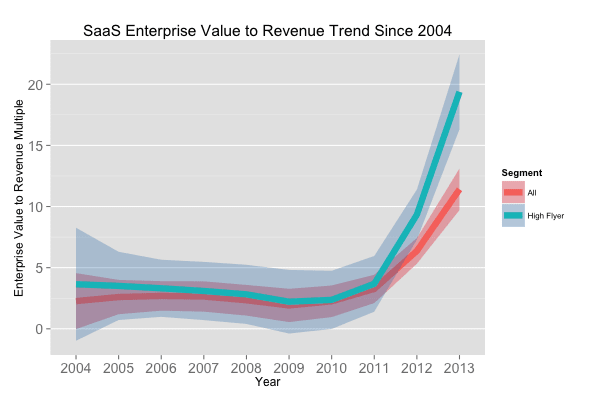
In the past 24 months, something extraordinary has happened. The value of publicly traded SaaS companies has grown by 200 to 400% while the underlying customer unit economics of those businesses hasn’t changed.

Below is a chart of the ratio between enterprise value to revenue for two segments of SaaS companies. The All Segment contains 36 publicly traded SaaS companies. The High Fliers comprises the upper half. image

Read more