Using Twitter Recirculation to Maximize Content Marketing Effectiveness

On this blog, Twitter is the second largest source of traffic. Twitter yielded 21% of visitors in the last 30 days. Because I suspect that tweets containing my blog’s links don’t reach a very large proportion of my Twitter followers, I’m experimenting with traffic recirculation techniques by retweeting older articles periodically. Of the approximately 150 posts on Svbtle, I have recirculated 30.

Recirculation encompasses the science and tactics of enticing users to read more articles during one session and also increase the number of visits to a site. Understanding recirculation is the key to maximizing the value of content.
Read more

Deserve is a Toxic Word

Deserve is a toxic word.

During my junior year in college, I trained like crazy to make the varsity boat on the crew team. Two workouts per day for six days a week during the four week Christmas holiday and on through winter training. That winter, I set a personal record for a 2000m sprint. In April, we left for Georgia and Augusta River for spring training where our coach seat raced the team to decide the varsity lineup.

Read more

Which of the Five Types of Data Science Does Your Startup Need?

Credit: O’Reilly

Startups, you are doing data science wrong. That’s the title of a post penned by Ryan Weald in GigaOm this week. Weald echoes DJ Patil’s idea: “product-focused data science is different than the current business intelligence style of data science.”

Weald points to a different model of data scientist, an engineer, not a statistician, who can perform queries and based upon some insights, improve the product with a few code changes and a push to git.

Read more

The 3 Competitive Defenses of Enduring SaaS Companies

A technology advantage isn’t enough to build an enduring enterprise SaaS company because at the core, all SaaS software share the same architecture. A relational database stores data and a web site presents the data. This is true for CRM (Salesforce), marketing automation (Marketo), email (Exchange), content management systems (Sharepoint) and so on.

Because SaaS apps use standard databases, engineers can easily transfer the data from one database to another. I’m greatly simplifying here because differences in architecture may exist, but in principle it’s simple to extract, transform and load data from one relational database into another. It may take time to complete the process and users may suffer during the transition, but nevertheless roughly 15%+ of every SaaS company’s customers leave each year to a competitor in this way. From Pardot to Eloqua to Marketo to Silverpop.

Read more

The Single Best Content Marketing Channel for Your Startup

The single best content marketing channel is email subscriptions powered by Twitter/social media distribution.

Thirty days ago, I began an experiment with this blog to determine whether email, Twitter or RSS would be the better content marketing channel. My goals with RSS, Twitter and email are two: first to maintain a relationship with a reader longer than a single website visit by creating a communication channel and second to use that marketing channel to drive re-engagement.

Read more

What Your Startup’s MRR Figure Is Hiding

The three words roll off the tongue: monthly recurring revenue (MRR). What’s not to love about subscription models? Negative working capital, predictable revenue growth and an average of 13x market cap to annual revenue in the public markets, with some darlings reaching 50x multiples. The list goes on.

But the words recurring revenue belies one small detail. These recurring customers must renew their subscriptions, at which point another three word phrase is uttered: revenue-at-risk, the amount of MRR that might be lost to customers who choose not to re-enlist.

Read more

The Developer Economy: Power to the Coders

During the past week, I’ve been tapping out letters on a 1921 Underwood portable typewriter that my wife gave me as a present. Sitting in front of it and watching the letter hammers pound ink onto paper reminded me that computer programming is still a very new field. Not 50 years ago, prehistoric programmers punched FORTRAN code on punch cards in this way.

In the past 10 to 15 years has computer programming entered mainstream culture and the number of developers has soared, popularized by the dot com era and the increasing prevalence of computers and mobile phones.

Read more

A Five Year Android User Switches To iOS

On the day of Android’s five year launch anniversary and my fifth consecutive year of using exclusively Android devices, I switched to a yellow iPhone 5c.

Like a well worn pair of jeans, it’s easy to grow accustomed to a mobile phone OS. Changing into a new pair is always a little uncomfortable at first. In that same way, migrating from Android to I iOS, I discovered the quirks and kinks of each OS:

Read more

Using The Friend Paradox to Maximize Your Effectiveness at Startup Networking Events

I’ll never forget the first large tech conference I attended after joining Redpoint. Held in the movie theater in downtown Redwood City, the TechCrunch conference attracted several hundred entrepreneurs, investors and journalists. Not one of whom I knew.

After a handful of conferences and a few awkward quick-name-badge-glance-then-say-hello conversations, I started to recognize faces and became friendly with the conference regulars.

Walking into a room and working it by building a network person by person is an essential part of entrepreneurship (and venture capital). That room might be filled with potential customers to sell, investors to woo, candidates to hire, or in my case startups seeking capital. For many founders and VCs, these networking opportunities occur at least weekly if not almost daily.

Read more

Sexism, Statistics and Space s How Disruptive Startup Ideas Are Discovered

image

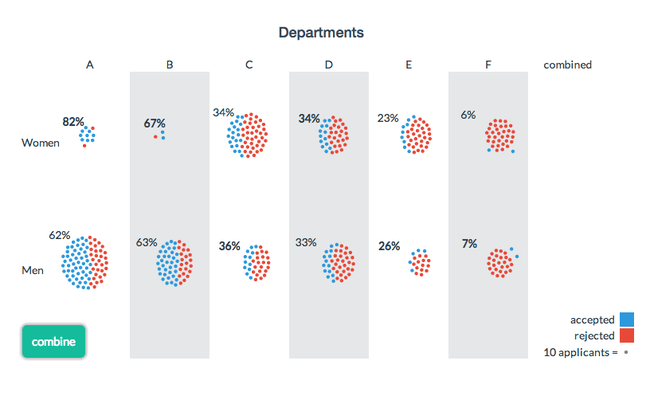
In response to analyses published on this blog, a handful of readers have raised the idea of Simpson’s Paradox to me. Because I wasn’t familiar with it, I’ve been researching it and last week, I came across VUDLab’s beautiful website which uses a sexism-in-admission lawsuit against Berkeley to demonstrate the idea.

In 1973, the University of California-Berkeley was sued for sex discrimination. The numbers looked pretty incriminating: the graduate schools had just accepted 44% of male applicants but only 35% of female applicants. When researchers looked at the evidence, though, they uncovered something surprising:

Read more