Dremio - A Foundational Component of the Modern Data Stack

In 2015, Dremio started in our offices. Today, the company announced its Series E at $2 billion valuation. The business has cemented itself as a foundational component of the Modern Data Stack.

About seven years ago, Dremio’s founder Tomer envisioned a product that would enable customers to manage data and compute separately. Today, we call this idea the data lakehouse and a query engine. Dremio enables Amazon, FactSet, Goldman Sachs, Microsoft, NCR, and Nutanix, amongst others to query oceanic volumes of data at comparable speed to data warehouses.
Read more

How Will the 52% Correction in the Stock Market Impact the Startup Fundraising Market?

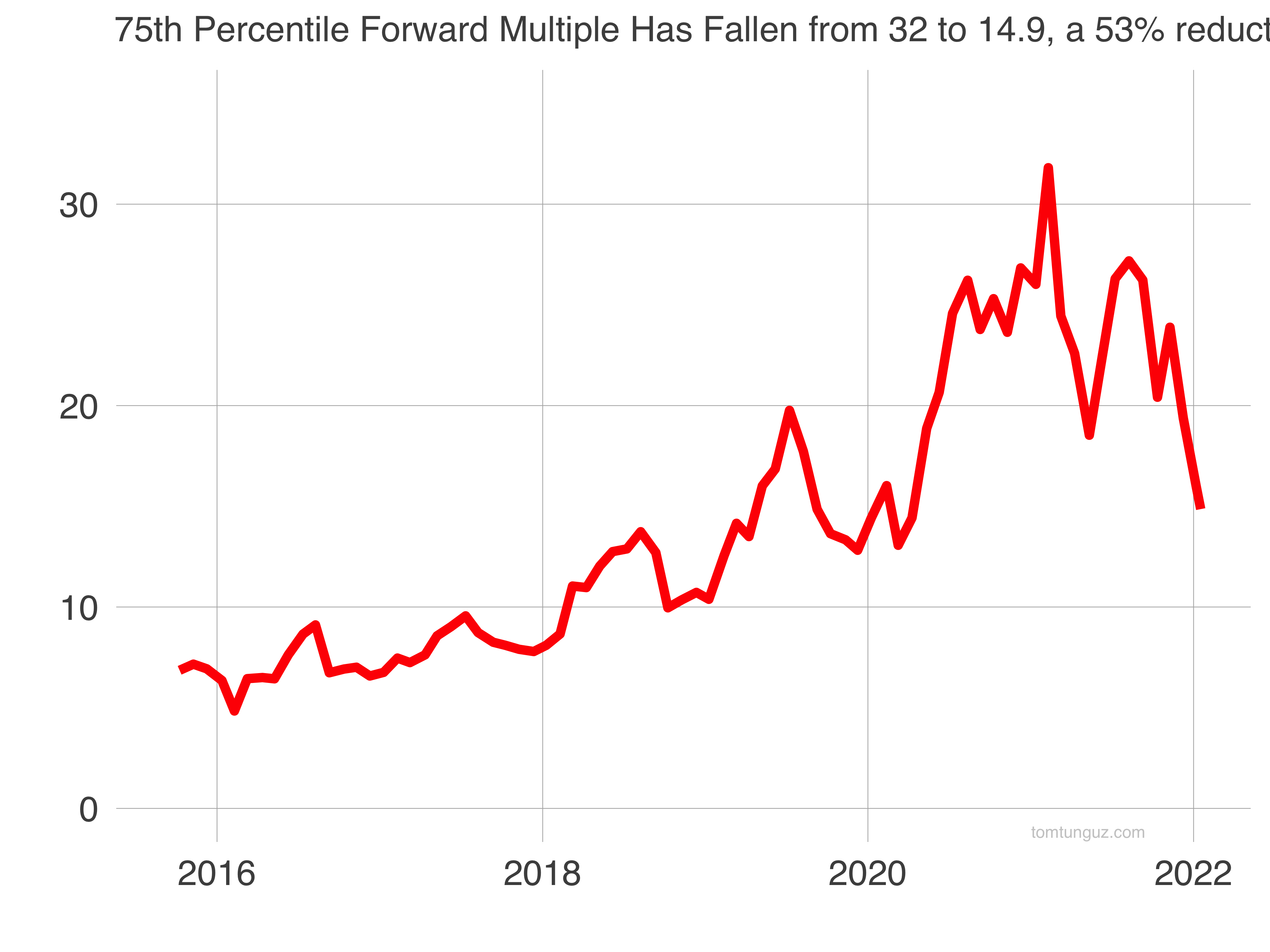
The public software sector is weathering the second deepest multiple contraction in the last decade. Only the 2016 reduction of 57% surpasses it. Public market investors are rotating out of high growth technology companies as the Fed’s policies of quantitative easing, asset purchases, and low rates abate.

image

The question on every software founder’s mind today must be, how will this affect the private financing markets? As a company’s scale approaches that of a public company, the greater the impact on their fundraising.

Read more

Is Compensation Stagnation to Blame for the Great Resignation?

The Great Resignation has rippled across headlines and boardrooms as employees’ values and priorities evolve. Has the Great Resignation been caused by a silent stagnation in compensation?

Let’s compare data from 2010 and 2021 to understand the longitudinal trends in cash and equity compensation. The cash compensation of three executive roles at early-stage companies has increased faster than inflation.

Role 2010 Cash 2021 Cash Cash Change
VPE 219 256 17%
VPM 220 250 14%
VPS 320 404 26%
CPI 217 262 21%

A VP of Engineering in a Bay Area startup that has raised less than twenty-five million dollars earned 17% more in 2021 than 2010. In constant dollars (correcting for inflation, which is listed here as CPI), a 2021 VPE took home 4% less. VPs of Marketing saw similar raises across their salary and bonus, and small loss to inflation. On the other hand, heads of sales’ pay appreciated 5 percentage points more than inflation.

Read more

How Correlated are the Web 2 and Web 3 Software Markets?

In the last few weeks, public software company multiples have halved. As have cryptocoins. Solana and Etherum followed Snowflake and Elastic downwards. So much for the Santa Claus rally. Both declines seem to have been catalyzed by the Fed’s intention to hike the Fed Funds rate three to four times in 2022.

Beyond the most recent cycle, how often do the web2 and web3 software markets move in synchrony? After all, Web3 is a future incarnation of software and infrastructure. Like high growth startups, cryptocoins are considered risk assets by the market. Is historical data compelling enough to hypothesize that investors’ rotation out of high-growth software should be mirrored in crypto?

Read more

Do Data Startups Command a Premium in the Fundraising Market?

After writing my predictions for the year 2022, a reader asked how I would measure if this were truly the decade of data. Good question!

The market determines which sectors are in favor and which sectors aren’t. Stealing a page from Michael Mauboussin’s Expectations Investing, company value contains information about investors’ expectations for a company. Naturally, comparing data companies’ valuations to the market should reveal investors’ aspirations for the data sector relative to the market writ large.

Read more

The Top Sectors of Web3 in 2022 by Revenue

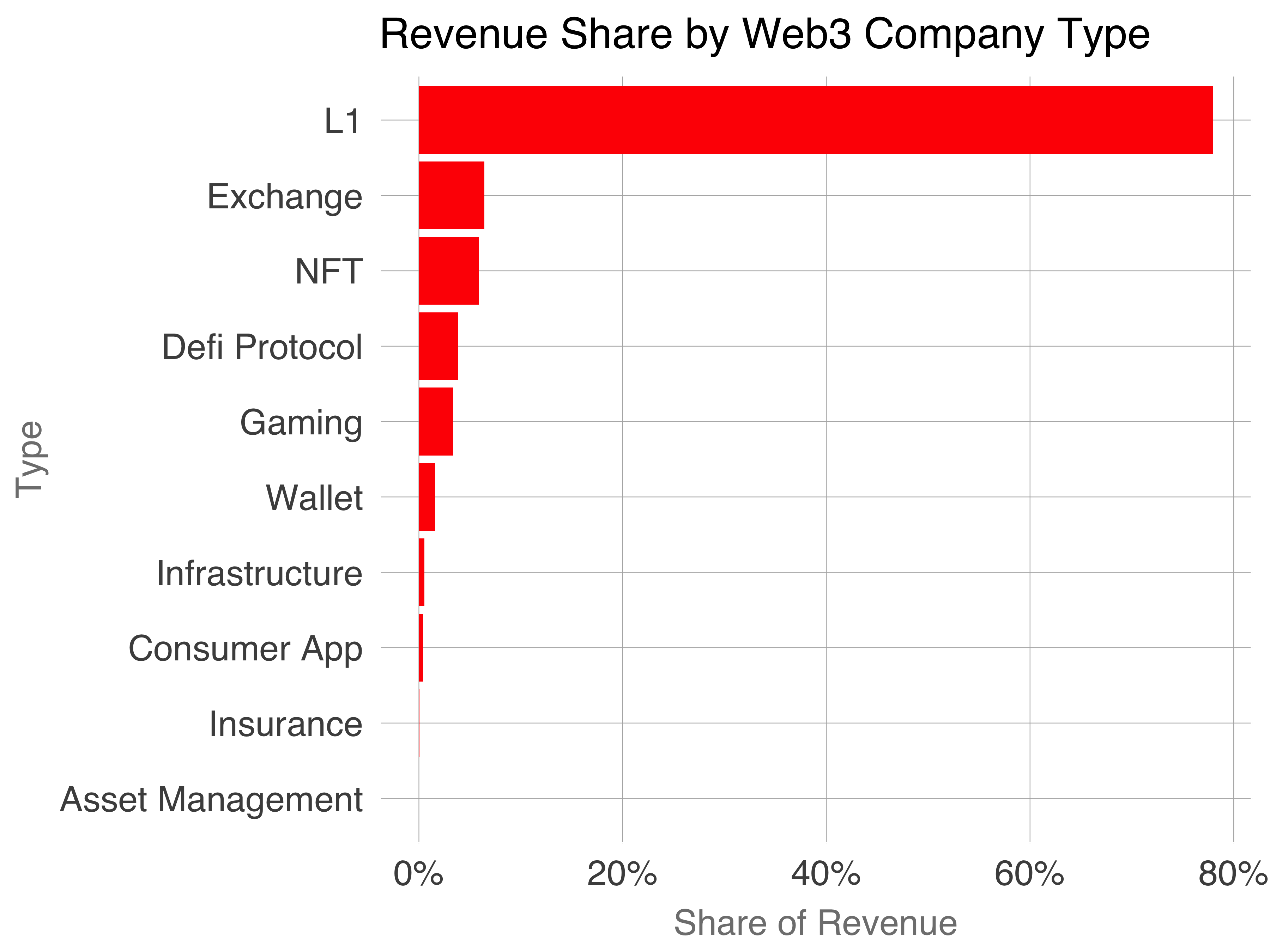
With the summer of Defi behind us and a new year for web3, I wondered which categories of web3 startups generate the most revenue.

image

L1s or blockchains, the public databases that record transactions, dominate the revenue share across the top projects producing 78% of revenue. Exchanges place second. Right behind, NFT exchanges rank third. Defi Protocols, which include lending, perps, farming, and swaps, slot in fourth. Gaming, Wallets, Infrastructure, Consumer Apps, Insurance and Asset Management chart negligible share.

Read more

My Favorite Books of 2021

These are my favorite books from this year.

The Future of Money. I’m waist deep in this compendium of financial history that traces money from the first paper currency issued by Kublai Khan to modern day crypto. The Future of Money is great so far, but I’m running out of time to finish it before 2022, so it might not truly belong on this list!

Words like Loaded Pistols. I discovered rhetoric in 2021 and read this book and The Elements of Eloquence which demonstrate the hundreds of literary devices we use to imbue language with flourish to entice or cajole the reader to hurdle over the period at the end of a sentence and sprint through the next, till the end of a tract.

Read more

Five Predictions for 2022

Every year I make a list of predictions and score last year’s predictions.

2021 marked the second year of COVID and like other crises, the pandemic accelerated change, especially in technology pushing many technologies like SaaS, video conferencing, crypto/web3 deeper into the Perez deployment cycle .

Here are my predictions for 2022:

  1. Web3 consumer products go fully mainstream with more than 35% of Americans, about 100m people, engaging with them by 2023. Metamask counts 10m MAU and Phantom is at 1.5m MAU growing quickly. This trend is only increasing. Wallets are the gateway to crypto and have funneled millions into consumer apps that have driven web3 adoption. These throngs stress systems and demand infrastructure advances. Improved infrastructure enables new applications, which attract more users. This oscillation between apps and infrastructure continues forever as a pendulum. Meanwhile, once there are enough infrastructure and consumer companies to serve, software businesses pop up, in this case to serve DAOs.
  2. Data companies continue to achieve astronomical growth. Software engineering best practices have begun to infuse data: data observability, specialization of different ETL layers, data exploration, and data security all thrived in 2021 and will continue as users stuff more data into databases and data lakehouses. Large software companies accelerated growth this year, despite their scale reinforcing the notion that users write data into systems but rarely delete it.
  3. GPT-3 and BERT infuse software massively reducing repetitive work and unlocking huge productivity gains. GTP-3 and BERT are massive machine learning systems called neural nets. Their neuron count is only one or two orders of magnitude less than a human brain, and parity isn’t far off. The result of all a supremely rational artificial cerebrum: type in a few key sentences into a GPT-3 powered app, click a button, and a blog post pops out. (Not this one; I enjoy writing too much to automate it). Or a personalized email to a sales prospect. Or a tweet. Toil will be automated by these robots, leaving us to garnish the vanilla cake output with a layer of digital frosting. Marketing, customer success, and sales software will be upended. Engineers’ productivity will skyrocket as AI pair programming increases code authoring speed and reduces errors simultaneously.
  4. The ML stack folds into the classic data stack. This idea is more controversial. The vast majority of ML users prefer simplicity and speed to customization and control. Consequently, data innovators will continue to push AutoML and SQL to query ML models to the technically analytical. Much of what’s built in the ML stack is a re-implementation of the modern data stack. ML specific data applications aren’t much different than classical data applications. ML specific feature stores can be managed through data lakehouse technologies like Nessie and Parquet, just as regular data ought to be. These stacks will begin a convergence. Within Google, Facebook, and other data leaders bespoke systems remain de rigeur as a core strategic advantage.
  5. The spirit of Silicon Valley continues a spread outward. The valley remains an important locus on innovation but its monopoly recedes as new geographies rise in importance and remote work, plus the return of in-person travel, creates a new way of working for many. Silicon Valley falls to below 20% in all venture financing.

Scoring last year’s predictions:

Read more

Mark-to-Market Rounds - What Will Your Startup's Strategy Be?

Ten years ago, startups pulled capital from the capital markets. A startup raised money, executed for 12-24 months then sought more capital on Sand Hill, flaunting milestones to justify a higher valuation.

Today, a global investor base pre-emptively shoehorns dollars into the most attractive startups, saturating the balance sheet with cash every six to nine months. I call these mark-to-market rounds.

Mark-to-market rounds press private markets closer to public markets in three ways.

Read more

Tokens as CAC - Are Crypto Companies More or Less Efficient in Acquiring Customers?

Tokens are the paid customer acquisition channel of web3. By analyzing how web3 companies invest tokens, we can calculate the cost of customer acquisition (CAC) for a crypto company.

When a user spins up a validator to verify transactions on a blockchain, stresses the testnet and is rewarded with tokens, stakes tokens to generate yield, burns tokens to transact, or receives an airdrop for tweeting, a cryptoco expends tokens to acquire a customer.

Read more