The Siren Song of ROI Based Pricing

Selling based on ROI (return-on-investment) sounds great. A salesperson lays out an iron-clad case for how the customer will make 5x or 6x or 10x their initial investment in a piece of software in three years or less. The champion will use ROI math to assuage upper management and procurement’s concerns. Or so the thinking goes.

If we reflect on the most successful software companies, the very largest, very few sell based on ROI. What is the return on investment of a Salesforce or a Workday deployment? How do you calculate it? How does an AE defend it?

Read more

A Mental Model for Prioritizing Your Startup's Energies

I’ve playing with a new mental model for early-stage startups: a pendulum. This pendulum oscillates between the limiting factors of the business at different stages. There are only two limiting factors in this mental model: product and go to market.

At the moment a startup is founded, the business is product limited. You can’t do much without a product. After the company establishes product market fit, the pendulum swings to go-to-market.

Read more

If You Have Great NDR Retention, Should You Increase Your Marketing Spend?

There’s a new debate about marketing efficiency recently, and it’s an important one in the era of product-led growth. If a startup has great net dollar retention (NDR), should it be willing to increase its customer acquisition spend proportionately?

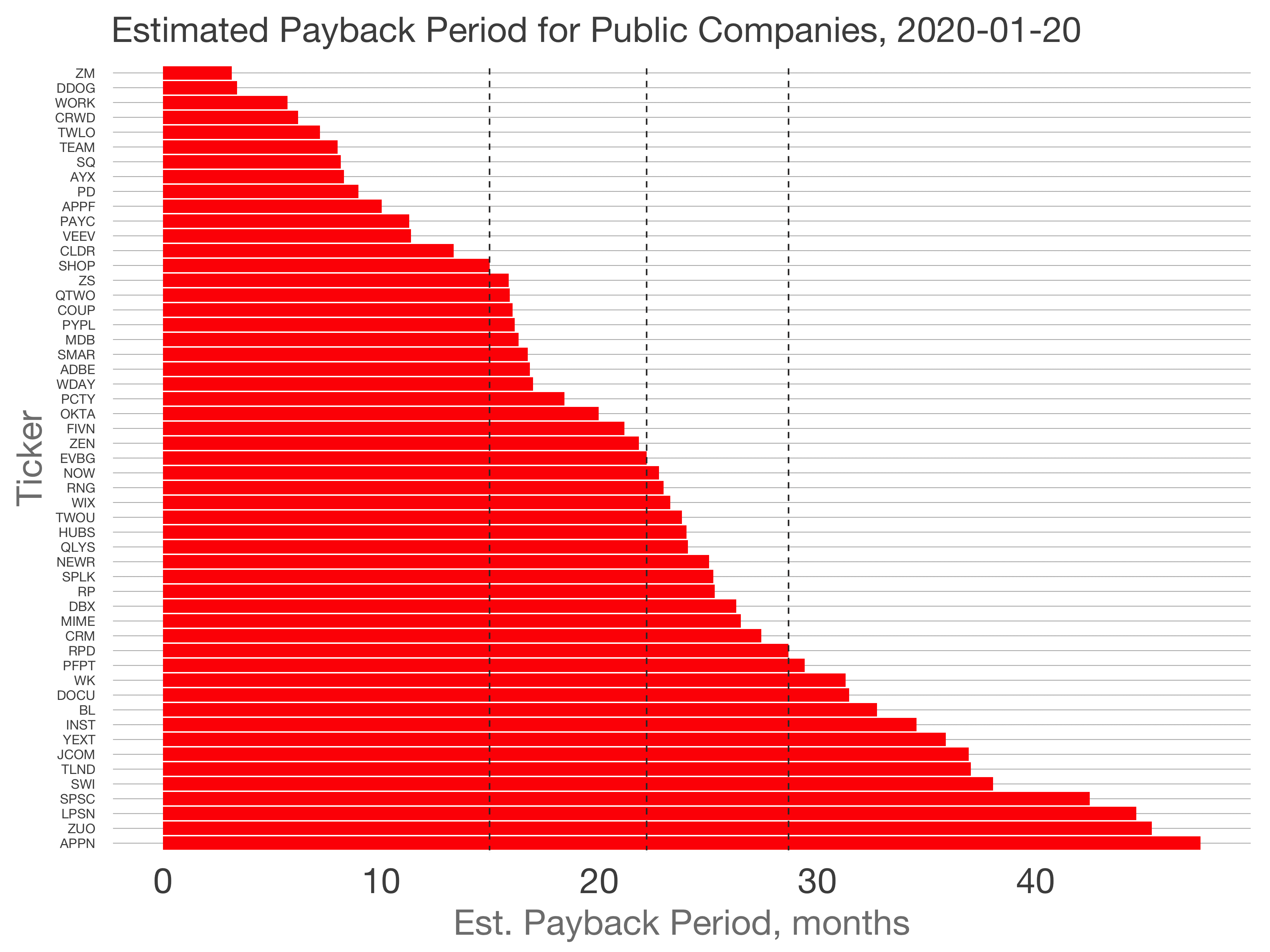
I remain a believer that months-to-repay is the best metric for measuring customer acquisition efficiency for a single reason. You know the answer immediately and accurately. With the annual contract you have in your hand and the amount of money you spent in sales and marketing to acquire a set number of customers in a period, you know exactly your MTR.

Read more

Benchmarking DataDog's S-1: How 7 Key Metrics Stack up

Recently, we’ve seen a series of product-driven companies building huge customer bases with tremendous account expansion and terrific sales efficiency. DataDog is no exception. DataDog provides a very popular IT monitoring solution that has grown from its founding in 2010 to a huge business. During that time the product has grown from infrastructure monitoring to application performance management, logging and user experience products. The company published its S-1 Friday.

DataDog counts more than 8800 customers, 590 of which spend more than $100k, and 40 of which spend more than a $1M. No customer represents more than 5% of ARR, which means the largest customer isn’t spending more than $15M a year - still huge.

Read more

Which Categories of Seed Startups are Thriving? Which Aren't?

Which sectors see more startup company formation than others? The answer has changed quite a bit over the last 8 years. Some sectors have hit their apogee and are declining. Others have grown by more than 3x. Yet others are growing geometrically. Let’s take a look.

Hot Spaces

Artificial Intelligence - yes, it’s a buzzword but it’s more than that. AI or Machine Learning is a new technology that will benefit nearly every type of sector and we’re still in the very earliest innings. Eight years ago, there were nearly zero AI startups seeded. Today, that number is 400 and the chart is a classic S-curve, tapering after a period of intense growth.

Read more

The 37% Rule: How to Decide When to Stop Wondering and Start Deciding

Earlier this year, I read Algorithms to Live By, a book that explains how to use insights from computer science in daily life. One of the rules is the 37% rule. It’s an important rule because it’s broadly applicable. But I had forgotten about it until I listened to the author on the Software Engineering Daily podcast.

The 37% rule says that if you have a decision to make, you should spend 37% of the amount of time you have. This is called exploration period. Seek advice, learn about demands of the role, and meet some candidates.

Read more

One Call to Make Before Picking Your Startup's Headquarters

If you must choose a long term headquarters for your startup, call an executive recruiter who focuses in that city. Ask her about each of the key roles your company will need to hire in the next 2 to 3 years. VP Engineering, VP Product, VP Sales, VP Customer Success, VP Marketing, or VP Operations.

How large is the candidate pool for each search? Which are the hardest searches to complete in this geography? Where are the best talent pools to sift through?

Read more

A Clever Hack to Reading More Books

My perception of books was shattered in first grade. A friend and I were arguing about the extinction of dinosaurs. “It’s right here!” I yelled pointing to the book in my hand.“A meteor crashed, cooled the earth, and killed all the dinosaurs.“

My friend countered with a book of his own. Volcanic eruptions had blackened the sky with ash and cooled the earth, he recited. Locked in stalemate, we appealed to a higher authority. Our science teacher told us that the books were just one person’s opinion. No one knows why the dinosaurs died but other species lived. Each of our books were speculation. To this day, scientists still don’t have a unified view.

Read more

Notes from Office Hours with Guillaume Cabane

A little while ago, we were lucky to host Guillaume Cabane at Office Hours in a new format: 30 minute 1-on-1s with a few companies. It was a huge success and a format that we will continue because of all the learning. Guillaume was kind to share some takeaways from the event below.

  1. If you’re in B2B SaaS, you most likely have a finite TAM. For the love of ARR, please get the exact list of all accounts in your TAM (at least US). Do some simple math to output a predicted value per account. Then decide which accounts you want to go after, with which channels, at what cost. Start charting your TAM penetration (in volume & separately in value)
  2. When doing outbound, lead with value. Never send an email where you focus on you or your product. If your contact to demo rate is below 1%, you’re burning your TAM inefficiently. Top companies with a strong brand, leading with value in an email, often get >10% demo rate on cold emails.
  3. Differentiate yourself. Think of your marketing like your product. Would you create the same features as your competitors? Of course not. Your marketing can be a defensible moat: use different words, leverage different channels. In essence, try to be memorable. If you’ve scored your TAM, you now know how much you can invest for each potential account. Be smart about it, maximize the effectiveness of that spend to create an experience unlike your competitor. And if you love your VC, don’t compete head on with paid channels. Paid is an OK channel at best, great if you can get a CAC/LTV < 1 (rare in SaaS).

Guillaume has an exquisitely tuned acumen for how to build scalable marketing systems. Watching him advise startups on how to build their machines, I noticed how much of an innovative thinker he is. The notes above echo it.

Read more

The Strategic Question at Seed Today

I’ve written before about the Jacob’s Ladder of Fundraising. The Jacob’s Ladder is a children’s toy that flips over, and it’s a great metaphor for the seed market. Seed rounds are rapidly approaching and now often equal to the sizes of Series As just five years ago. The chart above shows the mean round size in the US across.

As the Jacob’s Ladder flips, a series of important strategic questions arise in the market.

Read more