How to Reach More People with Content Marketing by Changing How You Write

The average English sentence has been shortened by half over the last five hundred years. Read the first sentence of the Declaration of Independence to see why. It is 71 words long and contains 8 recursive clauses. I read it ten times before I understood it. I have 48 seconds with you, my reader. No time to mince words. To reach more people with your content, shorten your sentences and ditch the jargon.

Read more

The Importance of Time Value of Money for Startups

A dollar today is worth more than a dollar tomorrow. This statement underpins all of finance. The idea has a fancy name: the Time Value of Money. It applies to all types of investments, including startups. Time Value of Money is the economic argument for startups to raise money when it’s available.

If I give you a million dollars today, you can invest it. You might buy 151 bitcoins. Or invest in a certificate of deposit at 1.5%. Or pay a team of four engineers to build a feature for your software startup. Each of these are investments with some risk and some potential reward.

Read more

The Salesforce/Mulesoft Acquisition is a Bellwether for the 2018 M&A Market

image

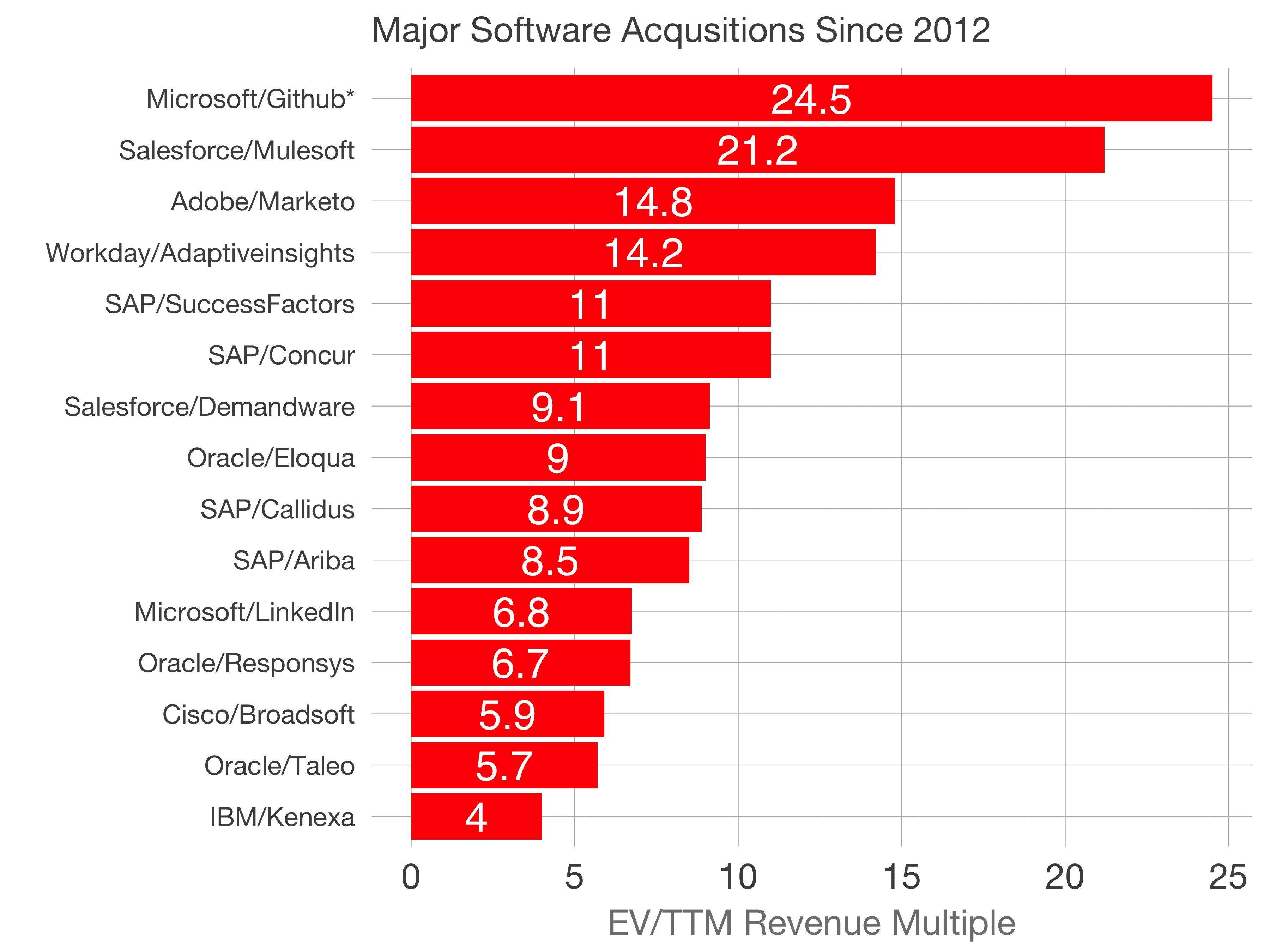
Yesterday, Salesforce announced it will acquire Mulesoft for $6.5B. A recent addition to the list of public software companies, Mulesoft is a tremendous business. The company generated $297M of revenue in 2017 at a 73% gross margin, and grew by 58%. Salesforce is acquiring the business for an astounding 21x enterprise value to trailing twelve months revenue multiple - nearly 2x the next closest.

Transaction Price ($M) TTM Rev ($M) Growth Rate Gross Margin Year of Acquisition Enterprise Value EV/TTM Rev
Salesforce/Mulesoft 6,500 297 58% 73% 2018 6,296 21.0
SAP/Concur 8,300 546 32% 63% 2014 5,988 11.0
SAP/SuccessFactors 3,764 328 59% 66% 2011 3,599 11.0
Salesforce/Demandware 2,800 274 40% 71% 2016 2,502 9.1
Oracle/Eloqua 957 95.8 34% 72% 2012 864 9.0
SAP/Callidus 2,400 253 22% 61% 2018 2,247 9.0
SAP/Ariba 4,607 517 27% 66% 2012 4,390 8.5
Microsoft/LinkedIn 26,500 3615 30% 87% 2016 24,385 6.7
Oracle/Responsys 1,770 194 25% 53% 2013 1,291 6.7
Oracle/Taleo 1,921 315 33% 67% 2012 1,805 5.7
IBM/Kenexa 1,397 333 25% 61% 2012 1,332 4.0

If we compare this acquisition on other dimensions, we see that Mulesoft is the second fastest growing at the time of acquisition, next to SuccessFactors in 2011. The gross margin is second highest to LinkedIn, and close to Eloqua and Demandware. On this list, the Mulesoft is second to LinkedIn.

Read more

Where are We in the SaaS Valuation Cycle?

image

Recently, people have been asking just where are we in the SaaS valuation cycle. I last updated the chart above more than six months ago. The answer is close to ten year highs.

The chart above shows the median enterprise value to forward revenue multiple to multiple. Enterprise value is the market of a publicly traded company minus the available cash the company holds. Forward revenue is the sum of the next 12 months’ revenue.

Read more

Is Geographic Dispersion of Seed Dollars Really Happening?

image

In the US, the median seed round has nearly quadrupled over the past seven years. In the mean time, seed investment has grown more than 7x and then fallen to a bit more than half of the high. As the market has grown and retrenched during that time period, I’ve been wondering about the geographic diversity of these seed dollars. Throughout these cycles, are startups in other states benefitting? Are they increasing their share of investment dollars?

Read more

Why Does Your Sales Team Lose Deals?

It’s one of the most important questions a CEO can ask. Why does our sales team lose potential sales? One of the companies I work with, Chorus, listens and analyzes sales calls to provide insights to heads of sales and account executives. Chorus explored the reasons account executives lose sales opportunities.

Set aside losses from competition. Of the remaining lost opportunities, 48% of prospects lacked budget. A further 38% demonstrated no urgency to buy. The remaining 13% of prospects didn’t have the buying authority.

Read more

The Clearest Articulation of a Marketing Roadmap

image

Recently, I met an exceptional marketer. She described the purpose, strategy and tactics of a marketing department remarkably succinctly. Marketing’s methods can seem intangible. But she explained them simply and elegantly. I drew the chart above based on her vision of marketing’s roadmap.

At the highest level, marketing articulates a compelling narrative. This is step 1.The narrative brings the market forward by contrasting the current state of affairs with a persuasive view of the future. This is a Gap Analysis - a comparison of the current state of affairs to the desired potential.

Read more

Dropbox S-1 Analysis - The King of Freemium

image

Founded in 2007, Dropbox epitomizes the freemium go-to-market. Dropbox has grown from 0 to 500 million users over that time period. 2% of those users convert to paid and pay an average of $9.33 per month. 90% of revenue originates through self serve channels - an astounding figure for company that generated more than $1B in revenue last year.

![image](" width=“500px”/>

Dropbox’s revenue grew from $604M to $1.1B from 2015 to 2017, a compound annual growth rate of 35%.

Read more

The ROI of Cash Burn for SaaS Startups

What should be the return on investment of a startup’s cash burn? Fred Wilson posed this question last year in his post Some Thoughts on Burn Rates. In that post, he suggests, and I agree, that a 5x ROI on cash burn is a good target.

How does one calculate ROI? It’s a simple formula:

Cash_Burn_ROI = Revenue_Multiple/Revenue_Pay_Back_in_Years1

If a business is worth 7x revenues and revenue payback is 14 months, the burn ROI is 6x or 7 / 1.2. If a business is worth 5x revenues and revenue payback is 18 months, the ROI is 3x. Note, I’m using revenue payback, not gross margin payback here.

Read more

Startup Best Practices 27 - How to Use Options to Retain Key Employees in Your Startup

You’re two or three years into your startup. You have hired a great team and want to retain them. It’s time to consider refreshing their stock options to motivate them to stay longer. How many options should you grant to each employee?

Startups should pay key people market rate to retain them. Otherwise, they may leave the business, lured by the promise of greater compensation elsewhere. Let’s walk through an example.

Read more