Patterns in Startup M&A Processes

At some point in the life of your company, you may consider selling the business. Every acquisition process might run a little bit differently, but these are some of the patterns that I have observed after about nine years in the venture business, and also having evaluated a handful of acquisitions when I was at Google.

There are two key constituencies within the buyer: the business owner and corporate development. Corporate development is often the first point of contact, and while they are a critical component of executing the transaction, it is ultimately the business owner who will champion the acquisition through the approval process.

Read more

The Five Questions You Need to Answer About Your Startup's Strategy

Michael Porter wrote the seminal book on strategy in the early 1980s. Called Competitive Strategy, I think it should be required for anyone starting a company. Strategy is a seemingly murky amorphous intangible concept, but Porter brilliantly prescribes the five questions strategy should answer. What are the answers for your business?

What is your distinctive value proposition? This distinctive value proposition comprises three key parts. Which customers will you serve? Which needs of those customers will you fulfill better than the competition? How will you position and price your proposition (premium/commodity)? This can be best answered by relative pricing. Amazon’s consumer value proposition is simple: the most selection at the best prices delivered fastest to all internet consumers in the US.

Read more

Gratitude

A friend died this week. It’s the first time I’ve lost a friend of a similar age. I don’t often see the fragility of life first hand, but this is one of those moments.

I’ve felt many different emotions after I received the news: despair, grief, fear. The one I’m currently experiencing, though, is gratitude. And I hope that’s the feeling that persists. You will be missed, my friend.

Read more

Prioritizing Your Startup's Roadmap

image

One typical Friday morning in 2004, I walked into a government building and headed to work. I was a junior Java engineer and part of a hired team building an internal system for a government agency. We were a few days behind on schedule, and a technical issue arose. During the morning team meeting, we made a plan to refactor a small key part of the codebase - an effort that should have taken just the morning. And I made a classic mistake.

Read more

Adoption Chain Risk - The Importance of Selling to Everyone in Your Startup's Supply Chain

In the Wide Lens, Dartmouth Entrepreneurship professor Ron Adner explores the risks associated with innovation. Execution risk is the obvious one. Then there’s co-innovation risk, what might be called chained technology risk. For example, to build a new ML focused microchip, a startup relies on the chip fabrication plant to develop 7nm equipment. But the most interesting of the three is Adoption Chain Risk.

Adoption Chain Risk is “the extent to which partners will need to adopt your innovation before end consumers have a chance to assess the full value proposition.” Adoption Chain Risk applies the idea of a supply chain to innovation.

Read more

What the Online Advertising World Can Teach Us about the Evolution of Machine Learning in SaaS

In software, we’ve moved from a world where a customer buys a piece of software to run on their own infrastructure, to a world where a customer pays a vendor to run software on the vendor’s infrastructure. With machine learning, we may see another evolution of this. Machine learning startups create models based on data provided by customers. Should customers be compensated for their contribution?

Unlike the first wave of SaaS software, machine learning startups benefit from the data their customers share with them. Many times, machine learning startups create one global machine learning model that is used across the customer base. Each marginal customer provides additional data that refines the model.

Read more

Why Amazon's Acquisition of Whole Foods Matters for Startupland

Amazon’s acquisition of Whole Foods is notable for many reasons. Of course, there’s the magnitude $13.7B. The second is the shockwaves reverberating through the grocery industry. Costco fell 10% and Kroger almost 25% on the news. Third, the acquisition underscores the importance of physical retail even to the largest American ecommerce giant. Those are all remarkable in their own right.

However, the most interesting part of this acquisition is that it marks the current apotheosis of technology’s impact in the broader economy. In the last 18 months, non-traditional tech acquirers changed the M&A landscape for startups. Walmart, Unilever, GM, Ford spent billions of dollars collectively to acquire Jet, Bonobos, Dollar Shave Club, Cruise, and Chariot. That’s all fine and expected.

Read more

How to Tell If You're a Great Manager

I’ve been reading Fred Kofman’s book, Conscious Business. Written in 2006, the book summarizes Kofman’s experiences as a management consultant to some of the great leaders in technology and other industries. In the book, Kofman lists 12 questions Gallup used to identify great managers in one of the largest management surveys conducted.

As I read this list of 12 questions, I started answering them for each of the different roles I’ve had. When I worked for great managers and answered the questions, I found I answered yes to almost all of them. The converse is also true.

Read more

The Intense Power of a Strong Company Culture

image

Earlier this week, I spoke at 2U’s annual employee conference. Redpoint partnered with 2U at the Series A, and they are now a $2B publicly traded education company that powers online degree programs for Georgetown, USC, Syracuse, Berkeley, and Yale, among others. It was an inspirational moment for me because I observed the intense power of developing strong company culture.

I’ve never read the list of core company values or spoken to the executive team about them. But I’m quite confident that I could enumerate at least five of them.

Read more

SaaS Fundraising in 2017

image

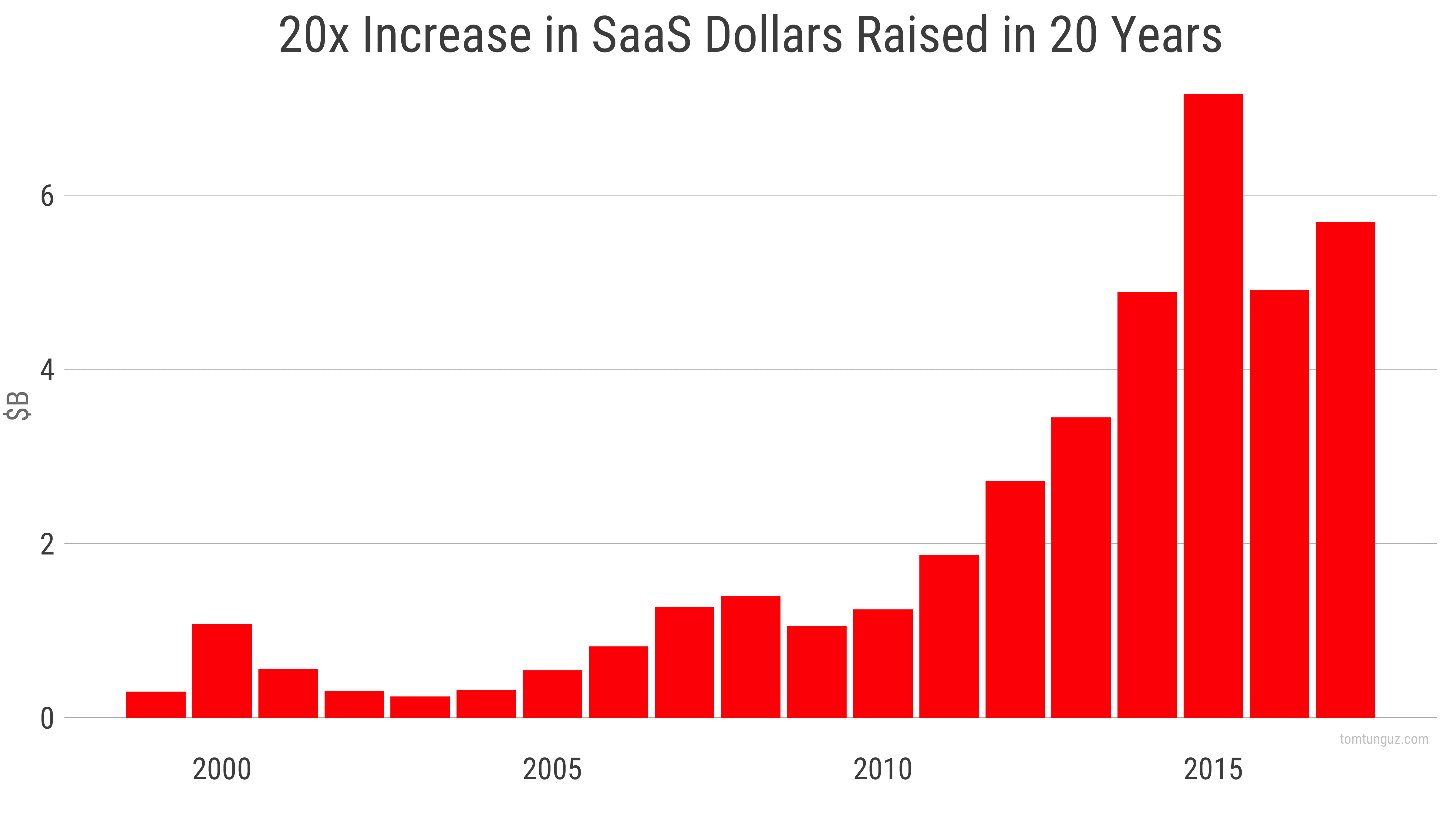
When I analyzed the SaaS fundraising market in 2016, three trends emerged. The number of SaaS companies raising rounds had stalled, while the total number of dollars plateaued. Meanwhile, round sizes swelled. In other words, there was a concentration of capital in an increasingly small number of names. A year later, those trends have continued to converge, and SaaS valuations have resurged, reaching their highs of the 2014-2015 boom.

Read more