My Algorithm is Better than Yours

My algorithm is better than yours. My algorithm performs better on the precision/recall tradeoffs. It surfaces fewer false positives. It converges to an answer faster. Perhaps it requires a bit less data. Those statements might all be true. But none of these advantages confer a competitive sales advantage in the market. They aren’t technology innovations leading to a go-to-market advantage.

I first observed the use of large scale machine learning at Google. In the early and mid-aughts, the advertising ecosystem bloomed. Hundreds of ad networks vied for publisher ad impressions. Each one promised a better targeting system, new algorithms, unique data, better performance, more revenue.

Read more

A Tale of Two Go To Market Strategies

There are approximately 22 million trucks in the US. Many of these trucks run software to track the location of the vehicle, manage inventory, and comply with regulation. There are two SaaS companies operating at greater than $100M in ARR in the space and they illustrate one of the mantras on this blog: there are many different ways to build a SaaS company.

After last week’s post, Is There a No Man’s Land in SaaS ACVs, a founder asked me to highlight some of the go to market strategies in different segments. The story behind Fleetmatics and Geotab illustrates the way two companies pursued the SMB logistics market in radically different ways, but built roughly similar sized businesses.

Read more

Is There a No Man's Land in SaaS ACVs?

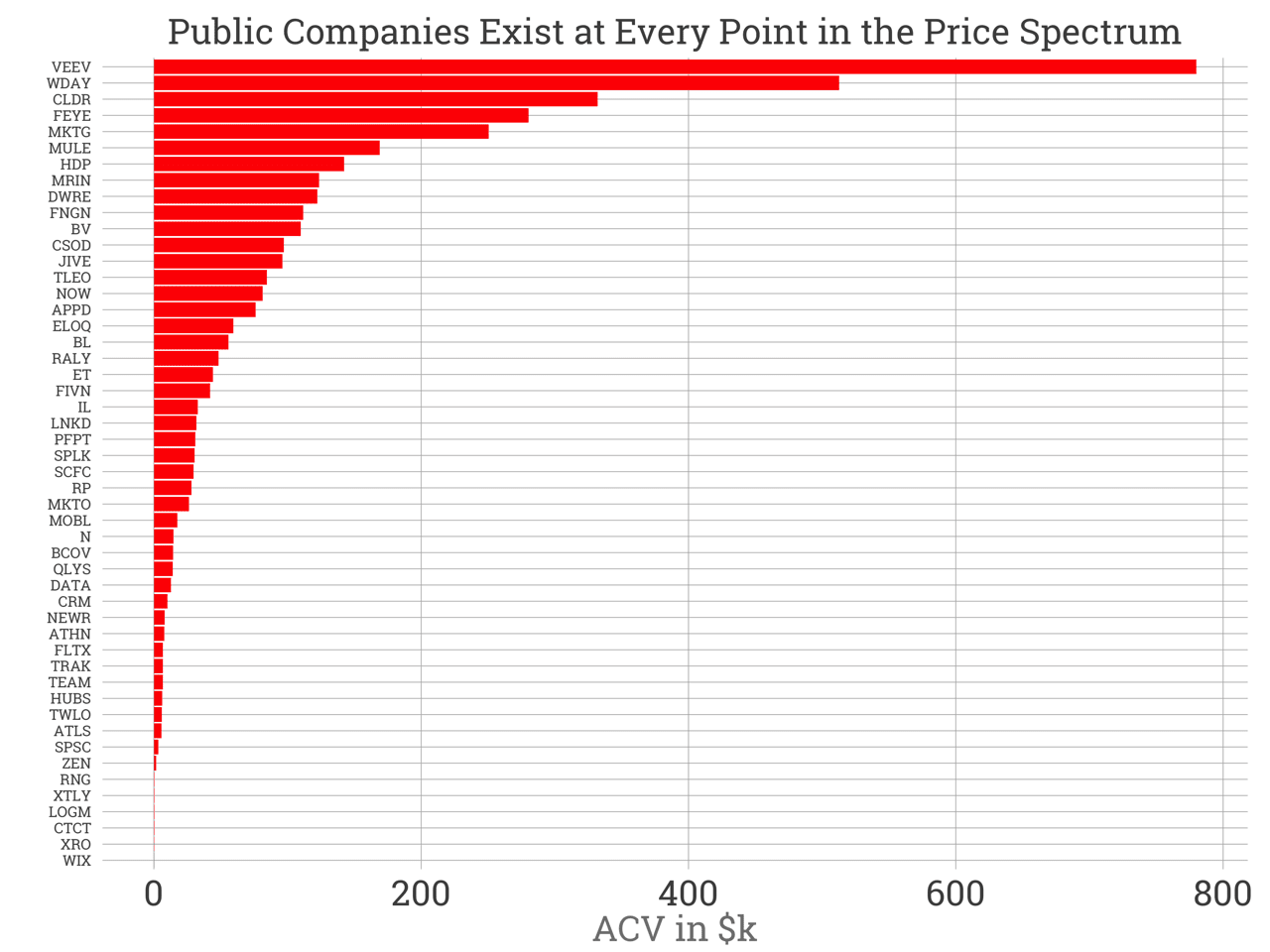
A founder asked me recently if a dead zone in ACVs (average contract value) exist around the $10k price point. Yesterday, I listened to a podcast in which an executive asserted that infrastructure software priced lower than $250k in ACV threatens the viability of the company. What does the data show?

image

I’ve plotted the distribution of ACV at IPO for all public software companies. There are no yawning gaps but a smooth progression from $87 to $780,000. So there are successful companies at every price point.

Read more

When Machine Learning Just Isn't Enough

At SaaStr earlier this year, I spoke about the huge potential of machine learning in SaaS. In that talk, I broke down some of the advances in ML that might be useful for software companies. In the discussion that ensued, I stressed the importance of not letting the technology obfuscate the value proposition of the software. Yes, ML is a huge step forward, but it’s not enough by itself. In fact, it likely isn’t the most challenging part of building a disruptive product.

Read more

The Four Dimensions of a Demand Generation Portfolio

After a startup establishes product market fit, scaling demand generation becomes the the next major challenge. Doubling or tripling ARR each year for several consecutive years is not easy. The best marketers create a demand generation portfolio. There are four axes to measure this portfolio: scale of investment, sophistication, breadth and potential.

At the outset, a startup may rely on a single channel of customer acquisition. But over time, in order to achieve larger and larger bookings, the company must diversify. Diversification prevents channel saturation risk. As spend in one channel grows, the cost of customer acquisition rises to untenable rates. Diversification also mitigates channel concentration risk. A change in terms of service of a dominant distribution platform might challenge the business’ existence.

Read more

SMB or Enterprise - Which is the Better Go To Market in SaaS?

A friend recently asked, “Which path is better for SaaS startups? SMB to mid-market to enterprise or straight to enterprise?” It’s a key strategic question for many founders building software companies.

Startups that initially target small to medium businesses benefit from several key advantages. First, these businesses are faster to revenue. Simpler products satisfy SMBs, so startups can begin to charge smaller customers much sooner than enterprise customers in a product development lifecycle.

Read more

The Asset Allocator in Chief

At a recent board meeting, a CEO said, “This experiment will cost $250,000 to run. After three months, we will know whether our new go-to-market strategy is viable.” There’s a brilliance this type of framing. By quantifying the cost of the experiment, the CEO frames company prioritization as asset allocation.

What is asset allocation? Asset allocation is a strategy that aims to balance risk and reward by apportioning a startup’s assets according to a company’s goals and risk tolerance. (I’m borrowing heavily from Investopedia, and recasting the definition for startups).

Read more

Startup Best Practices 25 - Bounding the Unknown Unknowns

image

Intel’s Business Plan

Every once in a while, I receive a FedEx from an entrepreneur I haven’t met. Inevitably, this mail contains a modern rarity - a business plan. Ten to twenty pages describing the idea, the genesis, the business model, the team and its structure, customer acquisition strategy, sales model and other key details of the business. A plan for how to start a company, and a defense of the idea.

Read more

Managing a User's Trust with Machine Learning SaaS Software

There’s no quicker way to lose a user or buyer of your software than to lose their trust. The software didn’t save my data. The database suffered corruption. The website is down frequently. Data integrity is a challenge every company storing data faces. Machine learning SaaS startups face another trust risk – one introduced by probability.

When Nate Silver forecasted the successful election of Barack Obama in 2008 with nearly 100% accuracy across districts, probability theory shined. The real world matched the likely predictions. Fast forward to eight years later, and the new President wasn’t the projected winner.

Read more

Benchmarking Cloudera's S-1 - How 7 Key SaaS Metrics Stack Up

Cloudera is the second of the Hadoop players to go public. Last week, the company filed their S-1 and revealed a massive business. Cloudera generated $261M in revenue, counts 500 clients and grows those accounts by 43% annually. 18% of their customers run Cloudera software in the cloud, a surprisingly large number.

Hortonworks is Cloudera’s chief competitor. In the following charts, we’ll compare the two businesses. These analyses compare the two companies based on the year they went public, marked 0 in the charts. Negative years are years before IPO.

Read more