After 24 years as a private company, SpaceX filed its S-1 yesterday. The filing reveals an AI-era conglomerate. SpaceX has three distinct segments : Space, Starlink, and AI.
In 2025, SpaceX generated $18.7 billion in consolidated revenue with $6.6 billion in Adjusted EBITDA. But the real story lies beneath those top-line numbers.
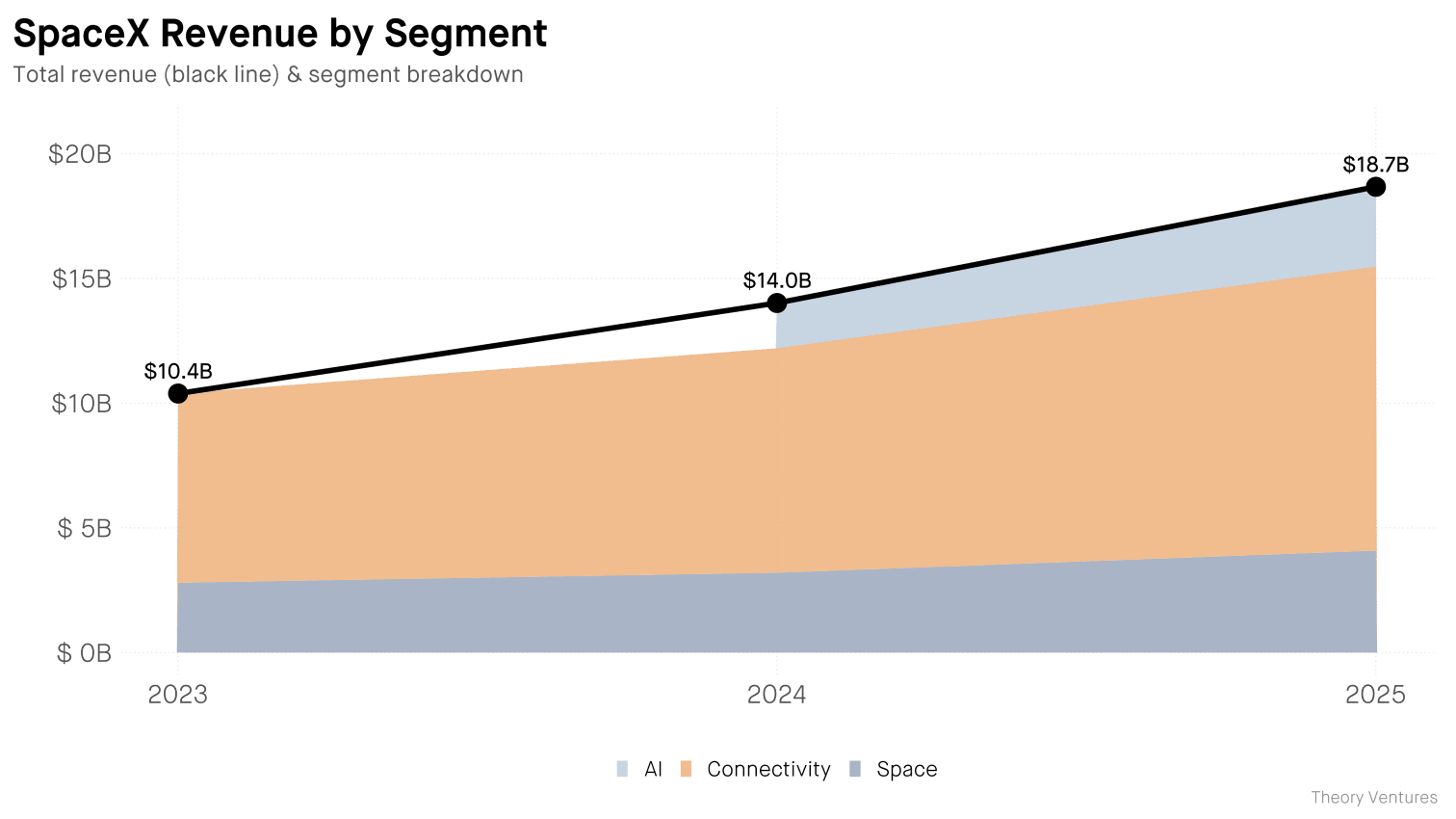
SpaceX runs three businesses with fundamentally different economics :
| Segment | 2025 Revenue | Operating Margin | CapEx |
|---|---|---|---|
| Starlink | $11.4B | +39% | $4.2B |
| Space | $4.1B | -16% | $3.8B |
| AI | $3.2B | -199% | $12.7B |
Starlink dominates at 61% of total revenue. Space launches contribute 22%. The AI segment (X platform advertising, subscriptions, and xAI compute infrastructure, consolidated through the xAI merger completed in February 2026) adds 17%.
Space enables Starlink (and eventually orbital AI). Starlink funds the enterprise. AI consumes capital today with the promise of future leverage.
Starlink : The Cash Engine
Starlink is SpaceX’s largest business & profitable.

Starlink delivered $4.4 billion in operating income in 2025 ; a 39% operating margin. Meanwhile, the Space segment ran a $657M operating loss (mostly Starship R&D), and AI burned $6.4B building COLOSSUS data centers and training Grok.
The S-1 provides historical subscriber data showing rapid growth :

Starlink subscribers grew from 2.3M (2023) to 4.4M (2024) to 8.9M (2025) ; a 97% CAGR. Revenue grew 49.8% year-over-year to $11.4 billion in 2025. As of March 31, 2026, Starlink served 10.3 million subscribers across 164 countries, territories, and other markets, supported by approximately 9,600 broadband and mobile satellites in LEO (low-earth orbit) ; 75% of all active maneuverable satellites.
Amortizing more revenue over the cost has improved the economics :
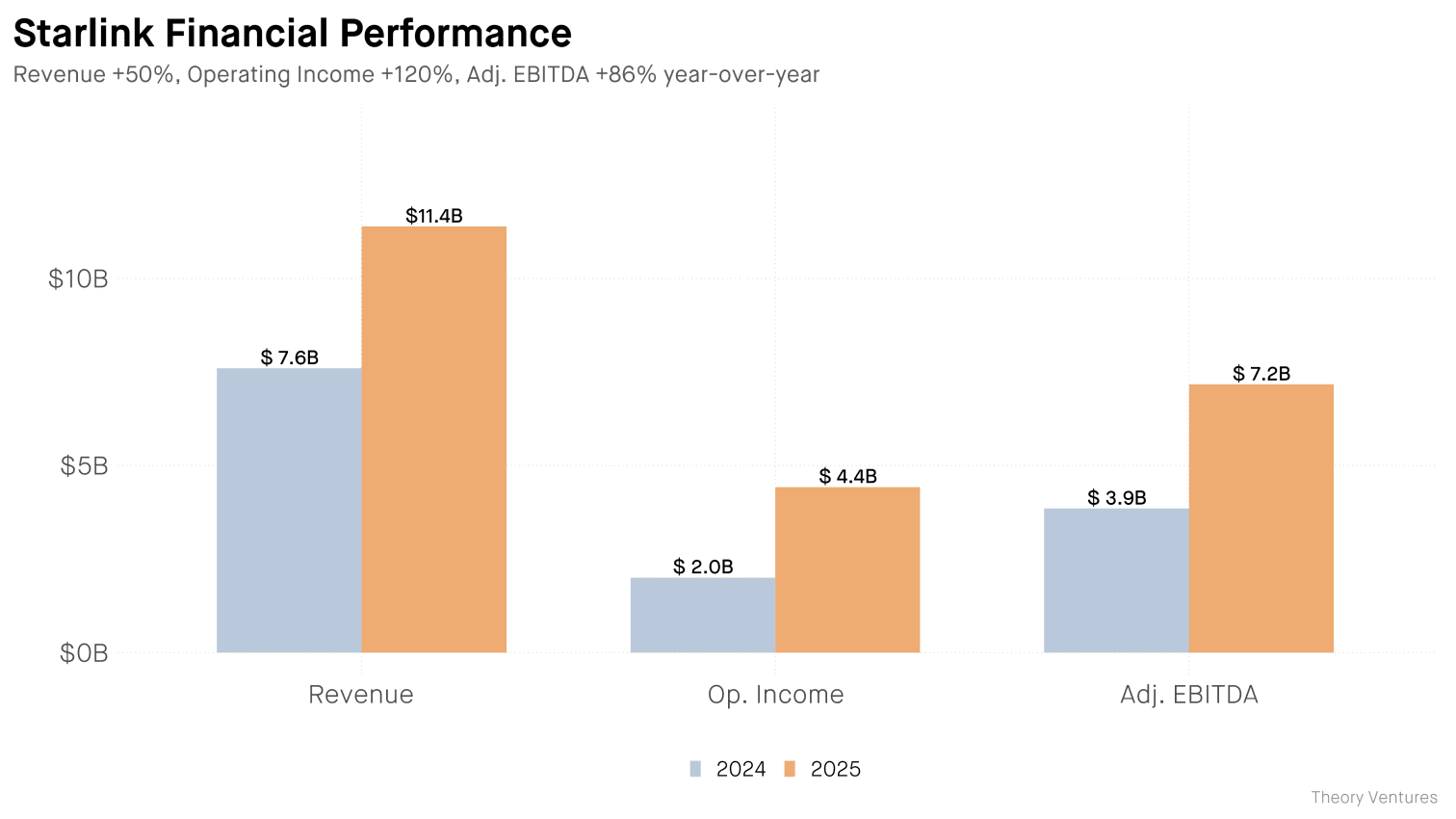
Revenue grew 50% year-over-year. Operating income grew 120%. Adjusted EBITDA grew 86%. This is the leverage inherent in a satellite network ; once the constellation exists, each new subscriber adds revenue at near-zero marginal cost.
Space : Market Dominance
SpaceX’s Space segment lost money in 2025 despite launching more than 80% of all mass to orbit globally.
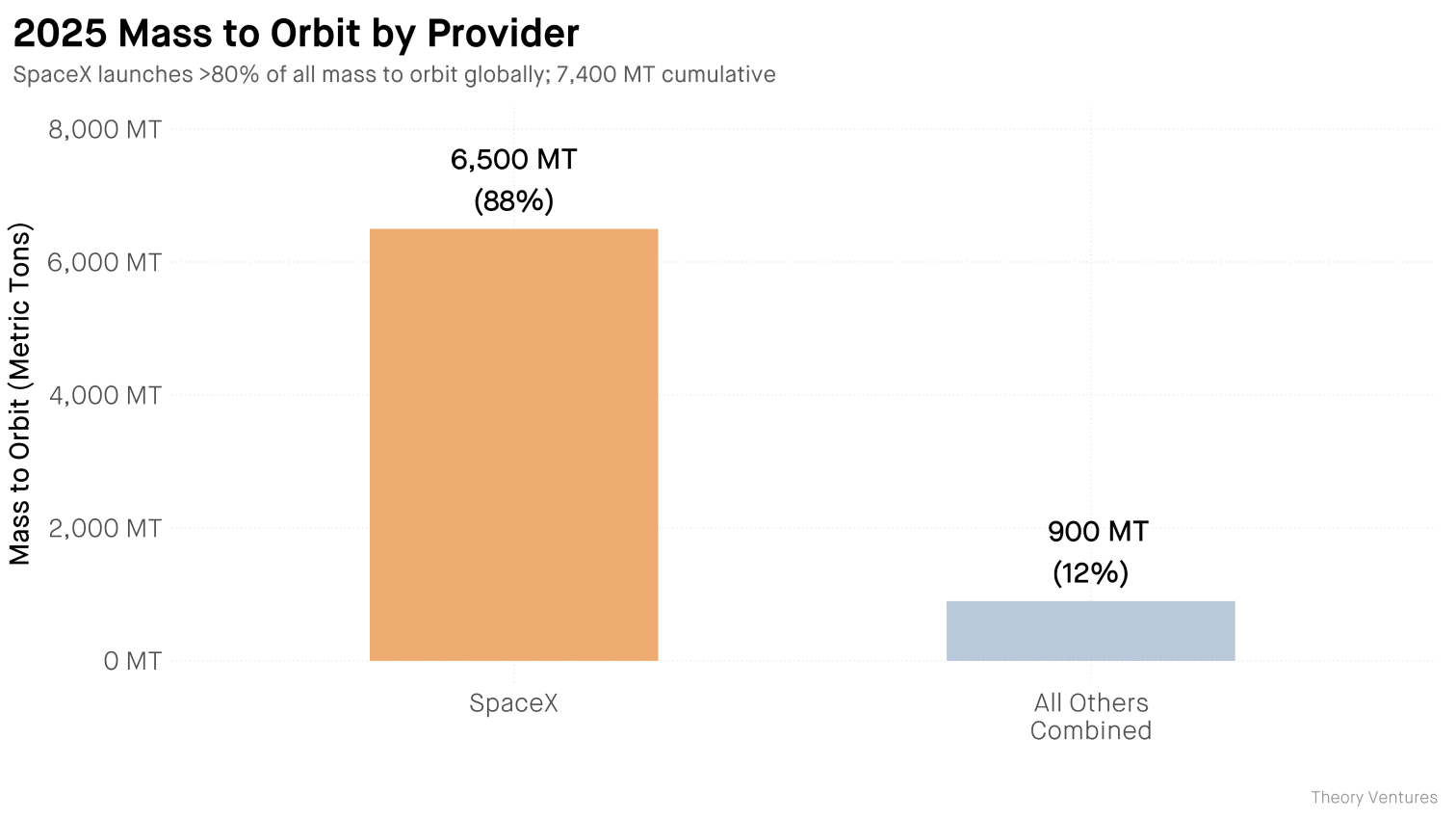
The losses stem from Starship development. The company has executed 11 Starship flight tests, with a 12th scheduled. SpaceX expects Starship to begin payload deliveries in the second half of 2026.
The economics of Falcon are already extraordinary. A Falcon 9 booster has demonstrated 34 reflights. At $67M per launch, and with 620 orbital launches completed and 99%+ mission success rate, SpaceX has cracked the code on reusability.
Starship aims to extend this further : 100 metric tons to LEO in fully reusable configuration, turnaround times comparable to commercial aviation, and a potential 99%+ reduction in launch costs relative to historical averages.
AI : Massive Investment
The xAI segment is where SpaceX is placing its biggest bet.

Of the $20.7 billion in total CapEx, 61% ($12.7B) went to AI infrastructure. SpaceX claims to have deployed the first coherent gigawatt-scale AI training cluster ; COLOSSUS and COLOSSUS II in Memphis and Mississippi.
The AI platform has scale :

550 million monthly active users across X, with 117 million using Grok’s AI features. That’s 21% AI penetration on the platform.
SpaceX’s $12.7B AI capex is substantial but dwarfed by Big Tech spending :
| Company | 2025 AI/Cloud CapEx ($B) | vs SpaceX AI |
|---|---|---|
| Microsoft | 80 | 6.3x |
| Amazon | 80 | 6.3x |
| 75 | 5.9x | |
| Oracle | 50 | 3.9x |
| SpaceX AI | 12.7 | — |
Big Tech collectively spent ~$285B+ on AI/cloud infrastructure in 2025. SpaceX’s AI capex represents 4.5% of this total, but generates only $3.2B revenue (25% revenue-to-capex ratio) compared to Big Tech’s more mature 2-3x ratios.
The S-1 reveals SpaceX’s long-term AI strategy : orbital AI compute. The thesis is elegant. AI infrastructure on Earth faces power constraints. The Sun contains 99.8% of solar system energy. Space-based solar arrays generate 5x more power per unit area than terrestrial installations. SpaceX plans to deploy AI compute satellites beginning 2028.
SpaceX targets a $1.75 trillion valuation at IPO on June 12, 2026, making it one of the five most valuable companies globally. The S-1 reveals the tremendous scale & nearly limitless ambition of a modern AI conglomerate.