Median Startup Valuations and Down Rounds in 2016

image

Average Series A valuations have hovered around $15M for the last 9 quarters. Series B rounds have settled into $50M, while Series C rounds have rebounded to $100M. Later stage rounds, however, have fallen by 50% from their high of $400M to just under $200M.

image

However, in the early stages the frequency of down rounds (e.g., a Series D with a smaller valuation than a Series C) aren’t at historic or even six year highs.

Read more

Fighting and Leveraging Inertia in Sales

image

When you’re selling a SaaS product to a potential customer, you have to convince them switching is worth the effort. And once you’ve sold the product, you have to do the opposite: convince the customer that switching to anything else isn’t worth it.

In chemistry, there’s a notion of an activation energy. A Swedish scientist Svante Arrhenius coined the term to describe the minimum amount of energy required to start a chemical reaction. The drawing above depicts this idea.

Read more

The Most Successful SMB SaaS Acquisition Channel Ever Built

image

Channel distribution represents one of the biggest and most important changes in customers acquisition for SMB SaaS startups in quite a while. Historically, channel distribution has been reserved for the most expensive software and hardware. IBM, Intel, Cisco and their kin generate more than 80% of their revenues through a universe of resellers and distributors.

As many of these channel partners move to newer distribution models, the brokerage channel model in particular, they represent an efficient and leveraged customer acquisition channel.

Read more

A Structural Pricing Competitive Advantage in SaaS - The Three Part Tariff

There are three pricing strategies for startups. Maximization dominates SaaS products in the mid-market and enterprise markets; penetration is synonymous with freemium in the SMB market. Once you’ve decided on the right strategy for your company, what is the best way to price? By seat? By minute? With or without a platform fee?

Modern behavioral economics study three different pricing structures. Let’s contrast them for a hypothetical web analytics vendor.

  1. Linear Pricing (LP) - Each analytics event costs $0.10.
  2. 2 Part Tariff (2PT) - The analytics software has a base platform fee of $10,000 and each analytics event processed by the system costs $0.10 more.
  3. 3 Part Tariff (3PT) - Again, the software has a base platform fee but the fee is $25,000 because it includes the first 150k events are free. Each marginal event costs $0.15.

Which is the best for software companies? For the first ten years of SaaS, the linear pricing model dominated. Recently, 2PTs have emerged, but are still uncommon. However, several academics argue the 3PT may be the optimal strategy especially when the number of vendors in a category is small.

Read more

The Quirky M&A Environment for SaaS Companies in 2016

image

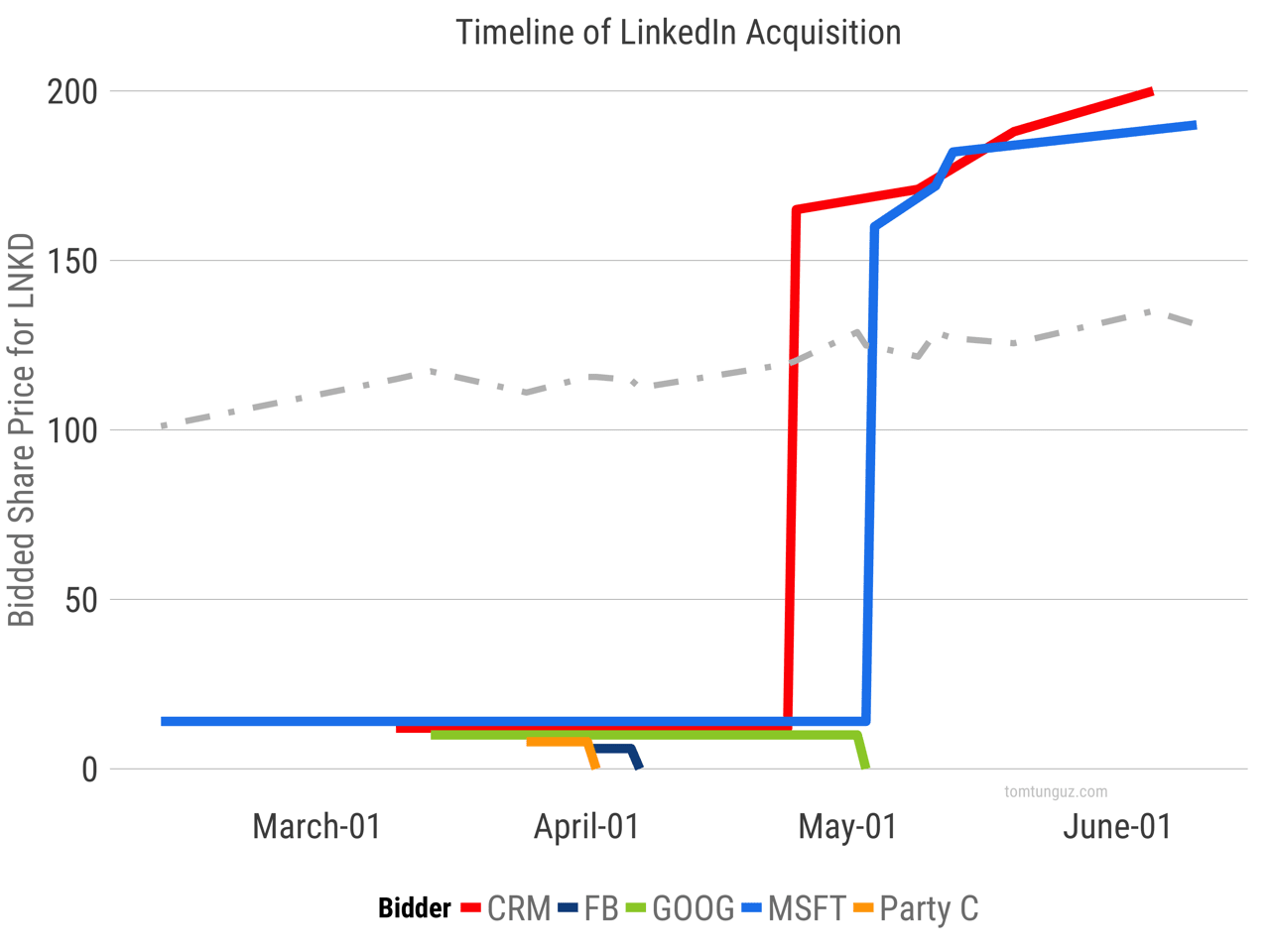
Through the end of July in 2016, $70B worth of SaaS companies sold. Their size follows a power law with LinkedIn at $26B and Netsuite at $9.3B. The more than $600B in cash on the balance sheets of large public tech companies combined with a recent pricing correction in SaaS companies presaged a flurry of acquisition activity. But it hasn’t unfolded as expected in three different ways.

First, 15 of the 22 US software acquisitions worth more than $0.5B have been public companies. Excluding LinkedIn, nearly 5x more dollars have been spent on acquiring public companies. The largest private software acquisition is Transfirst, a payment software business founded in 1995. It’s the 7th largest this year. The second largest, Jasper, is an internet of things software company founded in 2004, which Cisco acquired for $1.2B. Jasper ranks eleventh.

Read more

How Fast Does a SaaS Startup Have to Grow to Survive?

McKinsey released a study of high growth software companies entitled Grow Fast or Die Slow. One salient conclusion:

If a software company grows at 20% annually, it has a 92 percent chance of ceasing to exist within a few years.

In other words, software companies must grow quickly to survive. Slow growing businesses suffer from the lack of oxygen that fuels growth. Raising money is more expensive. Hiring becomes challenging. Without the capacity to invest capital in growth or the ability to compete for top talent, the slow growth cycle reinforces itself.

Read more

Which of the Three Software Budgets Does Your SaaS Startup Target?

Where is the budget to pay for your SaaS startup’s software coming from? There are three possible pockets. First, they are dollars the competitor you displaced used to collect. Second, the company enlarges the current budget to finance the purchase. Third, the company creates a new budget.

Which budget is an important question. The answer informs product, marketing and sales strategy. It’s also a frequent question investors and employee candidates will ask during their respective processes.

Read more

The Smallest ACV to Justify an Inside Sales Team at a SaaS Startup

image

What is the smallest price point at which a SaaS startup can justify building an inside sales team? This is a natural question that many SaaS startups raise as they begin to complement bottoms-up, product-led adoption with assisting customers through the sales process.

There are publicly traded SaaS companies at nearly every price point - even very small ones. At IPO, Wix went public with an average annual revenue per customers of $87. Xero at $167; RingCentral $352.

Read more

Flux in the Fundraising Market

image

Over the last year, the amount of series A investment in US startups has fallen by nearly 33% from a high of $6 billion to about $4 billion in Q2 2016. Later stage investments have followed a similar path. Curiously, the series B/Expansion stage market has witnessed remarkable resilience, continuing to increase despite volatility.

image

The series a market is also seen a similar drop in the total number of investments, indicating a slower investment pace. Later and expansion rounds have remained relatively constant.

Read more

Learning to Code in a Whole New Way

image

The last time I learned a new programming language was 2004. I had been writing in Java for about four years, and then I heard whispers of a new framework called Rails that allowed engineers to write web applications in one-tenth the time of a Java web application. Over the course of a few weeks, I bought an armful of paper books, read them, and worked through the examples. A few weeks later, I built my first Rails application and brought it to work at Google.

Read more