How Important Is It For a SaaS Startup to be Profitable?

image

The Information reported last week that in 2014, only 11% of tech IPOs in 2014 were profitable when they became publicly traded companies, an all time low stretching back to 1980, when the figure was 88%. This raises the seemingly absurd question, how important is it to be profitable for a startup? After all, growth is the largest determinant of valuation at IPO, not profitability.

image

Only 19 of the 48 publicly traded SaaS companies in the basket I track have ever recorded a financial year with a positive net income. As the chart above shows, the median publicly traded SaaS company, marked in red, never achieves positive net income. There are a handful of outliers who have sustained positive net income for a while, but they are very few. Only 3 companies of the 48 have more positive net income years than negative net income years.

Read more

Measuring Bookings, MRR, Revenue and Cash for Your SaaS Startup

Yesterday, I met with a bright, young SaaS entrepreneur who asked me to clarify four key numbers for SaaS companies: bookings, monthly recurring revenue, recognized revenue and cash collections. These four numbers are critical to understanding the health of a SaaS startup, and they can be quite different, so it’s important to have a strong grasp on the distinctions between them.

MonthJanFebMarAprMay...Jan
ACV Bookings12,000
Monthly Recurring Revenue (MRR)1,0001,0001,0001,0001,0000
Recognized Revenue5161,0001,0001,0001,000484
Cash Collections3,0003,000

Let’s consider a hypothetical SaaS startup called RedRocket, which sells software for $12k per year, and asks its customers to pay each quarter. On the 15th day of January, one customer agrees to pay RedRocket $12k for a one year contract. The startup doesn’t sell any more software for the next twelve months. The table above demonstrates the differences in bookings, MRR, revenue and cash.

Read more

Why the Bubble Question Doesn't Matter

“Is there a bubble?” is a question that seems to be asked every day. But it’s the wrong question - in fact, it’s an unimportant question. Maybe there is a bubble. Maybe there isn’t. Instead of asking the question, let’s just presume we are in a bubble.

Then, the far more important debate surfaces: given the bubble, how should a team manage a startup differently? If I were to survey entrepreneurs and board members, I presume I would hear something like this list:

Read more

The Innovator's Solution for SaaS Startups - The Flywheel SaaS Company

In the Innovator’s Dilemma for SaaS Startups, I outlined the path of many software companies, which disrupt incumbents by first serving the small-to-medium business and then move up-market by transitioning to serve larger enterprises with outbound sales teams. I argued this transition is largely due to the more attractive characteristics of larger customers, namely higher sales efficiency and reduced churn rates. This is the “traditional” way of disrupting. But, as Kenny van Zant of Asana and Mike Cannon-Brookes of Atlassian told me, there’s another way, a novel way of building companies that still isn’t very well understood: the Flywheel SaaS Company.

Read more

How Faster Sales Cycles Become a Competitive Advantage

image

Sales cycles, the time from acquiring a lead to closing an account, vary quite a bit by industry, product type, and price point. But universally speaking for startups, shorter sales cycles are better. Maintaining a short sales cycle is a competitive advantage for several important reasons.

First, faster sales cycles accelerate the discovery of a repeatable sales process. Different sales approaches must be tested: which role to sell to? which pitch (cost or value)? how to handle particular objections? A 45 day sales cycle will find those answers twice as fast as a 90 day sales cycle. Faster and more frequent sales cycles enable quicker experimentation and ultimately a more rapid discovery process to the right initial sales process.

Read more

How Many Unicorns Sell Each Year?

image

How many companies sell each year for $1B or more? In the last ten years, on average, 2.5 US venture backed IT companies are acquired for $1B+. In the last ten years, a total of 20 companies have sold themselves for greater than $1B. Over the past 20 years, that trend has been relatively constant, with the exception of the euphoria in 1999 and 2000.

image

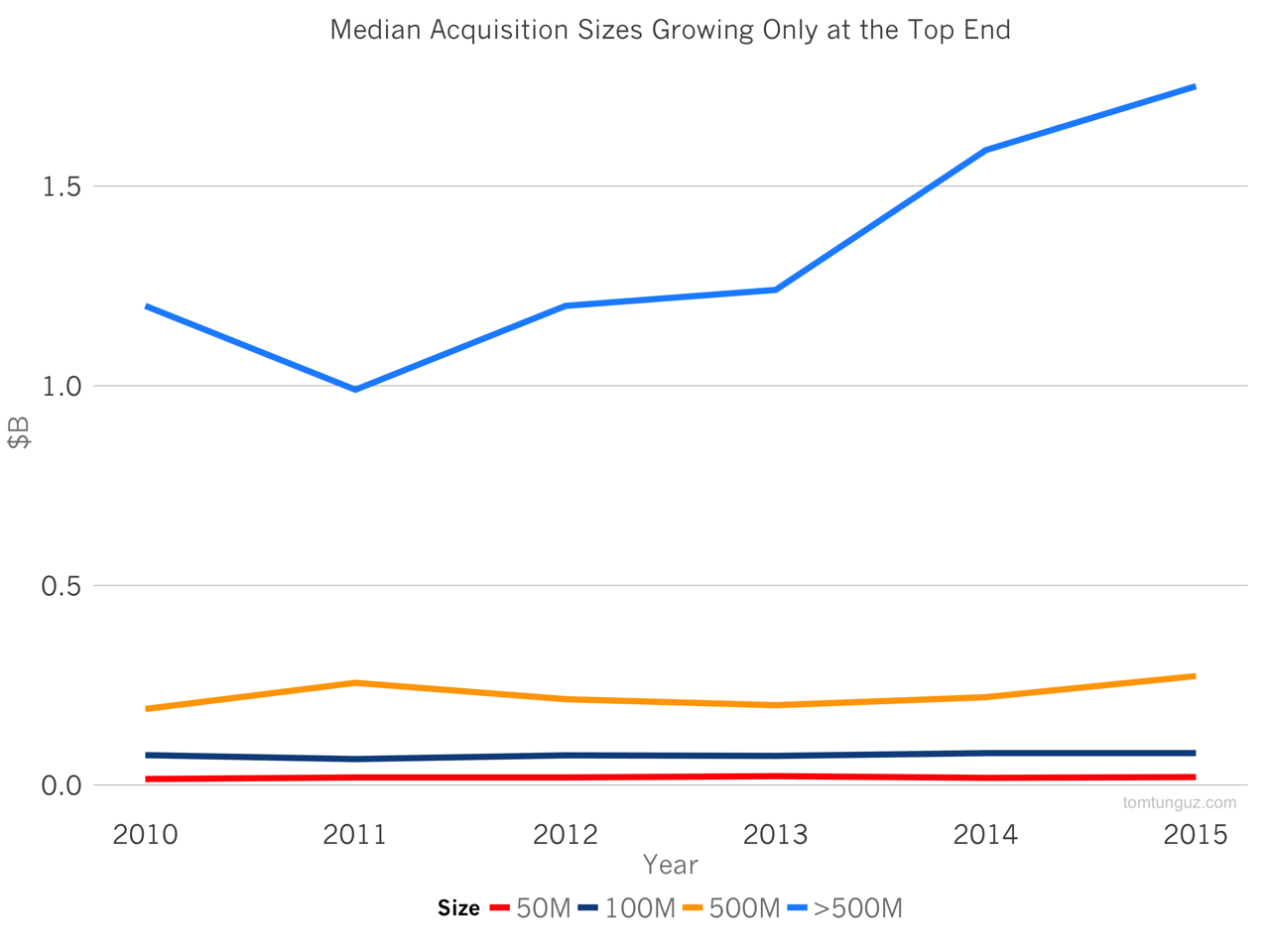
The typical unicorn acquisition generates $1.9B in proceeds. Though there is quite a bit of variance in the trend, because the numbers of companies are relatively small, we cannot say that the typical large acquisition is increasing in size. It seems relatively constant around $2B.

Read more

Hacking the Performance Evaluation

Performance reviews tax organizations, managers and employees to such an extent that some companies have abolished them outright. Reviews are emotionally complex conversations. Positive and negative feedback are intertwined with conversations about career progression, raises and equity grants. These meetings are emotional powder kegs; and it’s no wonder they stress us.

In Work Rules, Google’s Chief People Officer Laszlo Bock, argues for a different type of performance review: a split review. At Google, “annual reviews happen in November, and pay discussions happen a month later.”

Read more

The Gamble of the Private IPO

In a post earlier this week, Josh Kopelman coined the term Private IPO to describe patterns in the runaway late stage financing market. In addition to the points Josh makes about the dangers of stale valuations, there is another important and related implication for founders.

When entrepreneurs pursue a Private IPO as the ultimate round before they go public, they make an implicit bet about the growth rate of their businesses: company revenues will more than double before a public IPO. If the bet doesn’t pan out, then the IPO is a down round - a fund raise at a lower share price than the last private round.

Read more

The Innovator's Dilemma for SaaS Startups

image

See also: Innovator’s Solution for SaaS Startups

There’s a familiar path now to SaaS companies that start in the SMB (small-to-medium business) part of the market. Over time, they seem to inevitably begin serving larger customers. Box, Hubspot, Zendesk and among many others have exhibited this pattern. Why does this happen?

I believe we’re seeing Clay Christensen’s Innovator’s Dilemma at play. In short, new startups leverage a distribution advantage to acquire SMB customers at scale. These distribution advantages take many forms: a simpler product (Box vs Sharepoint); mobile app store distribution (Expensify vs Concur); content marketing (Zendesk vs Oracle/Peoplesoft). Early on, the SMB customers finance a startup’s growth and enable the startup to build a broader product over time that eventually becomes more attractive to enterprises. Because of the nature of SMBs, the startup must battle the higher churn rates of smaller customers which slow growth, creating the S curve above. At some point, the startup pursues the enterprise market to continue to achieve high growth rates with decreased customer churn.

Read more

Are SaaS Startups Today Worth More than Ten Years Ago?

image

In the Runaway Train of Late Stage Fundraising, I analyzed the growing disparity of the public and private markets. Ten years ago, we saw 2-10x as many IPOs as $40M+ rounds. Today, we see 16x as many $40M+ growth rounds as IPOs. There’s no question that companies are waiting longer to go public, fueled by late stage private investment. I was wondering if as a consequence, we might see bigger IPOs.

Read more