Data Network Effects in SaaS Enabled Marketplaces

image

SaaS Enabled Marketplaces benefit from a unique advantage in their go-to-market. They have a panoptic view of their market place, which over time provides them an unassailable competitive advantage.

SEMs provide software to suppliers and consumers, and then make a market between them. The first SEMs flourished in advertising. Google manages one of the world’s largest advertising market places. They provide software to publishers, the supply side, which manages available ad inventory with a product called DoubleClick for Publishers, or DFP. In addition, Google provides the demand-side inventory system, AdWords, to help advertisers manage their budget. In between, Google operates an advertising marketplace, AdX. Today there are an increasing number examples of SEMs including StyleSeat (beauty), Zenefits (benefits), Quartzy (lab management), Makeable (manufacturing), Yardbook (landscaping), Joist (construction), among others.

Read more

Data Design Patterns - The Building Blocks of a Data Driven Culture

image

In 1977, a British polymath named Christopher Alexander, who studied Math and Architecture at Cambridge and was awarded Harvard’s first PhD in architecture, published a book titled A Pattern Language: Towns, Buildings, Construction. This book would transform the architecture world, and more surprisingly, forever influence the way computer scientists write software.

A Pattern Language prescribed rules for constructing safe buildings, from the layout of a region of 8M people, to the size and shape of fireplaces within a home. Today, A Pattern Language still ranks among the top two or three best-selling architecture books because it created a lexicon of 253 design patterns that form the basis of a common architectural language.

Read more

The Importance of Payback Period for SaaS Startups

image

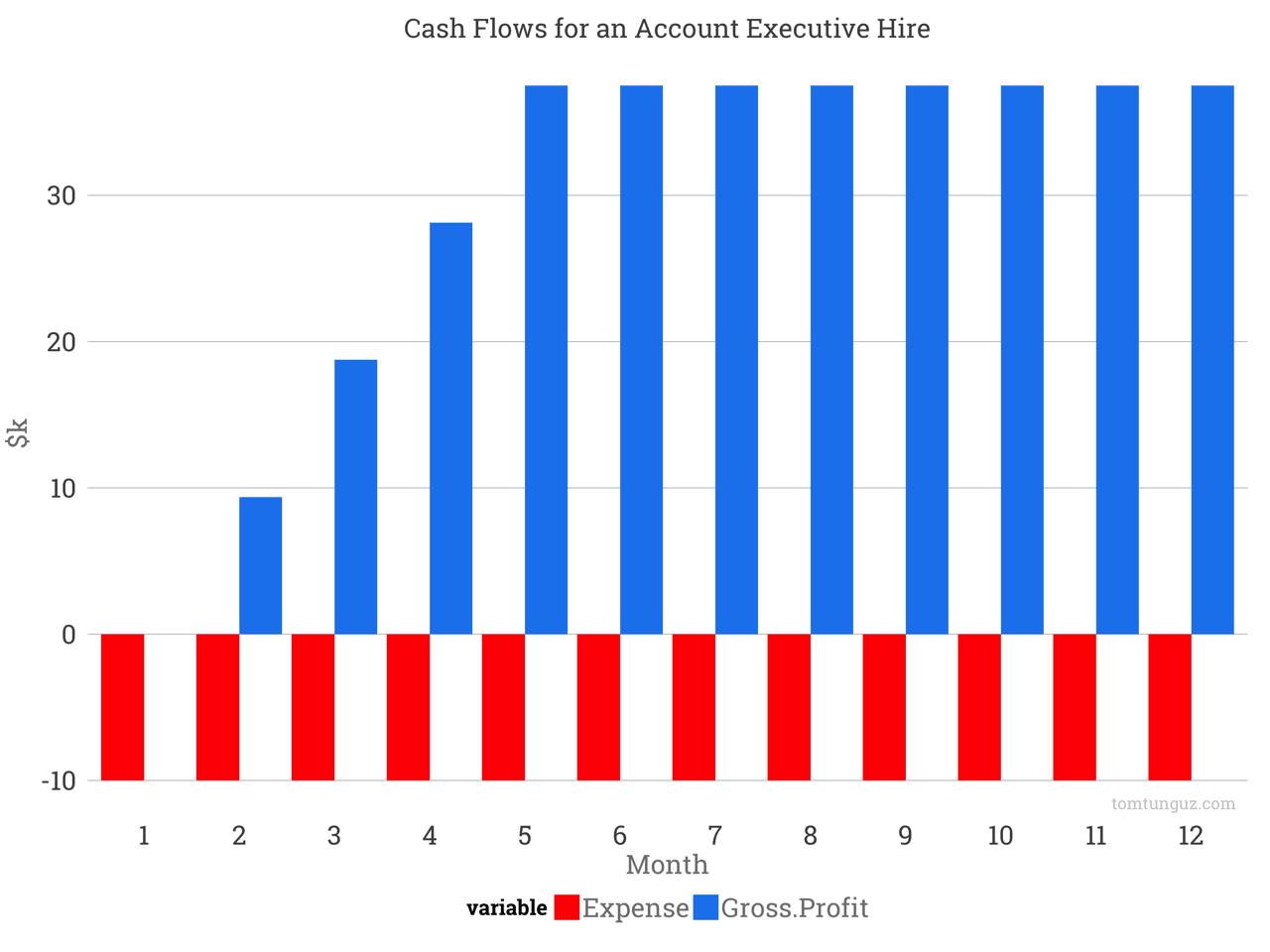
One of the most powerful levers for SaaS companies to master is payback period. Payback period is the number of months a company requires to payback its cost of customer acquisition. The median SaaS startup has a payback period of 15 months on a gross margin basis.

A short payback period confers two massive advantage to a startups: smaller working capital requirements and a consequent ability to grow much faster.

Read more

Do Vertical SaaS Companies Benefit from Higher Sales Efficiency?

image

When writing the post Vertical SaaS Startups Require Different Go To Market Than Horizontal SaaS Companies, I realized that there is a perception on my part and perhaps more broadly that vertical SaaS companies enjoy greater sales efficiencies than horizontal SaaS companies.

After all, vertical SaaS companies target a smaller number of potential buyers. The marketing team concentrates their media buys to target this audience, the sales team focuses on a smaller lead list.

Read more

Vertical SaaS Startups Require Different Go To Market than Horizontal SaaS Companies

Vertical SaaS requires a different go-to-market than horizontal SaaS companies. Vertical software companies, a recent important trend in SaaS startups, pursue customers only in a particular industry. They trade a more narrow customer base and consequent reduction in market size for a competitive advantage in that market segment.

The most salient example, Veeva, sells software to the largest life sciences companies, which are subject to a unique regulatory regime in their sales processes. A spectacularly efficient business, Veeva raised only $4.5M in venture investment before going public six years after founding. Today, Veeva’s market cap exceeds $3.3B. Similar large market cap examples exist in real estate (CoStar - $5.8B), insurance (Guidewire - $3.7B), logistics (Fleetmatics - $1.8B) among other categories.

Read more

Why Skillful Fundraising is a Huge Competitive Advantage

image

During their fundraising processes, founders often tell me “I’d really like to get back to building the business.” I’m certain it’s true. Every founder surely would certainly rather be building their product and company than fundraising.

Nevertheless, a founder skilled in fundraising can create enormous leverage for their business and develop unassailable competitive advantages. This is why it’s critical for early stage founders to invest time to perfect their pitches.

Read more

Why Bottoms Up Selling is a Fundamental Shift in SaaS

image

Much has been written about the consumerization of IT, the movement fueling many SaaS startup’s growth by targeting individuals in a target customer called B2C2B, rather than selling top down. But until yesterday, I hadn’t found anyone who had quantified the size of the movement.

In mid-2014, CEB published Harnessing Business-Led IT to answer this question. While the entire report is worth reading, the chart above answers the particular question above. Just how big is B2C2B?

Read more

Four Important Data Points about Purchasing Behavior in SaaS

image

The SaaS ecosystem has been evolving incredibly quickly. Most of the time, the changes in the ecosystem are embodied in one particular company which grows exceptionally quickly. Focusing on these fast-growers, the macro shifts can be hard to discern. Last week, Okta released a report Business at Work sweeps across SaaS to reveal these recent evolutions. These are the points that I found most interesting.

Read more

What SaaS Startups Miss in User Onboarding

Over dinner, a veteran product manager argued most SaaS products’ onboarding practices miss a crucial step: create value for the user in the first session. After that conversation, I signed up for many brand-name SaaS products pretending it was for the first time, and I couldn’t help but agree with him.

Most SaaS products guide a user through three steps. First, collect the requisite data to create an account, like email and password. Second, configure integrations with related services, customize the platform and/or invite other key users. Third, educate users about the product by indicating the most important menus and actions.

Read more

The Impact of the Stock Market on SaaS Valuations in 2015

image

The public markets are down more than 10% from their highs in the last few months. Public SaaS companies have been particularly hard hit. The chart above shows the enterprise value of publicly traded SaaS companies. Many of them are down substantially more than 10%. Let’s dig in a bit more.

image

Read more