The Machinery of Blogging

image

I’ve been getting a few questions about the tools I use to publish this blog, so I figured I’d write about it and reveal the machinery behind the curtain. I use four main tools Jekyll, Github Mou, and RStudio. Jekyll is the blogging engine; Github is the hosting provider; Mou is the app I use to write these posts; and RStudio is the place I analyze data and make charts.

Read more

Are VC Mega-Rounds the New Normal?

image

Each morning’s news seems to bring another fund-raising announcement of ever larger scale. Just a few months ago, Pure Storage raised $150M in the largest ever venture investment in a storage company. These record financings certainly generate significant press interest. But how representative of the fund raising environment are these mega-rounds?

The chart above breaks down fund-raising activity in US tech companies using Crunchbase data. Each chart shows the number of rounds raised bucketed by size from $0 to $5M and up to $150M to $200M from 2005 to 2013.

Read more

How Fast Must a SaaS Startup Grow to Raise a Series A?

Last week, Sean Ellis made an interesting comment in response to this post on public SaaS companies’ growth rates:

image

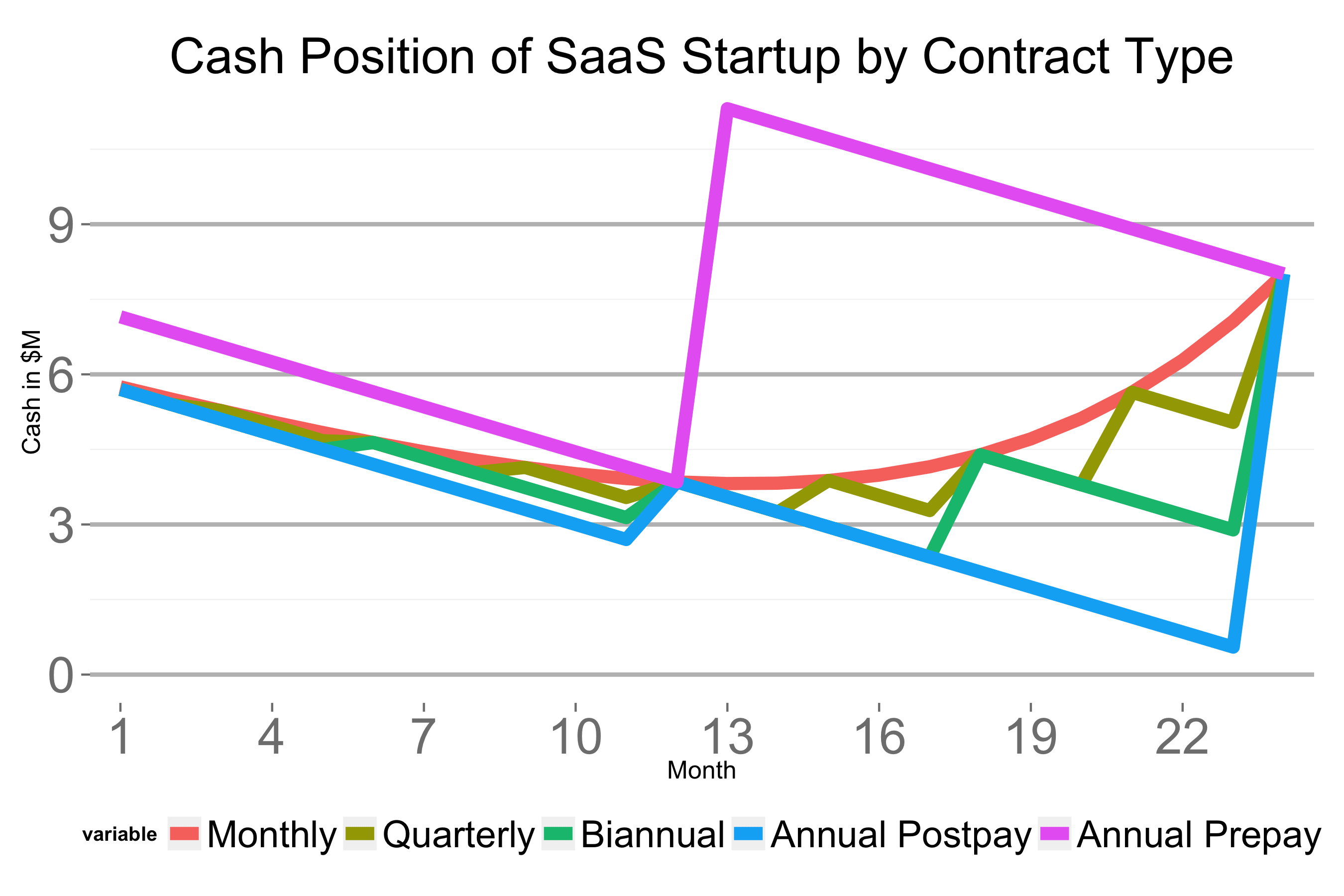
I’m guilty of giving the same advice to startup founders without providing a transparent rationale. This post is my explanation of why the 15-20% MRR growth number is a reasonably good target for post-Seed/pre-Series A SaaS startups to aim for.

Let’s create a hypothetical SaaS startup called SaaSCo with a set of founders who aspire to a fund-raising trajectory like the one in table below. The numbers in this chart are rough estimates of what a fast growing SaaS startup might command in the market, but they aren’t based in any data or surveys.

Read more

How Quickly Does a SaaS Startup Have to Grow to Go Public?

At the time of the IPO, the median Software-as-a-Service (SaaS) company generates $100M in revenue, creates $2.6M in profit and holds $85M in cash on the balance sheet. A company in this position typically raises $107M in its IPO and trades at 11x revenue, for a $1.1B market cap.

The path to getting there is revealing. Below is a chart showing the median revenue ramp of the 41 publicly traded SaaS companies by year since founding. In year 3, the median revenue is $11M. In year 4, the revenue figures more than double to $25M, and then again to $55M.

Read more

Why There's Never Been a Better Time to Found a SaaS Startup

SaaS companies are the darlings of the public market. The average publicly traded SaaS company enjoys twice as strong a revenue multiple as ten years ago. SaaS companies’ time to IPO has been decreasing steadily from over 10 years since founding to under 7. Despite the decrease in time to IPO, the average dollars raised at IPO has tripled from the early nineties and grown by 50% since 2000.

I analyzed the 41 publicly traded SaaS companies comparing to understand the trends in SaaS IPO. The data set is here. Here are four charts depicting the trends.

Read more

The New Market Places

One of the most important trends in the Internet at the moment is unbundling. Entrepreneurs are picking apart Craigslist and eBay, vertical by vertical. At the same time, other entrepreneurs have replicated the core functions and features of Facebook and LinkedIn, creating hugely valuable companies.

But simply calling this trend unbundling doesn’t do the movement justice, particularly in the transactional web. The trend is more fundamental.

Craigslist and eBay are the canonical internet market places. Craigslist is synonymous with internet classifieds. eBay coupled a payments system to the listings model, enabling user-to-user transactions at scale. Both eBay and Craigslist exposed the buyer to the seller in a transparent way. They avoid arbitrating or regulating disputes as much as possible, and push as much of the negotiation and price discovery as possible to the buyer and seller. For this, eBay charges 10% of gross merchandise value. Both companies provide large amounts of liquidity, a little bit of advice and take a relatively small stake of the transaction value.

Read more

A Moore's Law for Data

Since the first transistor, increasing speed has been at the core of much innovation in Silicon Valley . Over more than three decades, Moore’s Law has remained the engine of progress in chip technology. I’ve been wondering if a analogous productivity law will be written for data.

One level up the stack from the chip, software has benefitted tremendously from chip speed. I learned to code in Java, which I needed to compile before I could test my program. Each compilation required 3 or 4 minutes and this latency slowed me down. In comparison, the languages dominating today’s programming stacks provide instant feedback. I saw 90% time savings to write code when I shifted to Ruby.

Read more

Great SaaS Companies Focus on Behavior Change

Most SaaS companies provide tools to help people accomplish a goal in a better way than they could before. A key part of a SaaS startup’s toolkit, then, is changing end user behavior. A startup that doesn’t change the behavior of a customer will see the customer churn in a few months or at the expiration of their contract. Customers don’t change their behavior for many reasons. Sometimes the friction to adopting a new workflow is too great. Other times, the value proposition isn’t compelling enough for users. Or, the use case is too infrequent for users to remember to change behavior.

Read more

Do More Competitors in a Sector Decrease Fundraising Success?

image

Over the last 12 years, the number of startups founded has grown each year by 25%, according to Crunchbase data. That’s quite an acceleration each year! See the chart here. As the number of companies in a sector grows, do the odds of successfully raising capital decrease?

The chart above shows startup company formation rates, the number of new companies formed each year from 2004-2011 by Crunchbase sector. I didn’t graph the 2012 or 2013 data because the Crunchbase team told me the data sets need about 2 years to mature. Most of the categories are up and to the right. Advertising, hardware, messaging, music and PR are the notable exceptions with substantial decreases. On the whole, then, startups are competing with more and more other startups to raise capital.

Read more