A Five Year Android User Switches To iOS

On the day of Android’s five year launch anniversary and my fifth consecutive year of using exclusively Android devices, I switched to a yellow iPhone 5c.

Like a well worn pair of jeans, it’s easy to grow accustomed to a mobile phone OS. Changing into a new pair is always a little uncomfortable at first. In that same way, migrating from Android to I iOS, I discovered the quirks and kinks of each OS:

Read more

Using The Friend Paradox to Maximize Your Effectiveness at Startup Networking Events

I’ll never forget the first large tech conference I attended after joining Redpoint. Held in the movie theater in downtown Redwood City, the TechCrunch conference attracted several hundred entrepreneurs, investors and journalists. Not one of whom I knew.

After a handful of conferences and a few awkward quick-name-badge-glance-then-say-hello conversations, I started to recognize faces and became friendly with the conference regulars.

Walking into a room and working it by building a network person by person is an essential part of entrepreneurship (and venture capital). That room might be filled with potential customers to sell, investors to woo, candidates to hire, or in my case startups seeking capital. For many founders and VCs, these networking opportunities occur at least weekly if not almost daily.

Read more

Sexism, Statistics and Space s How Disruptive Startup Ideas Are Discovered

image

In response to analyses published on this blog, a handful of readers have raised the idea of Simpson’s Paradox to me. Because I wasn’t familiar with it, I’ve been researching it and last week, I came across VUDLab’s beautiful website which uses a sexism-in-admission lawsuit against Berkeley to demonstrate the idea.

In 1973, the University of California-Berkeley was sued for sex discrimination. The numbers looked pretty incriminating: the graduate schools had just accepted 44% of male applicants but only 35% of female applicants. When researchers looked at the evidence, though, they uncovered something surprising:

Read more

Which Half of Your Startup’s Emails Are Wasted?

We know by heart that half of our marketing dollars are spent improperly. But what’s worse is most products waste half of their chances to deepen a relationship with their customers.

There are two different kinds of email within products: product marketing emails and transactional emails. The first of these marketers optimize continuously and the other is oft forgotten.

Product marketing emails include acquisition campaigns, lifecycle marketing, retention marketing, cross-selling, up-selling and content marketing. Tools like Marketo, Silverpop, MailChimp and others have solved this problem for marketing teams. After all, a startup measures its marketing team by their impact on customer engagement, retention and conversion using email metrics primarily. Consequently, marketers hone and refine and perfect these emails.

Read more

How To Take Exceptional Notes and Be Productive with Paper

As a PM at Google, I carried a laptop to every meeting I went to. I typed notes, jotted down action items, and distributed the minutes of almost each one of my meetings. I stayed organized and tracked my teams’ progress this way.

But, as I learned when I starting working at Redpoint, outside the rainbow bubble of the Googleplex very few people take notes on laptops during meetings. It’s just impolite. People wonder if you’re typing emails (which I often was).

Read more

Interpreting Cohort Data - The 3 Key Analyses for Measuring Your Startup’s Product Performance

After I wrote a post on six important cohort reports, I received a handful of questions about how to interpret cohort charts effectively. When I review cohort data from companies I work with, I look into three different trends to evaluate a product’s performance.

This is a cohort chart of hypothetical product indicating percentage of monthly active users each week for 12 weeks. There’s great data here and but the amount of data can be overwhelming. Time flows down and right in the chart below.

Read more

How Wordpress Used VideoConferencing and IRC to Change the World

I’ve been reading Scott Berkun’s book The Year Without Pants which details his working life at Wordpress. The book reveals a thought-provoking collection of lore behind Wordpress and in particular, the day-to-day operations of a distributed volunteer team who built a technology that powers about 20% of the internet.

Scott embeds insightful gems about daily startup work life into his stories. My favorite so far is this one:

“Most people doubt online meetings can work, but they somehow overlook that most in-person meetings don’t work either.”

Read more

Google F1 and The Cascade of Innovation New Databases Create

The NoSQL movement launched officially in 1999 but rose to prominence much later perhaps closer to 2008 when Hadoop and other key value pair technologies became en vogue.

Today, it’s hard to argue with the success of the movement. Large banks, insurance companies, biotech companies and dotcoms rely on NoSQL to power their services and inform their most important decisions.

I first saw MapReduce at Google. I’ll never forget the conversation I shared with a search engineer who described MapReduce. Separate the data, process each chunk individually, and reassemble it. That’s how it works, he told me. It was fascinating and unlike the SQL mechanics I knew.

Read more

Crossing the People Management Chasm - A Necessity of Startup Growth

One of the hardest but least spoken about transitions in a startup’s life is crossing people management chasm.

At the outset of the startup, there might be three people, then eight, then fifteen. As they grow, startups often create ad hoc managers I call team leads.

Team leads manage 3 to 5 people. They work alongside their team, whether engineering, sales or marketing and contribute actively to achieving the goals of that team team. They code, sell or market for 50% of their time. With the remainder, team leads coordinate team members, set goals and measure progress. In company sizes around 30 to 50 or so, team lead structures work well.

Read more

Six Key Benchmarks for Your SaaS Startup

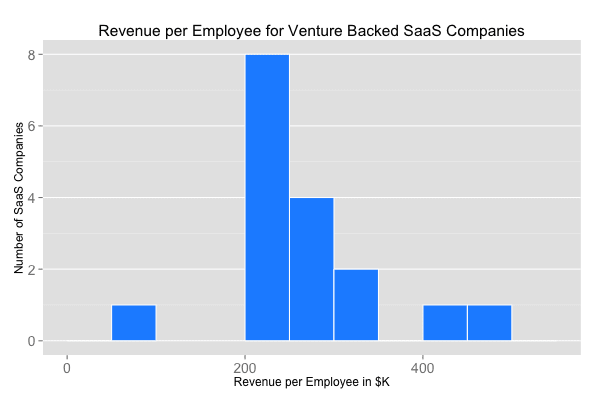
One of the most frequent questions entrepreneurs ask me is how does their business compare to others? Benchmarking is a great tool, if you can get access to representative data. Pacific Crest and David Skok have released a fantastic survey benchmarking SaaS metrics for early and growth stage companies. The entire report is well worth reading. Below is my list of the six most important benchmarks and observations from that report.

Read more