How Will I Enable Greatness Today?

In the summer of 2008, a crisis evolved on my team at Google: social networks had grown exponentially. The AdSense network was flooded with social network page impressions whose poor performance challenged advertisers and Google alike.

During that summer, we formed a tiger team of about four or five key people. We shed our daily responsibilities, relocated our desks to a conference room in a deserted building on the edge of campus where we brainstormed and debated and wrote patents and developed a plan of action. Those few weeks were some of the most productive of my time at Google.

Read more

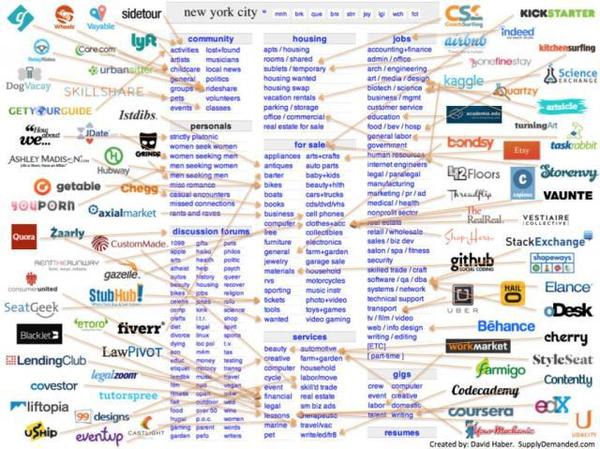
The Greatest Challenge to Facebook, LinkedIn and Twitter is Unbundling

image

Craigslist’s generic market place gave rise to fifty or more single-purpose alternatives some of which are quite valuable companies: AirBnB, Care.com, 99Designs, oDesk, CustomMade, Gazelle.

Each of these startups operates verticalized market places that solve customer problems better than Craigslist’s generic platform. In so doing, these startups have grown their observed markets.

The same unbundling trend will happen to social networks.

Read more

Reverse Engineering Your Startup’s Success

Who can forget gems like these word problems from 3rd grade math class?

Q: Jack walked from Santa Clara to Palo Alto. It took 1 hour 25 minutes to walk from Santa Clara to Los Altos. Then it took 25 minutes to walk from Los Altos to Palo Alto. He arrived in Palo Alto at 2:45 P.M. At what time did he leave Santa Clara?

It was during those classes that our mathematics teachers taught us how to work backwards through the problem.

Read more

Three Counterintuitive Points about SMB SaaS

Kenny van Zant drew this diagram for me on white board and I think it’s the best visualization of how SMB SaaS freemium business grow. The diagram highlights a few important mechanics of the SMB SaaS business model.

In any given freemium user base, small-office/home-office (1 to 20 employee shops) users tend to be a few times larger in size than true SMB customer (20 to 500 employees). Most of these SOHO customers remain unpaid evangelists. A few of these customers grow into SMBs and become paying customers - they cross the dashed line in this diagram. But most paying users for freemium services are SMBs.

Read more

Hiring Your Startup’s First Salesperson

To many entrepreneurs, hiring the first salesperson is a mystery. When should I do it? How much should I pay this person? How do I structure the work?

The great part about sales teams and sales departments is that they quantitative - sales teams thrive on numbers. At the most fundamental level, sales productivity has to exceed costs.

So let’s answer the question of when to hire a salesperson by understanding the financial mechanics of a sales team. When building a sales team, there are three things to consider:

Read more

The Secret to Growth Hacking

image

Could you grow your users at 5% for 15 months? Or at 7% for 12 months? Or at 10% for 9 months? That’s how long it would take to double your user base at those growth rates.

Though there is some science to growth developed by the technology-fluent marketer, aka growth hacker, growth remains a confounding art because there isn’t one feature - like implementing FB Connect or promoting Tweets or having a big red button on a home page. Rather, it is the sum product of a hundred little things.

Read more

What Today’s Revolution in Publishing is Missing

There’s something beautiful about handwriting that we’ve never been able to capture on the Web. Handwriting has style, a uniqueness to each writer and also an ability to capture the evolution of thought with crossed out words, carats and interjected clauses and margins full of edits. The image above is my favorite from Emily Temple’s curation effort of a series of famous authors' manuscripts on a Tumblog.

I was thinking about how much differently this blog feels to a reader than the above draft of Sir Arthur Conan Doyle’s “The Hound of the Baskervilles.” Doyle’s writing, careful and well-spaced, clean looks like Sherlock Holmes' hand and it gives a feeling of methodological study and thought.

Read more

The Antidote to Burnout is Progress

Andrew Dumont wrote about his grueling schedule at a startup and the lessons on “Avoiding Burnout” which spurred a torrent of comments on HackerNews. For me, the most interesting comment is this one by Daniel Ribeiro who quotes Isaac Yonemoto:

Burnout is caused when you repeatedly make large amounts of sacrifice and or effort into high-risk problems that fail…You effectively condition your brain to associate work with failure… The best way to prevent burnout is to follow up a serious failure with doing small things that you know are going to work.

Read more

Building Content Strategy by Segmenting and Analyzing Twitter Followers

To answer that question, you have to look for examples of the best storytellers. The best storytellers are the television studios. They divide the day into different segments to reach different audiences. Morning: news. Midday: soap operas. Evening: Nightly news segues into primetime sitcom. Late night: news segues into comedy.

An entrepreneur told me a few weeks ago, when we where talking about how to build a blog audience and I had asked him how he thought about content strategy. In short, segmentation was his answer. Figure out all the customer types and give each one what they want.

Read more

Design’s New Frontier: The IRL Era

When the neologism was popularized in 2004 by Tim O'Reilly, the words Web 2.0 captured a desire for the web to become interactive. It was a description of a movement towards social media and engaging users on the web. But more than an idea, it carried a design aesthetic which focused on the user, user experience and engagement. After all, users wouldn’t participate on a hostile site.

We’re no longer in the Web 2.0 age - look no further than the Google Trends data to prove the point - but the relentless pursuit of the best user experience lives on in a new era, the IRL (in real life) era.

Read more