Segmenting the SaaS Market for Sales

Developing a sales strategy is critical for software-as-a-service (SaaS) startups. The first step in developing a sales strategy is to build a robust market segmentation. I’ve used data from the US Census to develop a segmentation that reveals some surprising facts about the SMB market and may help inform your startup’s sales strategy.

Chart 1: 98% of businesses in the US employ fewer than 100 people.

98% of businesses in the US employ between 1 to 4 people. This large segment of businesses provides ample testing ground for product development, market fit validation and creation of word-of-mouth marketing.

Read more

Segmenting the SaaS Market for Sales

Developing a sales strategy is critical for software-as-a-service (SaaS) startups. The first step in developing a sales strategy is to build a robust market segmentation. I’ve used data from the US Census to develop a segmentation that reveals some surprising facts about the SMB market and may help inform your startup’s sales strategy.

Chart 1: 98% of businesses in the US employ fewer than 100 people.

98% of businesses in the US employ between 1 to 4 people. This large segment of businesses provides ample testing ground for product development, market fit validation and creation of word-of-mouth marketing.

Read more

All Great Managers are Alike

Hollywood and Silicon Valley often seems worlds apart. While movie making and startup building may always be very different endeavors, great managers use the same techniques in every discipline to empower their teams, hire the right people, and change the world.

Over the weekend, I watched Woody Allen: A Documentary which profiles the great director through the words of his actors, editors and producers. Allen’s management ability shone through every interview.

Read more

The Path to Exponential Growth

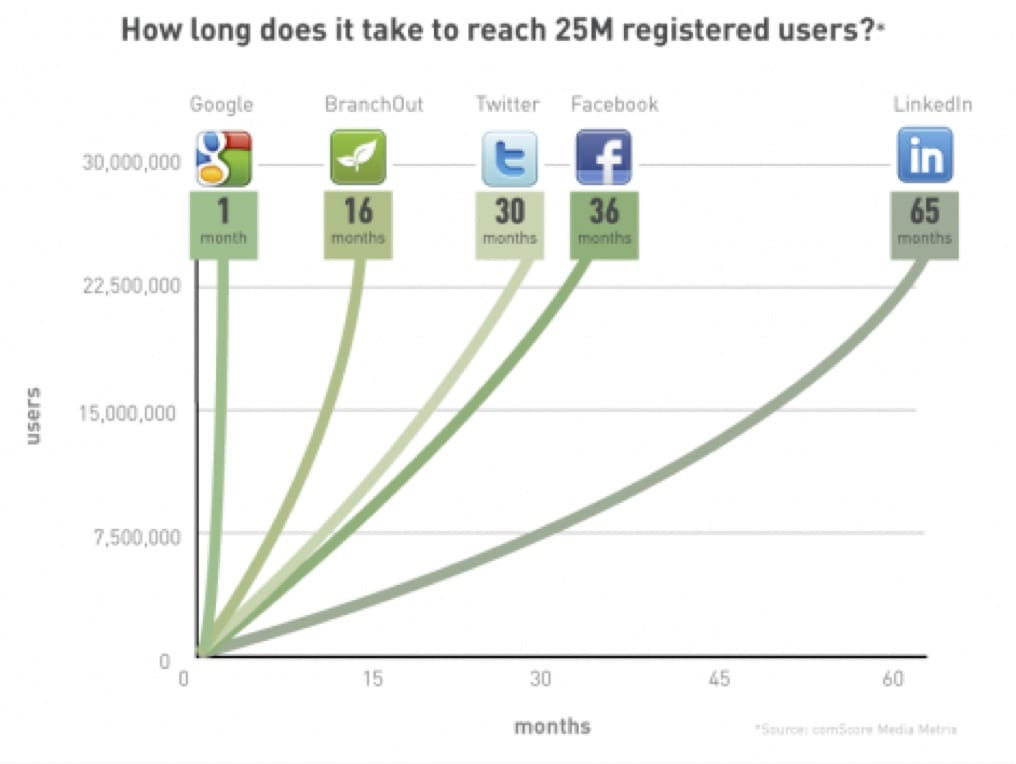
For years, a product can grow linearly before suddenly seeing compounding growth. Facebook is a great example. From 2004 to 2007, the company grew at a fairly linear rate. And then, the magic happened! The network effects kicked in and exponential growth ensued.

Linear growth always precedes exponential growth. For market places, in social networks or in advertising exchanges, the story is always the same. Linear, linear, linear. BOOM, exponential. One day, the magic happens.

image

Read more

Loyalty with a tinge of betrayal

Did you hear ‘em talkin’ ‘bout it on the radio

Did you try to read the writing on the wall

Did that voice inside you say I’ve heard it all before

It’s like Deja Vu all over again

- John Fogerty

I am emotionally attached to Android’s success. It’s the same loyalty I displayed when I campaigned for Apple in the mid-90s. But with a tinge of betrayal.

I reminisce about spending hours sifting through Zapf dingbats to transform PC Word files into usable Mac documents; choosing from a threadbare gaming library comprising three titles: Bungie’s Marathon series, SimCity and Civ; and waiting years for updates to Quicken and the Office Suite.

Read more

The 3 Kinds of Startup Metrics

Clarity is everything in a startup. That’s why metrics can be such a great help. But not all metrics are created equal.

One of my CEOs recently shared with me the way he thinks about metrics. I thought it was simple and brilliant. There are 3 kinds of metrics in a business:

  1. Vanity metrics are great indicators of momentum. These are useful for garnering press, investment and partnering interest. But they most often aren’t the end goal, the metrics that correlate to a business’s value.
  2. Business health metrics are high level metrics about the business. Revenue is a prime example. User activity is a second. Conversion-to-paid is a third. These metrics tend to be the ones shared with the board and leadership of the company. Goals can be established for these metrics and the health of the company’s initiatives can be measured in comparison to these goals.\
  3. Product decision metrics inform product, marketing, sales or other team level decisions. Examples include cost-per-customer-acquisition per channel, % of users using a particular feature, etc. Think through what kinds of metrics you and your team are focused on and run them through this filter. It will help you prioritize the right things.
Read more

Facebook’s new feature: your top 7 friends

Facebook is asking me to redefine my closest 7 friends.

I logged into Facebook today to see this new feature, starring your friends. Below this text is a Google circles like UI that asks me to star friends whose updates are particularly important to me.

image

With hundreds of friends, the average Facebook user logs in to see wall of updates that aren’t quite relevant. Some of us have reduced our friend graphs and unfriended contacts in order to return the feed to relevance, which isn’t a desired user behavior. Facebook, after all, wants to encourage expansive graphs.

Read more

Why did Apple’s unwillingness to compromise finally succeed?

Apple has built the most successful tech ecosystem of the past ten years. And they have done it, surprisingly, by dictating the rules of that ecosystem.

Compare iOS and Android. To win, both needed to develop initially 2 but eventually 3 things:

  1. A mobile OS
  2. Mobile hardware to run the OS
  3. And later, the content ecosystem

Apple controls nearly every aspect of this stack, from the prices of books and movies, to the place where apps are downloaded, to the payment mechanisms, down to the advertising and user tracking.

Read more

Stories, not sentences

First there were RSS feeds (Google Reader

Although today’s society is said to be in a state of information overload, in fact it may not be in excess. It’s just an overflow of odd and fragmented information in the media. The amount of information in each fragment is in fact quite small. In this slew of half baked information, isn’t the brain oppressed? The stress on the brain isn’t because of quantity, but because of limited quality.

Read more

Are We Investing Enough in Our Managers?

I met a seasoned executive recently. He made a bold claim. “Management is an art, and one that is overwhelmingly undervalued in Silicon Valley.” I wondered, are we investing enough in our managers?

Talent is the largest investment of an early stage company. 80%+ of startup operating expense flows to compensation. Retaining these employees is good business. Especially in such an expensive and competitive talent market.

Research shows employees leave their jobs because of poor leadership and poor management. All managers in a company influence employee retention - from the C-level to the line manager. This is why investing in each creates a competitive advantage.

Read more