The Future of Blockchain Data : Our Investment in Allium

The Future of Blockchain Data : Our Investment in Allium

image

Large scale ETL (extract, transform, load) processes are a critical part of any data pipeline. They are responsible for moving data from one place to another, transforming it into a usable format, and loading it into a destination system.

In the world of blockchain, these processes are even more complex.

In web2, the engineering team building a payment processing system will convey to the analytics team the data schema. In web3, any programmer can create transactions & inject meaning into fields.

Read more
Punctuated Equilibrium in AI : Is it Better to Be A First Mover or A Last Mover?

Punctuated Equilibrium in AI : Is it Better to Be A First Mover or A Last Mover?

Machine learning advances tend to evolve in bursts. Researchers publish a new paper with a newly discovered technique. It launches the industry forward & more researchers rapidly iterate to improve it further.

Progress looks like this - a series of aS curves one after another. image

No one knows the time period between the rapid progress or the slope of the curves or how much progress we’ll make during one of these curves.

Read more
No SaaS! How AI Agents Will Change Software Pricing

No SaaS! How AI Agents Will Change Software Pricing

image In a world where AI agents are 2.5-3x as productive as humans, which would parallel mechanical robots, how does a software company price?

Building on yesterday’s post, pricing in software companies may change significantly when AI agents become the norm.

The SaaS business model of the last 20 years for SaaS is a beautiful one. Annual prepaid contracts are free loans to software companies ; seat-based pricing is a tangible metric for pricing ; as a client grows so does this account, producing good net dollar retention.

Read more
AI Pricing Strategies for SaaS Companies Offering Copilots

AI Pricing Strategies for SaaS Companies Offering Copilots

Pricing an AI product will be a defining question in software for the next few years. AI products offer productivity gains. But greater productivity may reduce the demand for seats over time, ultimately decreasing the size of software markets.

We can observe the market trends today across some of the larger SaaS companies who offer AI pricing.

Company Product Base Price AI Price Ratio
Github Github Enterprise 21 10 0.48
Gitlab GitLab Duo 19 20 1.05
Google Workspace Business Plus 18 20 1.11
Loom Business 12.50 4 0.32
Microsoft Office 365 45 30 0.67
Salesforce Einstein 1 Service & Sales Cloud 330 170 0.51
ServiceNow Pro 100 60 0.6
Zapier Team 69 0 0
Zendesk Suite Professional 115 0 0

The table above lists the company ; the product ; the base price per-seat for the enterprise plan if available, otherwise the team plan ; then the price for the AI or co-pilot add-on ; and finally the ratio between the AI price and the base price.

Read more
Select avg(Moby Dick) limit 2 sentences

Select avg(Moby Dick) limit 2 sentences

The SQL statement above is a quote from our recent Office Hours with Benn Stancil. It’s not a SQL statement that would work today in a cloud data warehouse. But an LLM would understand it : summarize the book Moby Dick in two sentences.

Sure enough, ChatGPT answers the question :

image This pseudocode blends the structured queries of data analysis with the unstructured data contained in a classic novel. This is how Benn views the future of BI

Read more

The First of Your Newsletters

“This is the first of your newsletters that doesn’t align well with what I’ve been seeing in the field.”

After publishing The Four Barriers to AI Adoption, Dave Morse, a reader & a friend who was most recently CRO at Hebbia & VP Sales at Scale AI sent me this email.

Dave continued :

“The biggest blocker to adoption at AI application companies is user education and limitations of frontier models. Finding use cases that work; steering users away from failure cases. Prompting for use cases that work. Dealing with stochasticity.

Read more
The Four Barriers to AI Adoption

The Four Barriers to AI Adoption

image AI adoption is slower than expected in many spaces. Some of the reasons are straightforward, but others are more subtle.

Most leaders wants to inject AI into their business to develop a competitive advantage. There are four challenges.

  1. The first challenge is understanding the technology’s ability. Because the capabilities evolve so quickly, it’s hard to keep up. If PhDs in the domain are rushing to understand the capabilities reading papers every week, how are business leaders meant to grok the state of the art?

Also, because the systems are non-deterministic, they are unpredictable. The pace of innovation, the early understanding of AI internals, & the non-determinism compound to create doubt.

Read more
2024 Theory GTM Survey

2024 Theory GTM Survey

image

It’s time for the 2024 Annual Theory Go-to-Market Survey. This is a brief 28-question survey.

Our goal is to understand how startups have evolved their sales, marketing, customer success, and cash management over the last four years by comparing these results to those through the go-go years of 2020 and beyond.

We will publish these results and answer questions about them at upcoming Office Hours.

Read more
How Much Revenue Must a Company Generate to IPO?

How Much Revenue Must a Company Generate to IPO?

What does it take to go public? Has it changed over the last 15 years?

image

We gathered data on the US venture-backed software companies that went public between 2010 & today. We corrected the trailing 12 months’ revenue at the time of IPO for inflation & plotted the data.

Before 2018, only one company IPOed with more than $200m in revenue. In fact, the median revenue at IPO at $90m. Today, the median revenue at IPO is $189m (corrected for inflation), more than double.

Read more
The Series A Crunch or the Seedpocalypse of 2024

The Series A Crunch or the Seedpocalypse of 2024

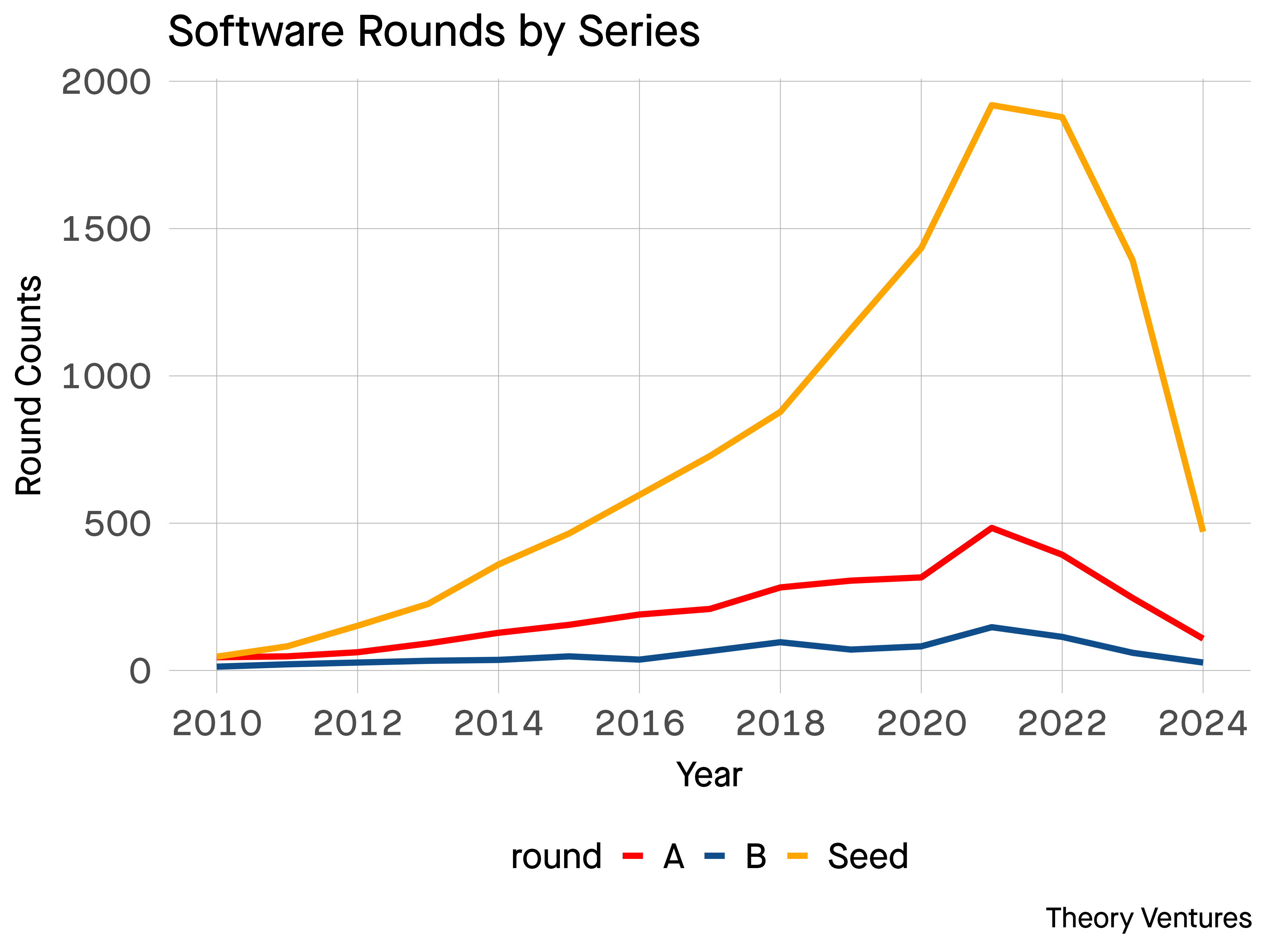
2012 was the year of the Seedpocalypse. Also called the Series A Crunch, a fear gripped Startupland : raising a Series A. Two years later, this indigestible excessive bolus of fundraising rounds hit the Series B market & Series Bs became the most challenging round to raise.

Whenever there are “too many” of fundraises of one type, the next round becomes the hardest to raise.

In 2024, the Series A Crunch has returned. Software companies that have achieved the previous era’s milestone, $1m or more in ARR, face a challenging Series A market. Why is this happening again?

Read more