Where Have All the Angels Gone?

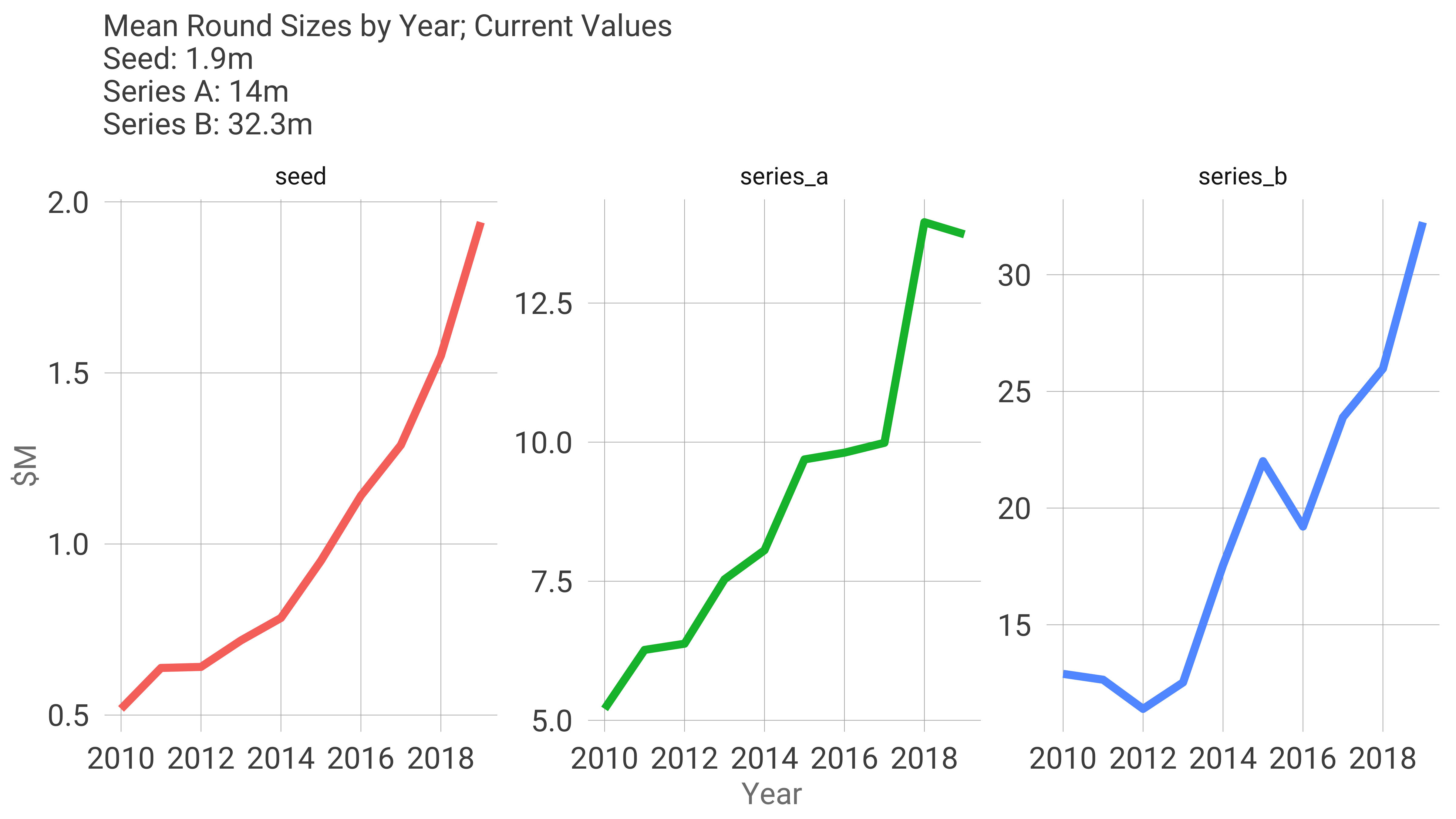
Rewind a decade. Angel investing was an important part of the Startupland ecosystem. Today, you can’t make the same argument. 2018 observed the fewest number of angel-led financing rounds since before 2010. Angels led 156 rounds last year, a figure that collapsed from 714 in 2015. In that same time period, the median angel round has fallen from $500k to $270k. And the total number of dollars invested by angels halved from a peak of $365M to $177M.

Read more

Should Your Startup Employ Both Assisted and Unassisted Trials to Acquire Customers?

A founder posed me a question earlier this week: Do you have any data/perspective on whether it’s worth keeping the unassisted free trial flow vs. providing only one path which leads to a demo and an assisted free trial? This is a complex question. Let’s break it down.

The unassisted free trial has benefits. There’s a deeper discussion in this post: Confessions of a Perpetual Freeloader.

  1. You capture the buyer at the point of maximum intent and reduces the activation energy of the sale.
  2. You broaden the universe of people who try the product. You educate the market on your product.
  3. You establish longer term relationships with customers since they can engage with the brand and product earlier on in their journey.
  4. You create barriers to entry by reducing the cost of customer acquisition and inhibit newer competitors who might disrupt using this acquisition strategy.

There are also costs.

Read more

The Free Trial Survey on the Saastr Podcast and Hitting a Blogging Milestone

Last week, the dynamic Harry Stebbings and I recorded episode 213 of the Saastr podcast, where we discussed the learnings from the free trial survey in a bit more detail. Harry’s a wonderful interviewer, and moves effortlessly from topic to topic. I made him laugh once later in the show when I told him about the last book I read. Normally, he’s the one making me laugh.

Discussing the results with Harry, the data that is the most baffling to me remains the activity scoring data. In that analysis, the data showed lead scoring was ineffective at lower price points and negatively correlated with conversion rate at higher price points.

Read more

A Lasting and Enduring Gift

When I was a teenager, I read many books about Dr. Richard Feynman. The irreverent but kind Nobel prize winner in physics became famous for his contributions to quantum mechanics. Though I’ve never understood quantum mechanics all that well, I’ve always admired Feynman, like many others.

To read Surely You’re Joking, Mr. Feynman is to hear about his upbringing in Queens, New York, where as a boy Feynman teaches himself advanced math, plays practical jokes and fixes radios during the Great Depression to help neighbors, and impresses all of them with his intellect.

Read more

AI Superpowers - A History of Chinese Startups and the Implications for the Future of Startupland

I remember the first time I visited China. We landed around 11pm local time in Beijing in the midst of the summer heat wave. As we landed, humidity fogged the Boeing’s windows, and the runway lights projected mirages from the haze. I could have sworn that heat was the product of a billion people’s fervent labor to advance their country and pull themselves into a new era.

Since that trip, when I visited RenRen, Autonavi and a few other blossoming startups, the Chinese startup ecosystem has grown tremendously. Chinese startups raise nearly half of all venture capital dollars and nearly 100 are valued at $1B.

Read more

Should Your Startup Differentiate On Pricing?

Startups are innovation machines. They identify market opportunities, develop novel products and go out to change the world. Some companies want to change the world in one dimension: a better product or a disruptive go-to-market. Others want to innovate in every dimension and re-invent every discipline from pricing to marketing to support to customer success.

Brad Birnbaum, founder and CEO of Kustomer, discussed the challenges of innovating on two dimensions simultaneously on the Saastr podcast. Kustomer’s platform is a fundamental re-architecture of customer support software. That product innovation is novel and differentiated in the market. At the outset, Brad also sought to change the pricing model.

Read more

In Defense of Troublemakers

In Defense of Troublemakers. I love the title. Who doesn’t want to be a troublemaker? Charlan Nemeth is a professor at Berkeley of Psychology. She’s studied the role of dissent in group decision-making and written this book on the topic. It’s a critical part of a functioning team.

Here’s what I learned from the book:

The minority, dissenting opinion in an argument is essential to ensure we make the best decisions.

Read more

Answering Readers' Questions about the Free Trial Survey

After publishing the survey last week, I received many questions. I’ve answered a few here. I’m happy the data has garnered so much interest and I hope it’s helping with our two goals of sharing benchmarks and sparking conversations about how to optimize trial. If you have stories or data that buttresses or contradicts any of these findings, please share them. I’d love to publish them here. Also, if you have ideas for future surveys like this, send them my way.

Read more

A Common Mistake in Hiring Plans

As you build out your startup’s financial model for 2019, a key component will be the hiring plan. You’ll need to calculate the number of managers and individual contributors to achieve your goals. But don’t forget to plan for mishires.

You will make mistakes hiring people. We all do and it’s part of the process of building a company. Someone looks great on paper but isn’t a culture fit. Another doesn’t ramp quickly enough. A third might not have the work ethic. Whatever the reason, it will happen.

Read more

1.01^365 = 37.7

Before we’d leave campus - Christmas vacation or spring break or summer vacation - our rowing coach would tell us, “You’re either getting faster or you’re getting slower. There’s no such thing as staying the same.” It was his way of inspiring us to train hard during those times. I’ve never forgotten it.

More recently I came across two math equations that confers the same idea, with a twist. The compounding effect of improving every day.

Read more