The 5 Forces Driving Startup Valuations Today

image

There are five forces driving the startup ecosystem today. They are working together to reinforce a high valuation environment. These forces are:

  1. An infusion of capital into Startupland. There are many reasons for this. The money supply in the US has doubled in the last 10 years. A low interest rate environment means a low cost of capital, which means yield is hard to find for cash.
  2. VCs raise larger funds and more frequently. Core funds, opportunity funds, supergrowth funds. Private capital has become so abundant that it supplies hundreds of millions and billions to startups. In addition to the size, venture capitalists are raising funds more frequently. Instead of every three years, many VCs are raising every two years. Greater dollars means more competition. And we all know what happens when demand exceeds supply: prices increase.
  3. Market maturity. Software models are well understood. Many of the metrics that formerly were applied only to public companies are now applied to SaaS companies. We talk about valuation as a function of new quarterly bookings or revenue multiples/ARR multiples, even at the early stages. There are standard metrics for sales, customer success in marketing efficiency that are used broadly within the industry. There are books written about the ways to build a go to market for software company. All of this means more efficient pricing of startups.
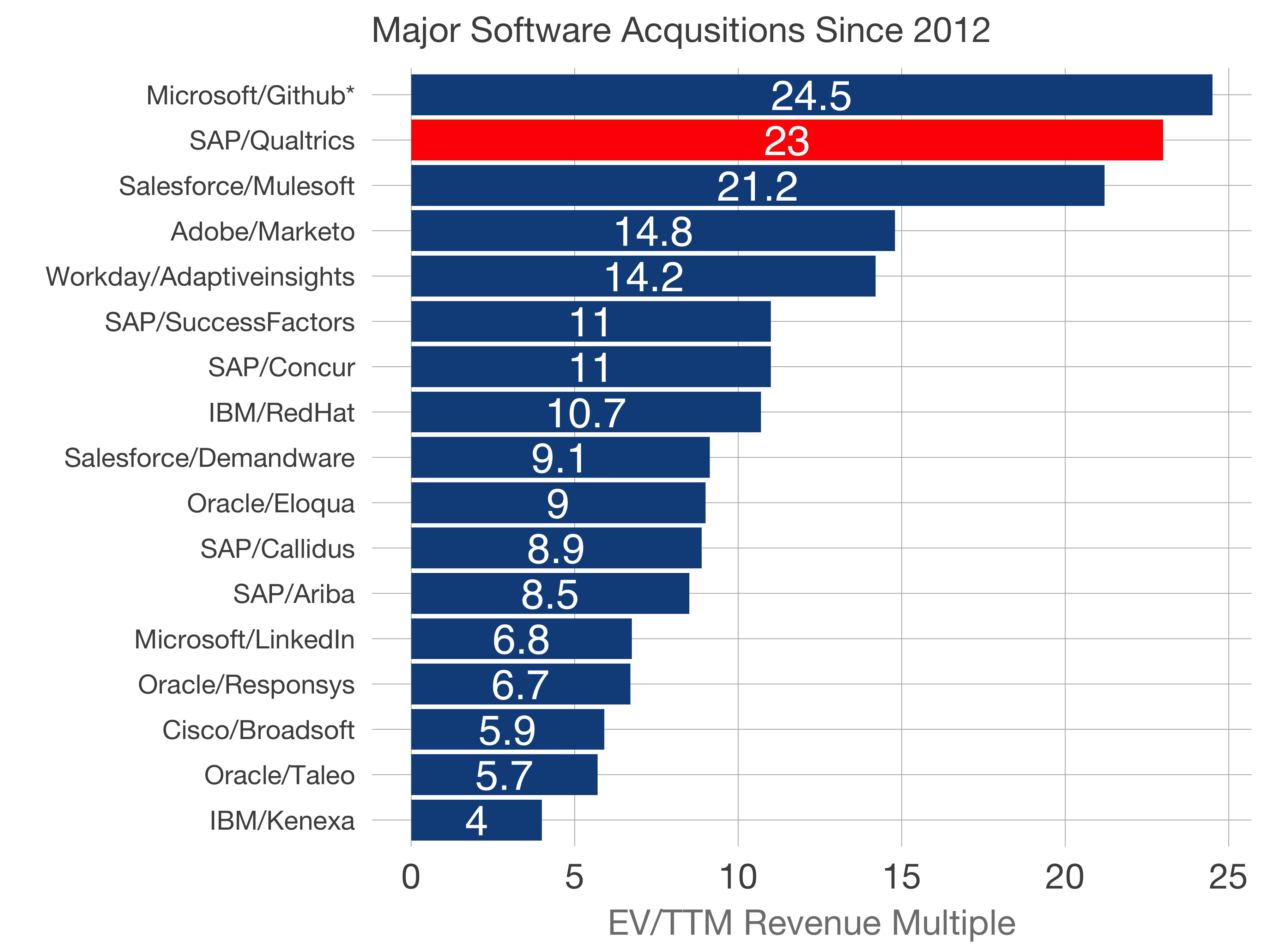
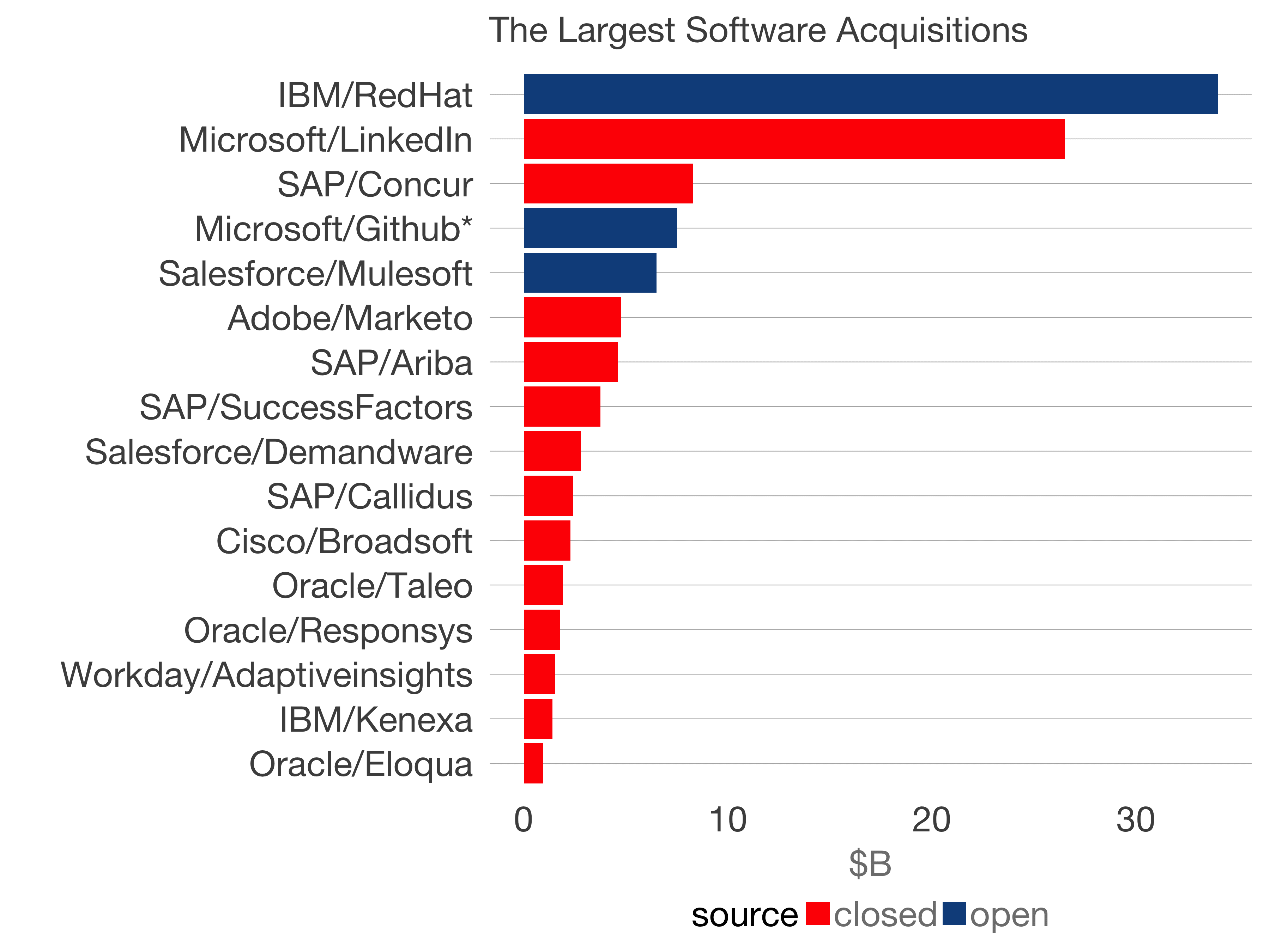
  4. Aggressive Acquisition Market and Strong Multiples in the IPO Market. SaaS forward multiples are at ten year highs. The average forward multiple is now 8.5x. This means public companies are worth more when they go public and as they are public. Acquisitions also occur at much larger multiples. The recent Github and Mulesoft acquisitions occurred at astounding multiples relative to public comparables. When startups are valued this highly in the late stage markets and the public markets, the effect is also felt in earlier rounds.
  5. Balance Sheets as Competitive Advantage. Balance sheet sizes have become a moat. In addition to technology, network effects, and expertise, a startup’s cash position is a competitive advantage. Imagine two startups in the same space with similar funding. The one that can raise a $250m round from a later stage mega-fund suddenly has a huge and difficult-to-assail advantage.

The question is whether the trade is positive, negative or neutral for founders and investors.

Read more

The Most Important Book You'll Read All Year

Imagine you came across this ad.

Scientists have discovered a revolutionary new treatment that makes you live longer. It enhances your memory and makes you more creative. It makes you look more attractive. It keeps you slim and lowers food cravings. It protects you from cancer and dementia. It wards off colds and the flu. It lowers your risk of heart attacks and stroke, not to mention diabetes. You’ll even feel happier, less depressed, and less anxious. Are you interested?

Read more

When Will the Next Wave of UI Advances Happen?

Technology innovations swing to a pendulum’s cadence. Sometimes innovations begin with infrastructure changes and reverberate up the stack. Other times, front-end engineers innovate at the application layer, which demand downstream changes in the infrastructure to scale.

The last major epoch of front end evolution has celebrated its ten year anniversary. We’re in a period of punctuated equilibrium. When will we see rapid speciation?

Web 2.0 and mobile applications built on iPhone and Android transformed the way users interacted with technology.

Read more

An Ode to the OKR - How to Motivate Greater Ambition in Teams

I remember the first time I wrote an OKR (objective and key result) at Google. “You should set your goals so that you attain 70%. That’s success,” my manager told me. “Even better if you have a moonshot goal in there, with a 5% likelihood of success.” I was uneasy with calling 70% goal achievement as success. The habits formed from 17 years of schooling and a 100 point scale run deep.

Read more

A Crypto-Trading Uber Driver and a Billionaire's Spat over Candy - On The Importance of Sticking to Your Strategy

At Redpoint’s annual investor meeting earlier this year, I quipped, “The day-trading taxi drivers of the dotcom era have been replaced by crypto-trading Uber drivers.” But over the weekend, a grizzled Uber driver with a mane of grey hair and wind-and-sunburnt cheeks asked me about crypto. “Can you explain to me why public key/private key technology is important on the Blockchain?” He pointed out the Bitcoin ATM that charges 10% from his cigarette-infused Prius. “That’s for suckers; Coinbase charges only 2%,” he said as we whizzed past.

Read more

The Challenge of Uncertainty

There’s the challenge of dealing with uncertainty, where you’re operating in the weird zone that you’re making decisions that have significant long term impact or that are difficult to reverse or course-correct in the face of great uncertainty.

Uncertainty is often unnecessary in the sense that you could, in principle, reduce the uncertainty. You could go research the question more. You could obtain more information, or run an experiment.

It’s not cosmic uncertainty, without absolute knowability. When there’s true, deep, un-mitigatable uncertainty then it’s not to hard to say, “we’re just going to choose something and make the best decision we can.”

Read more

Separating The Quality of the Outcome and the Quality of the Decision

image

“Don’t be so hard on yourself when things go badly and don’t be so proud of yourself when they go well.” I think this is one of the hardest pieces of advice to follow. Chance is an important contributor to any outcome. sometimes we just get lucky. That recent crypto trade in which you made 25% in an hour. The time you met your significant other for the first time. The hiring decision in your startup that was a wild guess, but worked out beautifully.

Read more

The Effect of Flush Private Markets on Software IPOs

image

The venture capital markets are flush with capital. We’re approaching the heady days of the dot com era. In that epoch, despite the record volumes of venture dollars, startups went public quickly, in 4-5 years. Today, that timeframe is no longer realistic. In fact, the surfeit of private dollars delay IPOs.

From 2000-2005, the “typical” IPO-bound startup listed on an exchange 5 years after founding. After the Lehman collapse and the crisis of 2008, the IPO closed, and startup age spiked to 16 years median.

Read more

Why I Overestimate My Contribution to My Team

“When I die, I want all the people with whom I worked on group projects to lower me into my grave, so they can let me down one last time.” Someone once sent me this e-card as a joke. I laughed and laughed, and never forgot it. I can’t remember a school group project which teammembers contributed equally. Paradoxically, I bet everyone in the group felt the same way.

There’s a good reason I bristled in those group projects. Every person in a team overestimates his or her contributions to the team. The bigger the team, the greater the overestimation - “especially when group members’ unequal responsibility allocations are made explicit.” Add an egocentrist, someone who takes more credit, and the social dynamics boil.

Read more

The Disappearance of the Fundraising Demo

image

Ten years ago, Guy Kawasaki took this photograph of me. I was attending my first YCombinator Demo Day, maybe three months into my time at Redpoint. Much has changed. I’m am not as young or as green. YCombinator has thrived and scaled. And the startup demo has disappeared.

At that August Demo Day, each pitch lasted eight minutes. Without fail each featured a demonstration of the product. It was the height of the Web 2.0 era. The iPhone was just a year old and mobile hadn’t blossomed yet. The web was still the center of innovation. And the demo provided founders a chance to explain these innovations. I felt like I was seeing a wisp of the future incarnated in code.

Read more