Over the next five years, US data center capacity will grow from 25 gigawatts to 70 gigawatts, part of a global buildout costing roughly $5t.1
Where will the money come from?
Data centers are built as real estate projects with some equity, but the majority debt : typically 70% or more2. Assuming we achieve our plans to build all these data centers, is there enough debt available in the credit markets to finance it?3
To understand the magnitude, I compared the $4t of new AI debt to the sizes of the world’s primary credit markets. The AI buildout represents a 34% expansion of the US corporate bond market.
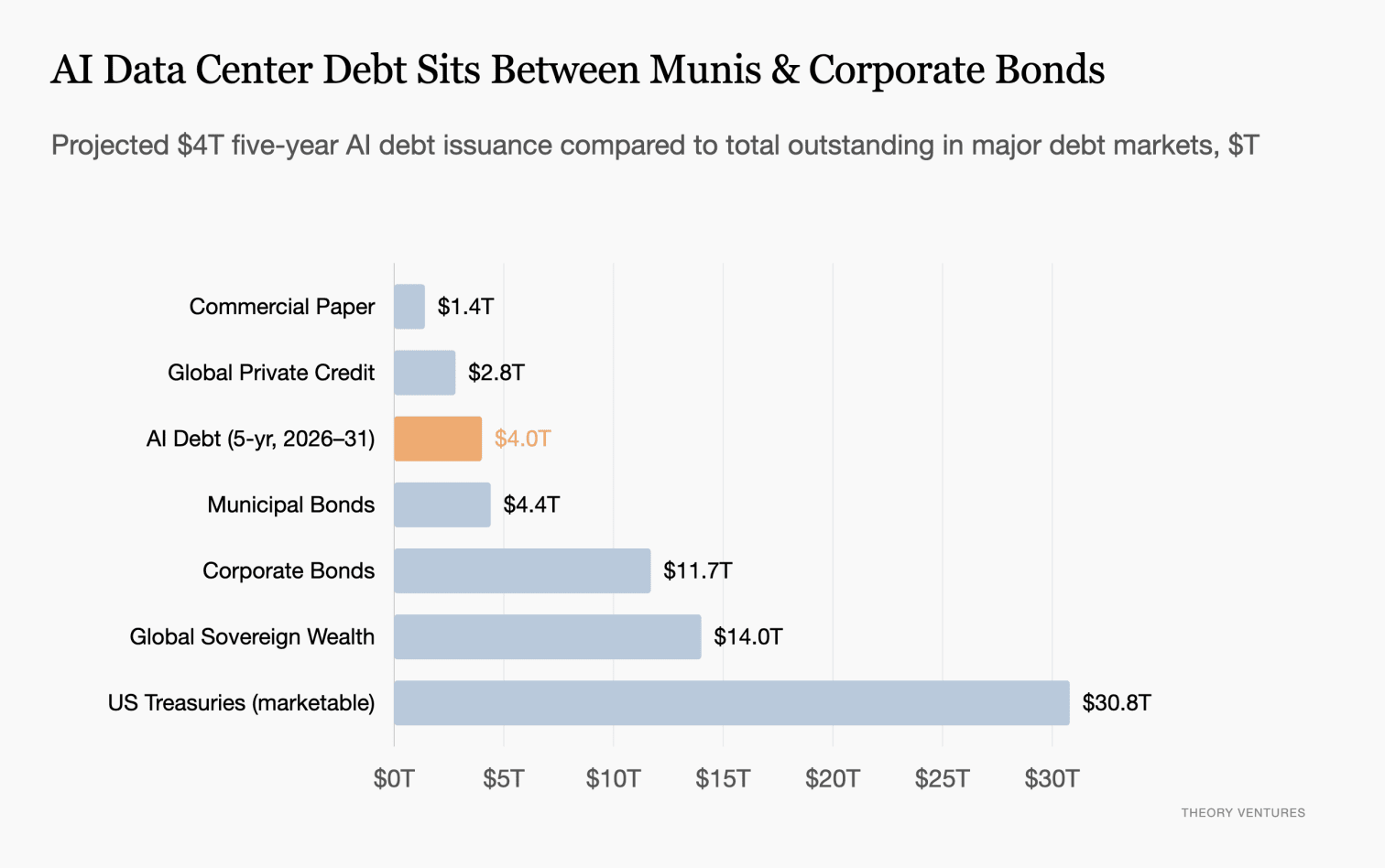
At this scale, data center debt triples the outstanding commercial paper market, grows larger than the global private credit market, & equals 91% of the US municipal bond market.4
For decades, the $4.4t municipal bond market has financed the physical buildout of American roads, bridges, water systems, & airports. It also raises the question of whether municipalities seeking economic growth will use municipal bonds to fund some of these data centers, much like power plants.5

All of this debt needs to be serviced from profits : annual AI revenue must exceed $1.2t to $1.5t by 2030 across software, tokens, & enterprise automation.6
Today, annualized AI data center revenue across all cloud providers & model labs is estimated at $100b to $200b.7
Reaching $1.35t from roughly $150b today requires a 55% compound annual growth rate (CAGR) over the next five years. By comparison, hyperscalers currently grow between 37% & 82% annually (AWS at 37%, Azure at 43%, & Google Cloud at 82%) ; but the growth is accelerating.8
For perspective, the global enterprise software market totals roughly $1.4t today, out of an estimated $9t in worldwide IT spending in 2030.9
Financing the AI infrastructure boom is no longer a venture capital or corporate earnings story. It is a macroeconomic credit event that will rival the largest debt expansions in financial history.
-
J.P. Morgan Asset Management, Western Asset, & PIMCO research estimates on data center capacity expansion & $5t in total capital expenditure through 2030. ↩︎
-
Columbia Business School real estate professor Stijn Van Nieuwerburgh & CREFC analysis on data center project finance find facility-level leverage routinely carries 65% to 75% debt (& up to 90% in synthetic joint venture SPVs like Meta’s Beignet vehicle), compared to traditional 40% corporate leverage. ↩︎
-
As a venture capitalist, I have a naive view of the bond market. ↩︎
-
Commercial paper is short-term corporate debt, typically maturing in under 270 days, that companies use to fund payroll & day-to-day operations. Corporate bonds, by contrast, are long-term debt with maturities of several years or more, used to finance capital projects. Global private credit assets under management across direct lending, mezzanine, & distressed credit strategies. ↩︎
-
Municipal bonds are debt issued by state & local governments to finance public infrastructure like roads, bridges, water systems, & airports. ↩︎
-
Servicing $4t in debt at prevailing market rates between 6.5% & 7.5% requires $260b to $300b in annual interest expense alone. At an investment-grade interest coverage ratio of 3x, the infrastructure requires roughly $800b to $900b in annual operating profit to satisfy lenders. Assuming cloud & AI gross margins of 60% to 70%, that implies $1.2t to $1.5t in annual AI revenue. ↩︎
-
Based on hyperscaler disclosures through mid-2026: Microsoft reported an AI revenue run rate surpassing $13b, AWS reported an AI & custom silicon run rate exceeding $50b, alongside rapidly scaling AI infrastructure revenue across Google Cloud, Oracle Cloud, & leading foundation model labs. ↩︎
-
https://tomtunguz.com/aws-answers-the-cloud-race/ reports current cloud growth rates: AWS at 37%, Azure at 43%, & Google Cloud at 82%. ↩︎
-
Gartner Worldwide IT Spending Forecast projects enterprise software spending reaching $1.4t in 2026, with overall worldwide IT spending compounding toward $9t in 2030. ↩︎