Yesterday, Anthropic released a new model & cut its price. Ninety minutes later, OpenAI did the same.
Most business AI use is the messy middle: multi-step workflows that need a smart enough model at a price a company can afford. It is the most important part of the market today, & it is where the competition is fiercest. The price cuts are the evidence.
In June, Anthropic set the frontier price at $10 & $50 per million tokens with Fable 5. In July, OpenAI answered with GPT-5.6 Sol at $5 & $30, matching that capability at a third of the cost per task.
The Opus line had never moved. Opus 4.5, 4, 4.8 & 5 all listed at $5 & $25 per million tokens. Yesterday’s cut was the first.

It is even more extreme at the low end. OpenAI cut Luna by 80% in July, then cut it another 50% yesterday.

More than just closed source rivalry, open models deflate prices too. The generics on the AI grocery aisle run a majority of token volume on the gateways that publish data, at an 86% discount to the blended price of closed models.
Large customers pursue even greater savings with fine tuning. Cursor’s Composer 2 fine tuned Kimi K2.5, an open-weight base, cutting its overall cost 86% against its previous in-house model. Harvey did the same, cutting cost per cell 55% against Sonnet 5 while scoring higher than Fable 5.
But the right tail of the market is thinner than almost anyone forecast. Anthropic’s Fable 5.1, its most capable & most expensive model, commanded only 3.7% of gateway spending in its first twelve days. Its predecessor peaked at 13.2% when access was restored in July, then fell to 4.9% a month later when Opus 5 shipped at half the price. Among large corporate accounts, frontier models fell from 53% of token consumption in early August to 45% by September.
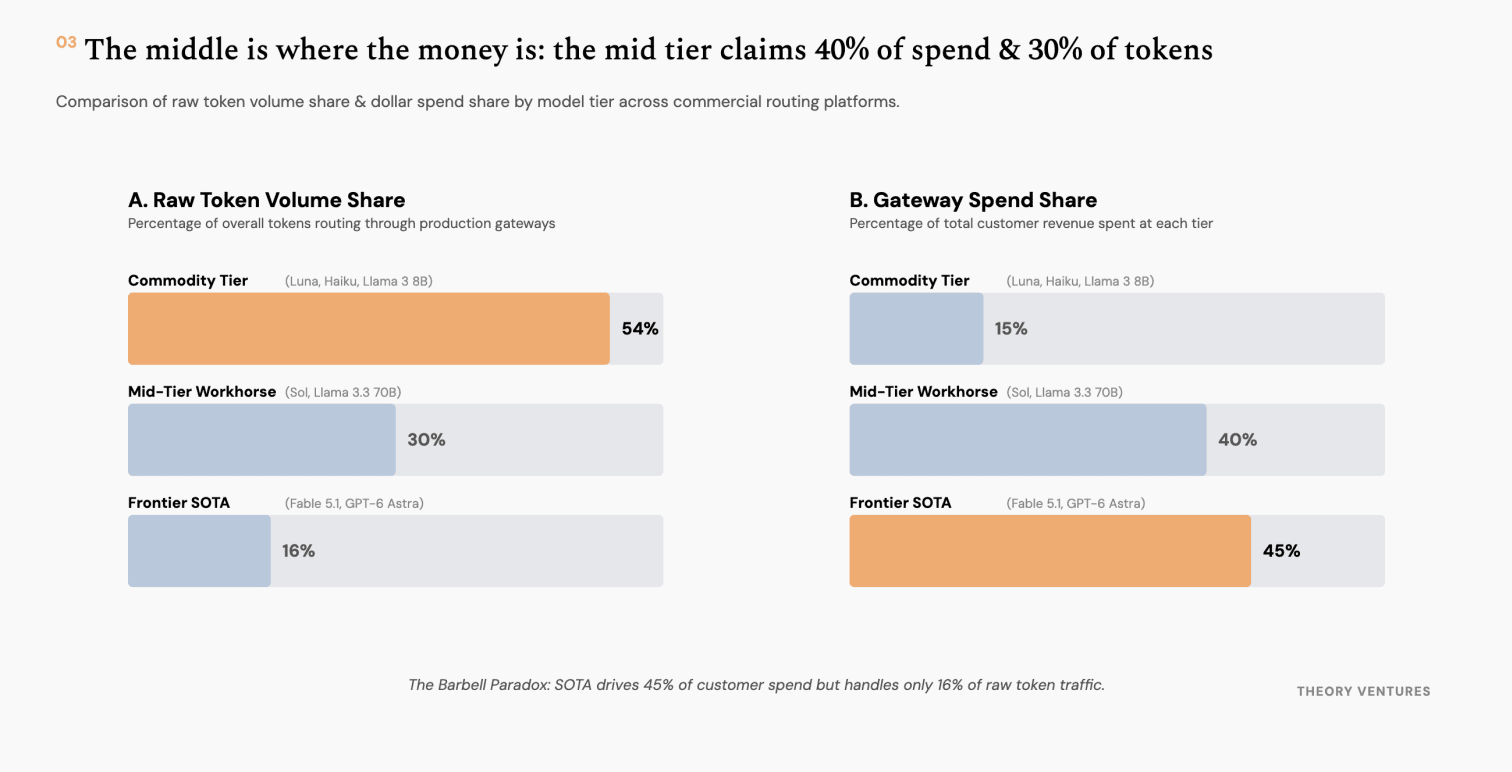
Demand for intelligence is not a pyramid with a small, wealthy peak paying for everything beneath it. It is a normal distribution with a fat middle. The middle buys intelligence per dollar.
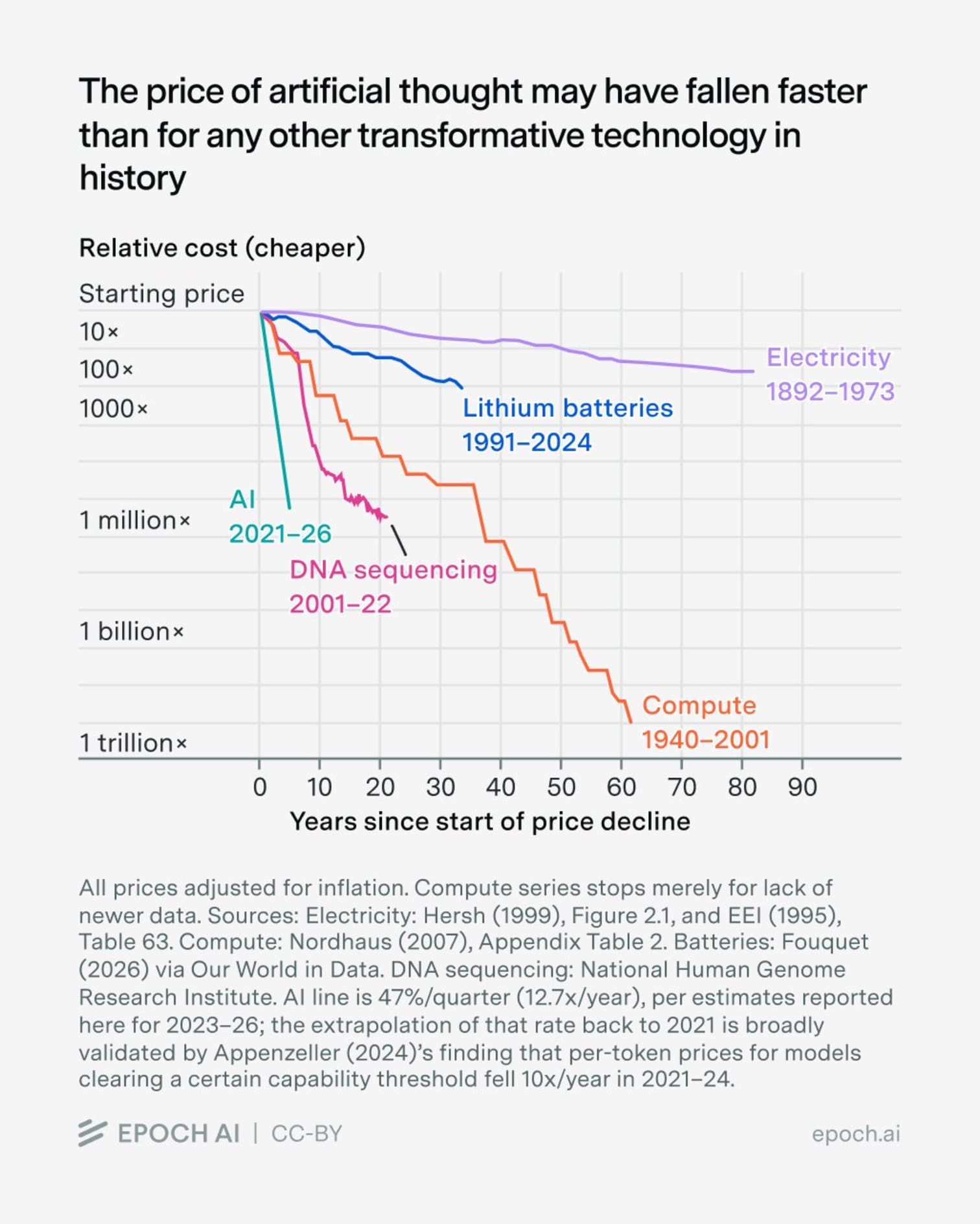
Intelligence costs keep plummeting. What enterprises demand from AI does not change nearly as fast. So the tier that satisfies a fixed requirement keeps getting cheaper.
As intelligence per dollar explodes, the distribution of tokens may shift to commodity. Whether that happens will determine the economics of the AI market.