OpenAI & Anthropic each hold roughly 90% market share of an AI segment, but those segments are different : Anthropic holds dominant share at the premium end (94%), & OpenAI at the low end (81%).1
Across 10,000+ enterprises, that split raises a business question : is this a deliberate pricing strategy to capture different ends of the market, or a structural cost difference in how the two labs serve tokens?
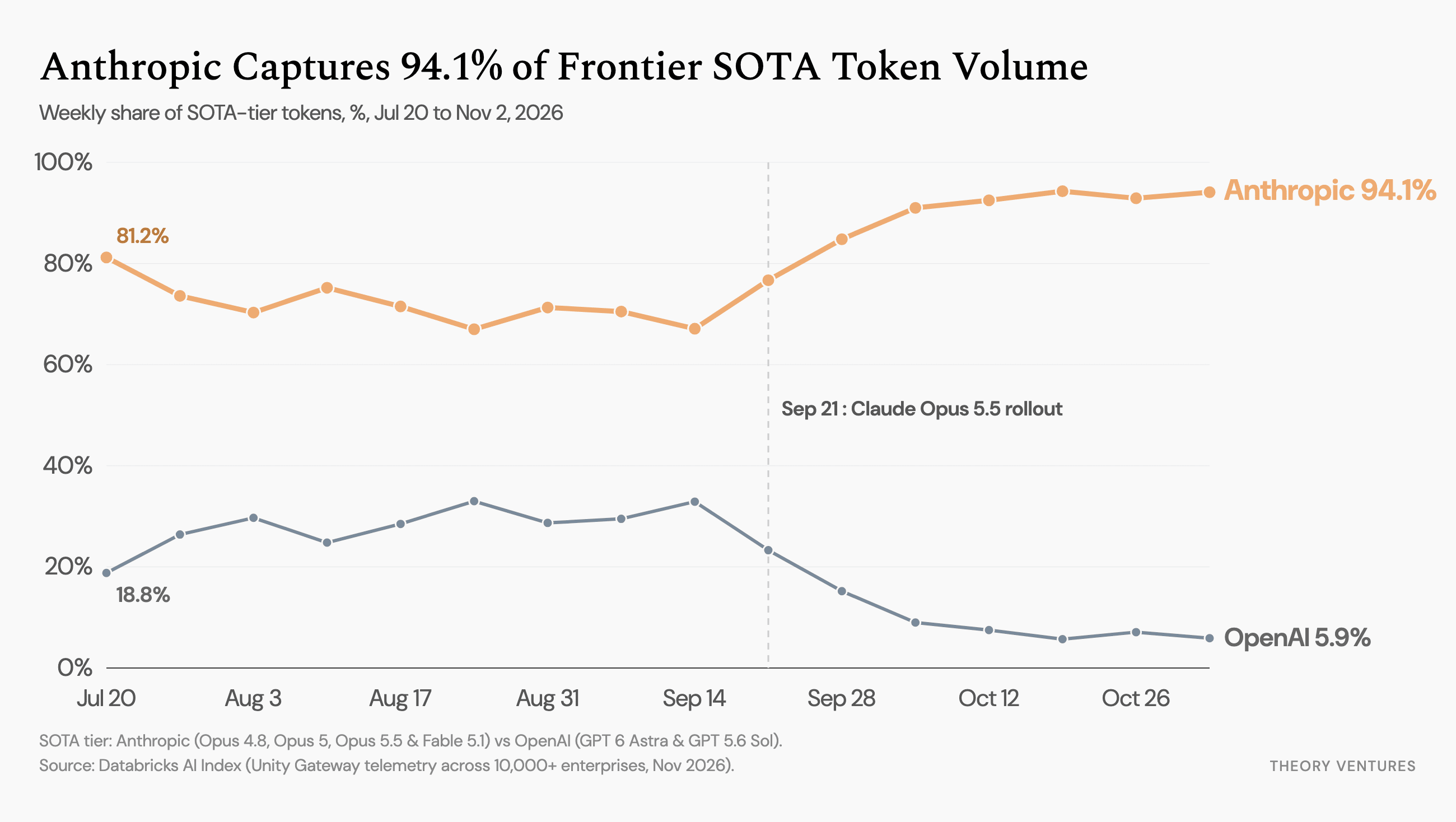
Anthropic sells a premium product & dominates the SOTA (state-of-the-art) tier. Anthropic’s share of SOTA token volume rose from 81% in July to 94% on November 2, propelled by the September 21 rollout of Claude Opus 5.5.1,2,3
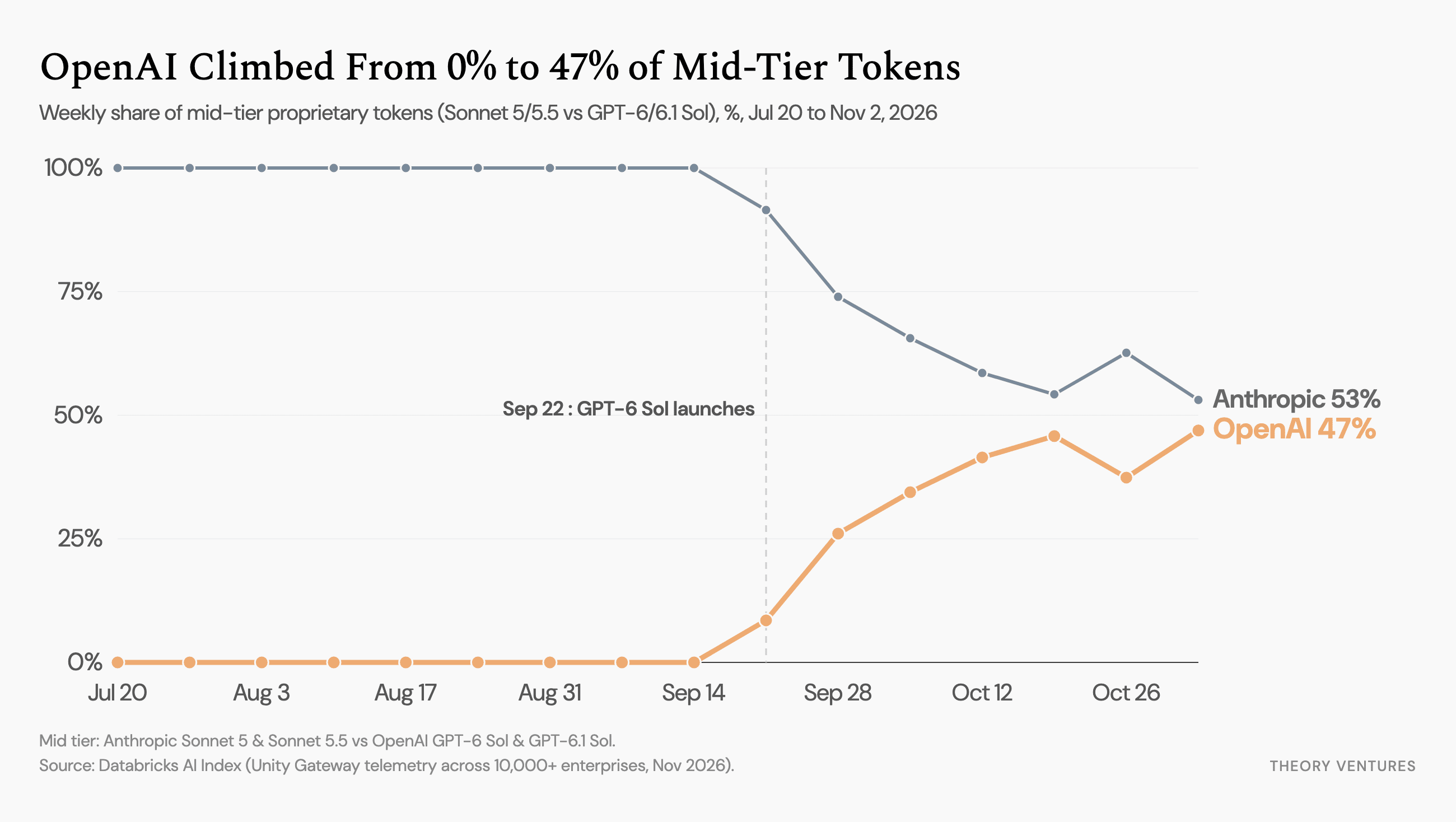
The mid tier is where the two labs now collide directly. Across all Sonnet & Sol versions (Sonnet 5 & 5.5 vs GPT-6 Sol & 6.1 Sol), OpenAI climbed from 0% in July to 47% of mid-tier volume by November 2, & took 57% of the newest Sonnet 5.5 vs Sol 6/6.1 cohort within six weeks of launch.1,4
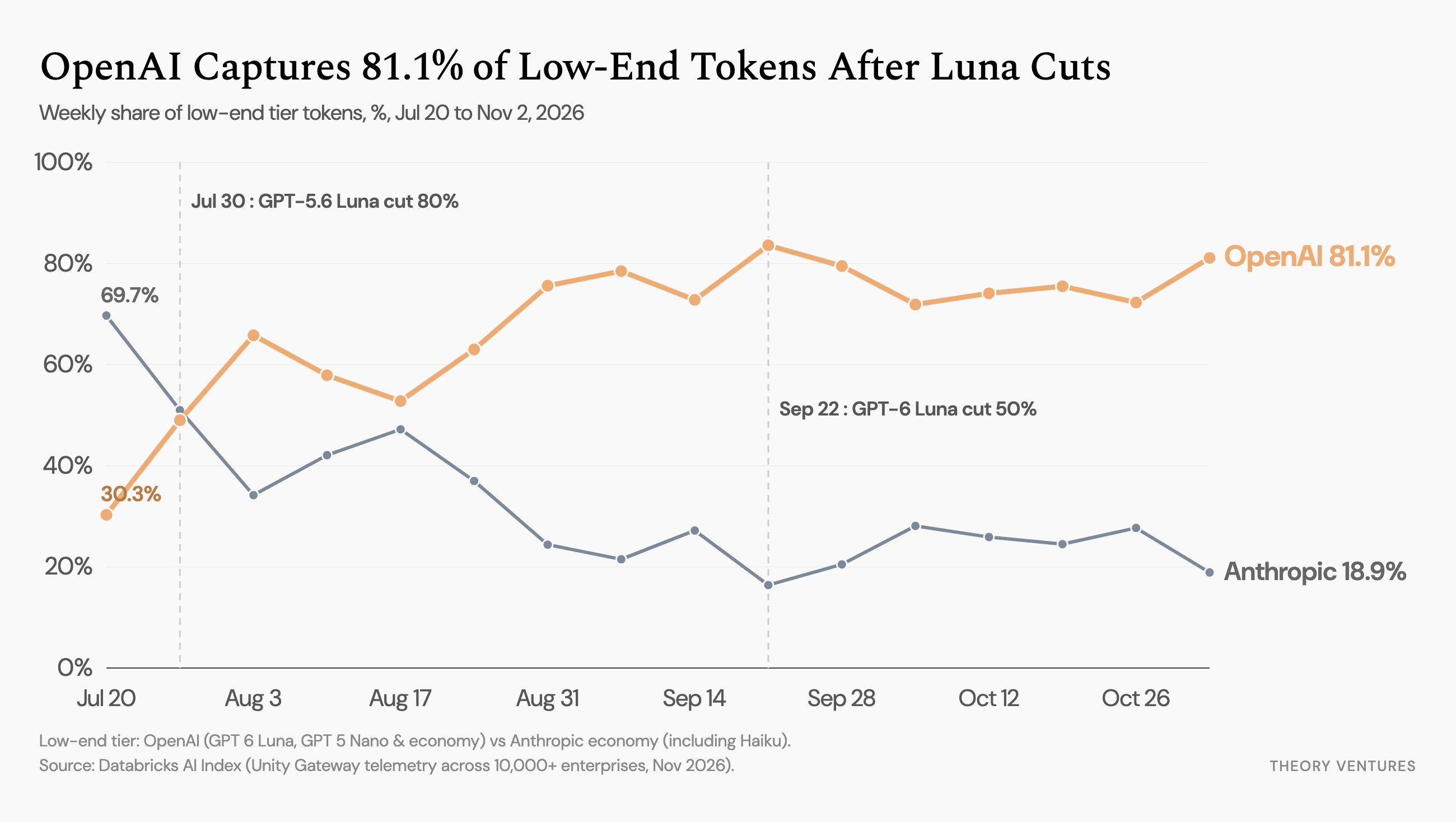
OpenAI pursued the opposite strategy, using aggressive price cuts on Luna to capture the high-volume floor. On July 30, OpenAI cut Luna pricing by 80% & then another 50% just a few months later, for a 90% total reduction.5,6
On September 22, OpenAI launched GPT-6 Luna at $0.10 per 1m tokens.6 Its low-end share surged from 30% to 66% after the first cut, peaked at 84%, & finished at 81% on November 2.1,7
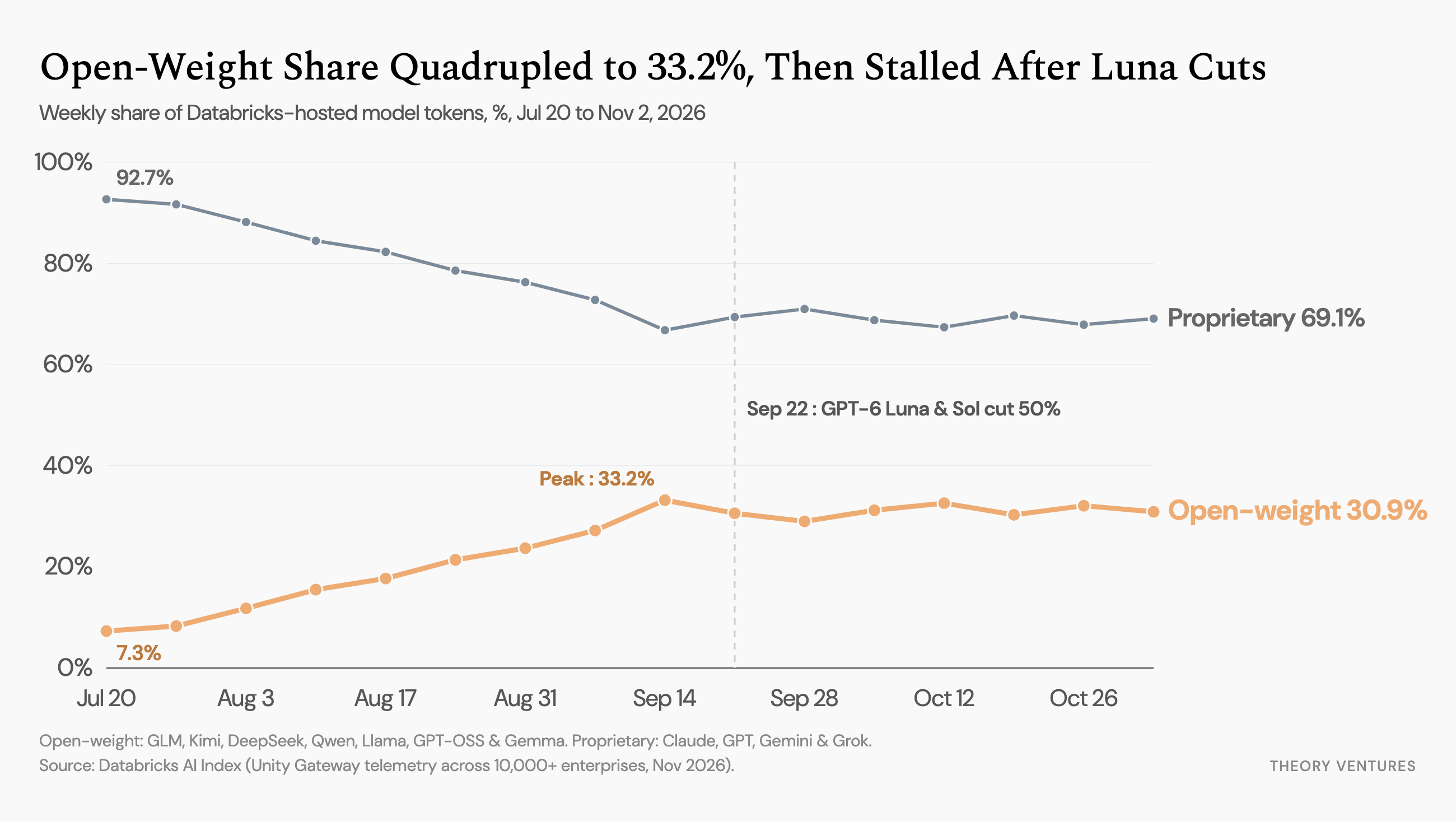
Open-weight token share climbed every week from 7% in July to 33% in September, then stalled at 31% in the same week GPT-6 Luna & Sol cut prices by 50%.1,8
That raises the strategic question in foundation models today : is Luna’s pricing a short-term market-share subsidy, or a structural cost advantage in OpenAI’s model architecture?
-
Databricks, Databricks AI Index & Introducing the Databricks AI Index : The state of enterprise AI tokenomics, published November 16, 2026 (weekly share series through November 2, 2026 ; coding benchmark updated November 10, 2026). Unity Gateway reflects Databricks’ enterprise customer base (data-platform & agentic-coding workloads) rather than the entire enterprise AI market. ↩︎ ↩︎ ↩︎ ↩︎ ↩︎
-
SOTA-tier share sums Anthropic’s frontier models (Opus 4.8, Opus 5, Opus 5.5 & Fable 5.1, reaching 39.8% of total proprietary tokens on November 2) against OpenAI’s frontier models (GPT 6 Astra & GPT 5.6 Sol, 2.5% of total proprietary tokens on November 2). ↩︎
-
Blended token prices throughout this post assume a 200:1 input-to-output token ratio :
(200 x input + output) / 201per 1m tokens. ↩︎ -
Mid tier compares Anthropic Sonnet 5.5 against OpenAI GPT-6 Sol & GPT-6.1 Sol. Databricks does not report Claude Haiku separately in its token-share series (it sits inside Older Anthropic Models), so budget-tier comparisons rest on list prices & benchmark cost per task rather than token share. Standard API list prices per 1m tokens as of November 2026 : OpenAI API Pricing, Anthropic Claude Sonnet 5.5 ($2.00 / $10.00 / $0.10 cached) & Claude Haiku 5.5 ($0.10 / $0.50 / $0.01 cached up to 100k prompt tokens ; $0.50 / $2.50 above 100k), Zhipu GLM 5.3 Flash ($0.15 / $0.50 / $0.03 cached), & DeepSeek V4.1 Flash ($0.15 / $0.60 off-peak ; $0.30 / $1.20 standard ; $0.003–$0.006 cached). ↩︎
-
OpenAI, Advancing the price-performance frontier with GPT-5.6, published July 30, 2026 : GPT-5.6 Luna cut 80% from $1.00 / $6.00 to $0.20 / $1.20 per 1m input & output tokens ; serving cost reduced 20% via GPU kernel improvements & token generation efficiency increased more than 15% via speculative decoding. ↩︎
-
OpenAI, Introducing GPT-6 Sol & Luna, originally published September 22, 2026 (updated September 29, 2026) : GPT-6 Luna priced permanently at $0.10 / $0.50 per 1m input & output tokens ($0.01 cached input), 50% below GPT-5.6 promotional pricing. ↩︎ ↩︎
-
Low-end tier share compares OpenAI’s economy models (GPT 6 Luna, GPT 5 Nano & Older OpenAI Models, 19.3% of total proprietary tokens on November 2) against Anthropic’s economy bucket (Older Anthropic Models including Haiku, 4.5% of total proprietary tokens on November 2). Including mid-tier workhorses (GPT 6.1 Sol & GPT 6 Sol vs Sonnet 5.5 & Sonnet 5), OpenAI’s non-SOTA share rose from 13.6% on July 20 to 61.4% on November 2. ↩︎
-
Databricks, The Enterprise Case for Open-Weight Models on Databricks, published November 4, 2026. ↩︎