I used to think AI productivity meant doing less. Automate the mechanical work, & human effort shrinks toward zero.
The reality is stranger. AI does not shrink human effort. It raises the ceiling of what the same amount of work produces.

My writing workflow is an interactive loop with an agent. I seed it with an idea, data, or transcript. It drafts the essay in seconds, & then we work through line by line. I never touch the raw text directly ; I issue verbal & written instructions to the model, reviewing diffs, challenging phrases, & refining rhythm until the argument lands. Each night, the system updates my style guidelines, building a personalized Strunk & White.
I thought this workflow would decrease the time to ship a post. But it didn’t. Line-level sentence edits remain constant around a median of 136 per piece.
AI doesn’t reduce editing. Does it increase quality?
To test whether this workflow actually produced better writing, I built a scoring rubric & had an AI panel evaluate fifteen random published posts per year from 2021 to 2026 on a 1–5 scale.
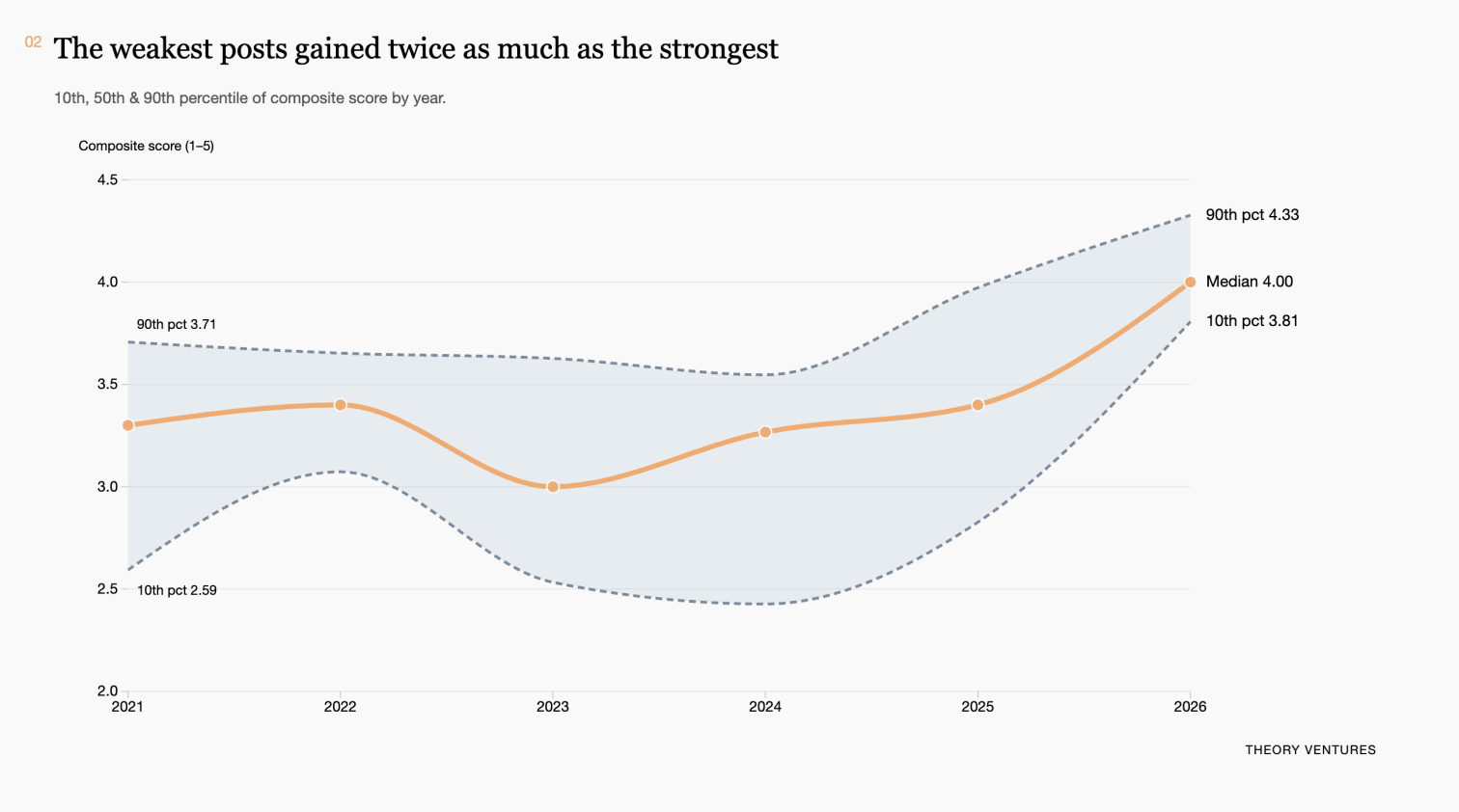
The result is a rising quality floor. Across five years of writing, the composite quality score of published posts expanded across every tier, but the bottom moved fastest. The 10th percentile surged from 2.59 to 3.81, gaining nearly twice as much as the 90th percentile. Automating structural triage does not just save time ; it prevents bad drafts from reaching the reader.
In Words Like Loaded Pistols, Sam Leith writes that words are not passive containers for information. They are loaded mechanisms aimed at a reader’s mind.1 Rhetoric is the hidden machinery that makes an argument land.
Efficiency in knowledge work does not increase our hours. It concentrates our craft.
-
Sam Leith, Words Like Loaded Pistols: Rhetoric from Aristotle to Obama (Basic Books, 2012). ↩︎