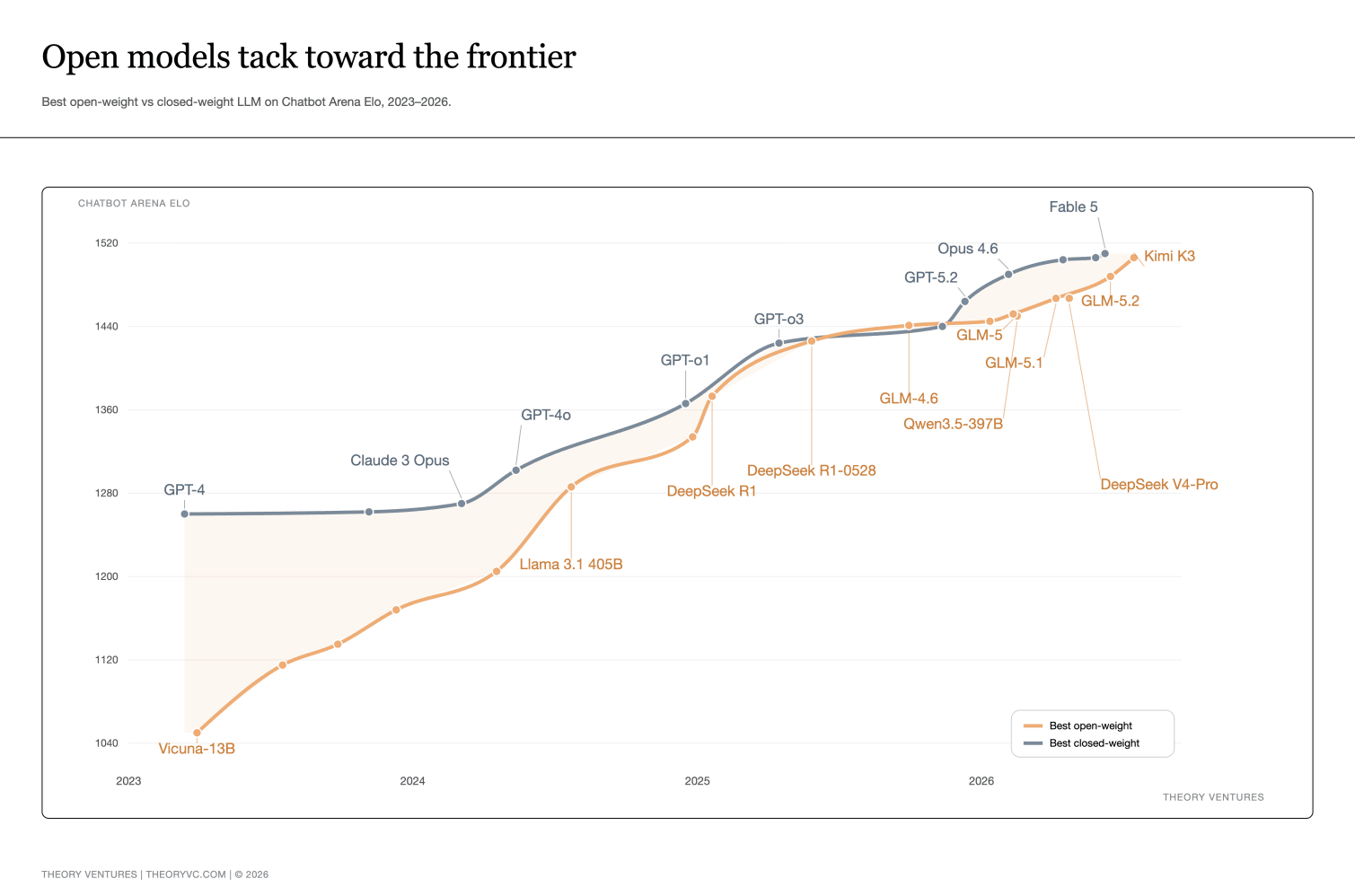
Like two sailboats in a marathon race, open & closed AI labs are tacking & jibing in San Francisco Bay.
In 2023, closed source models led by an enormous margin on Chatbot Arena Elo1. Two years later, the DeepSeek R1 moment arrived, the open-source answer to the ChatGPT moment. The two boats raced side-by-side for nearly a year.
Architectural improvements & the first Blackwell-trained models brought a step change with GPT-5.2 & Fable 5 starting in 2026.
The next few weeks will see another flurry of open-source releases. Moonshot shipped Kimi K3, a 2.8T parameter open-weight model, on July 16. Alibaba previewed Qwen 3.8, a 2.4T model, on July 19. DeepSeek V4 graduates from preview in mid-July. These follow Thinking Machines’ Inkling, a 975B Apache-2.0 multimodal model released July 15, & Meta Superintelligence Labs’ Muse Spark in April.
Open-source models have never taken an open-water lead, but that may not be necessary. Blend prices at a 90/10 input-to-output ratio & the median open-weight frontier model runs about 15% cheaper than GPT-5.2. The cheapest open model, DeepSeek V4 Flash, is roughly 90% cheaper.
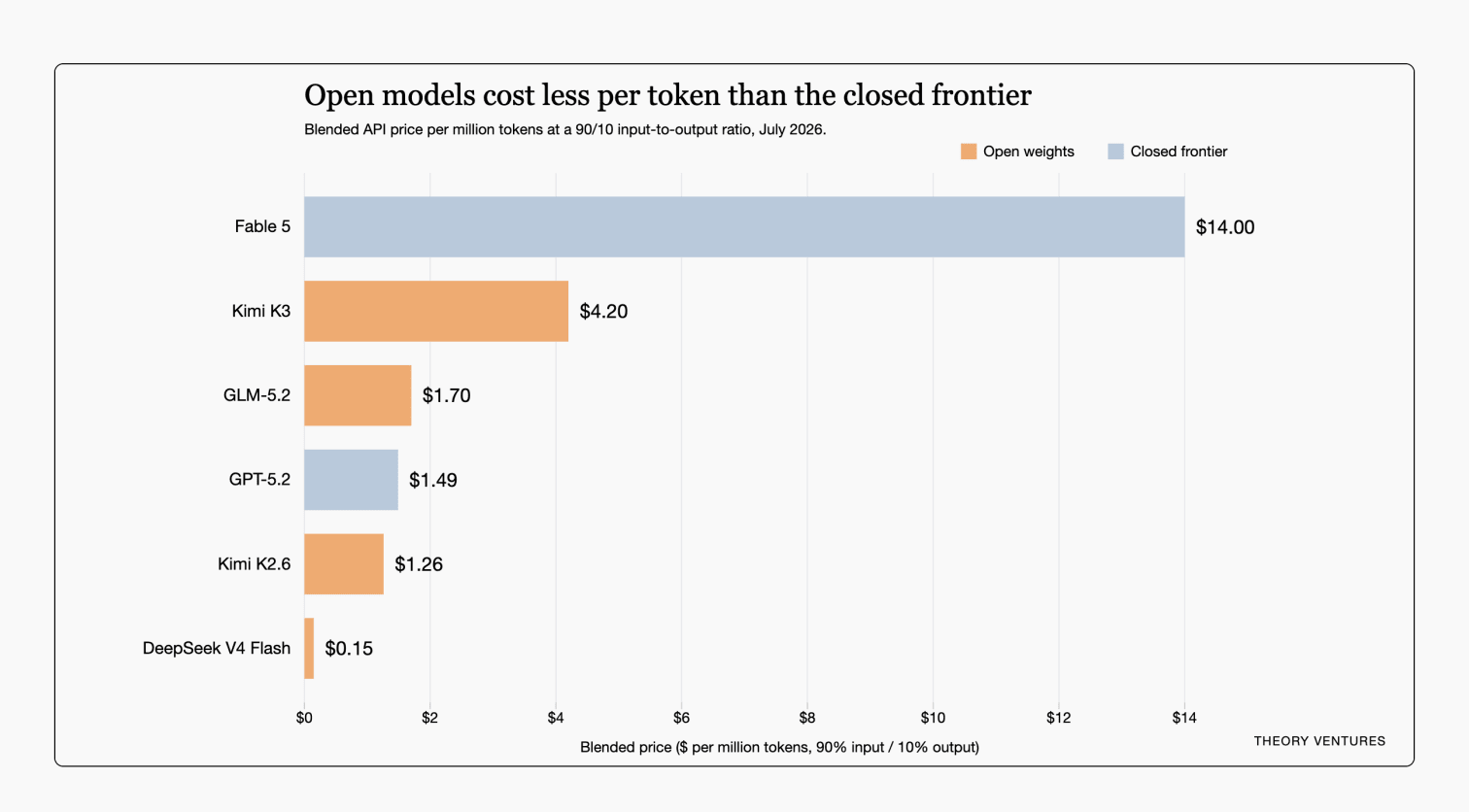
We may have a dynamic where the closed models drive the industry forward & open-source rapidly copies to commoditize. Will that slow down innovation?
Competition tends to do the opposite. OpenAI has cut inference costs by 50%. Kimi shipped a new attention architecture, KDA. Fable’s step function has an entire industry redoubling to catch up.
The major question put to the industry is what will happen to margins. Anthropic is about to post its first profitable quarter. Bezos said your margin is my opportunity. Open source’s competitive dynamics keep margins & pricing competitive.
The AI wave will be among the largest infrastructure projects2 ever for the US & likely one of the greatest contributors to faster economic growth. Competition is essential to keeping the race fast.
The frontier is no longer a one-way race. It is a repeating cycle: closed models pull ahead, open models catch up, & the whole market moves faster.
-
Chatbot Arena Elo is a rating system borrowed from chess. Users see responses from two anonymous models side-by-side & vote for the better one. Each model starts at 1000. Winning against a stronger model earns more points than winning against a weaker one; the gap in ratings predicts the probability of winning a matchup. A 100-point Elo gap implies the higher-rated model wins about 64% of the time. The score reflects human preference on open-ended chat, not reasoning, coding, or agentic benchmarks. ↩︎
-
See The GDP Impact of LLMs for the scale estimate & the growth channel it flows through. ↩︎