The Three Frameworks You Need to Create Powerful Presentations and Tell Compelling Stories

I remember many the great TED talks I’ve watched. Sir Ken Robinson’s ,“How Schools Kill Creativity” and the story of a little girl whose genius was unrecognized in school until she was allow do dance, and ultimately became a prima-ballerina, is simply unforgettable. In most of my meetings, I remember Amy Cuddy’s “Body Language” talk for a split-second. Commanding her body language changed her career. And who can forget Steve Jobs announcement of the iPhone?

Read more

Benchmarking Tableau's S-1 - How 7 Key SaaS Metrics Stack Up

This post is part of a continuing series evaluating the S-1s of publicly traded SaaS companies in order to better understand the core business and build a library of benchmarks that might be useful to founders.

All of the businesses we’ve looked at in the past have been purely SaaS businesses. Today, we’ll examine Tableau, the market leader for data visualization software. Tableau sells software the old-fashioned way, with perpetual licenses not subscriptions. Customers pay a fee for the software up-front, in addition to an annual maintenance fee of about 20-25%. To offset the mostly one-time payment from customers, Tableau employs a land-and-expand strategy. The company went public in 2013 and we’ll use data from their S-1 through 2013 to benchmark the business.

Read more

What You’re Making Is In A Perpetual State Of Almost Right Up Until The End

Jason Fried, co-founder of 37Signals and Basecamp, published a blog post today called Faith in Eventually that captures the emotional tensions of building a product:

During the development of most any product, there are always times when things aren’t quite right. Times when you feel like you may be going backwards a bit. Times where it’s almost there, but you can’t yet figure out why it isn’t. Times when you hate the thing today that you loved yesterday. Times when what you had in your head isn’t quite what you’re seeing in front of you. Yet. That’s when you need to have faith.

Read more

Startup Best Practices 8 -Getting the Most from Your Team By Preventing Burnout

image

Startups are intense experiences. Driven by a burning passion to change some aspect of the world, startup teams push, push, push to grow as fast as possible. Without the right balance, though, teams burn out - a terrible outcome. One of the most important responsibilities of every startup’s management team is to shepherd their teams to maximize their performance and prevent burnout. But how?

Read more

Benchmarking Veeva's S-1 - How 7 Key SaaS Metrics Stack Up

This post is part of a continuing series evaluating the S-1s of publicly traded SaaS companies in order to better understand the core business and build a library of benchmarks that might be useful to founders.

In the two most recent analyses, we’ve explored the S-1s of Hubspot and Zendesk, two of the public SaaS companies with the smallest Average Revenue per Customer. Today, we’ll look at Veeva, masters of the massive enterprise sale, and one of the most remarkable SaaS businesses.

Read more

The Innovations Free Compute and Storage Unleash

image

What will the world look like when cloud compute and storage are free?

Cloud computing prices are hurtling to zero. The chart above shows the logarithmic decline of the cost of a transistor cycle by 11 orders of magnitude (11 decimal places) over the past 40 years. AWS has decreased prices for EC2, elastic compute cloud, and S3, simple storage service, 42 times in eight years.

Read more

A Collection of Uncommon Points of View on Startups

I wish I had been in Stanford’s CS183 class in 2012, the year Peter Thiel taught it. A student of the class, Blake Masters, copied all the class notes and I read every post, like thousands of other visitors to the site. In a few days, Thiel and Masters will release a book version of these notes called Zero to One: Notes on Startups or How to Build the Future.

I was given a copy at TechCrunch Disrupt. Over the past day or so, I’ve read it in its entirety. Every person curious about or in the world of startups should read it, because it contains so much original thought.

Read more

The Optimal Price to Maximize Sales Efficiency for a SaaS Startup

image

Is there an optimal price for a product to maximize a SaaS startup’s sales efficiency? As I’ve been analyzing the S-1s of publicly traded SaaS companies, most recently of HubSpot and Zendesk, I’ve been asking myself that question. Do million-dollar enterprise price points and field sales people create more efficient sales organizations than content-marketing-driven SMB startups? Or are the high-velocity inside sales teams of the pursuing the mid-market, the most efficient?

Read more

Benchmarking Zendesk's S-1 - How 7 Key SaaS Metrics Stack Up

This post is part of a continuing series evaluating the S-1s of publicly traded SaaS companies in order to better understand the core business and build a library of benchmarks that might be useful to founders.

Zendesk is a 700 person company that builds customer support software. Zendesk went public earlier this year. It’s a remarkable business primarily because the founders and the team have built an incredibly efficient customer acquisition funnel. It’s important to note that Redpoint is an investor in and shareholder of the company.

Read more

The Best Way to Benchmark a SaaS Startup

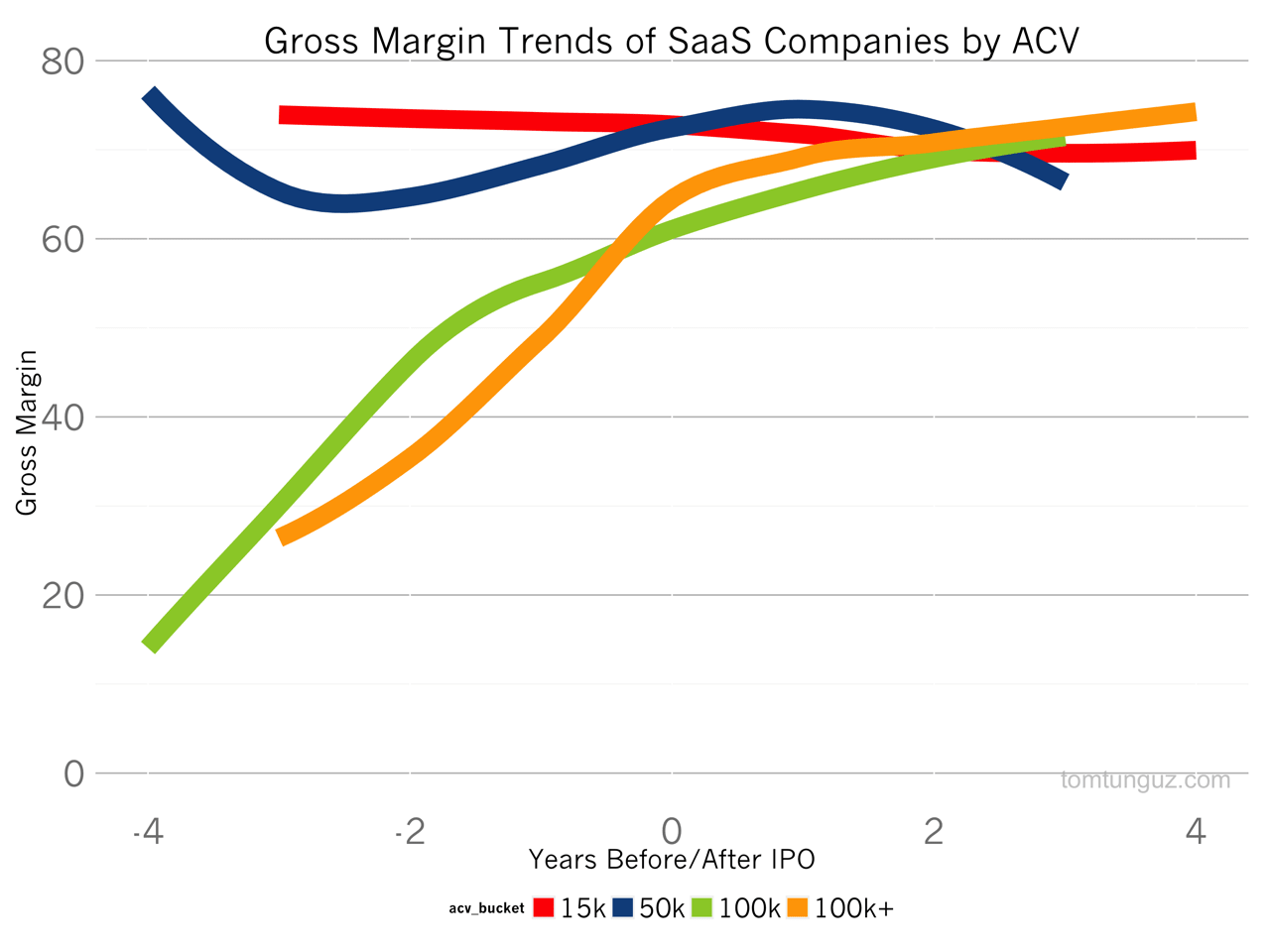
Following this week’s post Benchmarking HubSpot’s S-1, Josh and Nikos raised an interesting question on Twitter. What are the right ways to benchmark SaaS companies from their early days through IPO? I have always used years-since-founding as the time axis to compare companies, because if I were a founder, that’s how I might think about benchmarks. But after their comments I wondered if there were better ones.

Some potential alternatives are:

  1. Using time before/since-IPO for the time axis.
  2. Grouping companies by ACV to compare growth rates
  3. Grouping companies by Revenue at IPO to compare growth rates

First, let’s compare using years-since-founding to years before/after-IPO. Below I’ve plotted revenue growth for each of these two timelines.

Read more