Lessons from Interviews of Pre-Eminent VCs in 2000

In 2008, when I started working at Redpoint I knew very little about how the venture business worked, and before I started at the firm, I wanted to prepare by learning as much as I could about the industry. Unfortunately, not much was written about venture capital at the time.

In fact, I found only two books: a textbook on private equity and venture capital by HBS professor Joshua Lerner, and an out-of-print collection of 32 VC interviews called “Done Deals,” published in September 2000. I bought a second-hand copy on Amazon and read it cover to cover.

Read more

Data is Useless Unless You Can Act on It

I see a recurring three step pattern with data waves:

First data collected.
Then it’s presented.
Last it is made actionable.

In every data wave, the companies that transform data into actionable insights are the most valuable because their products not only identify but solve problems. Knowing about an issue without understanding the mechanics required to fix it causes paralysis.

Quantified self tools like FitBit and JawboneUp and Nike Fuel capture and display sleep data and while these devices confirm that I wake at 130am every night, they can’t help me sleep through the night. This user experience induces neurosis. The same is true for the pedometer function - I can measure the steps I walk but not how much healthier I become (how much longer I’ll live date: 2013-01-24 ---

![image](https://res.cloudinary.com/dzawgnnlr/image/upload/q_auto/f_auto/w_auto/image_163_528992076" width="500px">

Read more

How to Maximize Your Organic Twitter Content Marketing Efforts

image

Last week, Twitter released a feature enabling users to download organic tweet data. Naturally, I put my data through its paces to see if I could find any best practices for this blog. Below are the conclusions, which are tested to 95% confidence. I’ve also linked below to the code for recreating this analysis for your audience.

  1. Engagement rate, defined by Twitter as clicks, highlights, and favorites of a tweet is relatively constant throughout the day.
  2. But impressions, the total number of views of a particular Tweet, spike right at the beginning of the workday, from 8-11 and then at the end of the workday, from 3-5.
  3. Not surprisingly, retweets, which drive impressions and reach, are most common from 8-10 and from 4-5.
  4. Readers are most likely to click on an embedded link in the morning. 6am just as successful as 8-10am.
  5. Amazingly, Twitter user behavior, at least for my content, has no statistically significant difference by day of week.
  6. The length of the tweet has no impact on engagement.
  7. The average tweet reaches at best 19% of my followers, implying tweet recirculation is important.

In summary, the best time for me to tweet is between 8-10 am every day and then from 3-5pm. I’m going to change my Buffer schedule to reflect this data. I’m also going to recirculate Tweets more aggressively.

Read more

One of the Greatest Opportunities to Learn

Listening is hard, as my friend once said, because you run the risk of having to change the way you see the world.

That line stopped me cold when I was reading In the Light of What We Know because it’s so true. To set aside the way we’ve thought about an idea in the past and consider it as if it were a totally new concept is what a Buddhist might call Beginner’s Mind. It means taking the time to reflect and consider new perspectives. Consequently, listening is one of the greatest opportunities to learn.

Read more

Trends in the Startup Acquisition Market

image

See an updated version of this post: Trends in the Startup Acquisition Market in 2015

The venture-backed startup IPO market has remained strong over the past five quarters, with 20 or more IPOs in each of those quarters. I was curious how the strength of the IPO market has impacted the acquisition market. In particular, how the number and value of startup acquisitions has changed, and more specifically, whether there are any trends in the sizes of acquisitions.

Read more

How Vibrant is the Hardware Startup World?

“x”

It would seem hardware startups are booming. First, the amazing success of the GoPro business and IPO, which set a 23-year high-water mark for a consumer hardware company. Second, there seems to be a growing number of hardware startups bubbling in incubators like Lemnos Labs and Highway1. Third, Kickstarter and other crowdfunding sites have enabled hardware startups to mitigate one of the biggest risks in starting out: obtaining a reliable proxy for consumer demand. But do the data support the idea that the hardware ecosystem is as vibrant as it seems?

Read more

An Exceptional Story with Exceptional Data

Benjamin Morris, a writer for arguably the best computational journalism publication, fivethirtyeight, published “Lionel Messi is Impossible” which describes in words, statistics and charts why Lionel Messi is one of the greatest players in the world. Even if you’re not a soccer/football fan, the article is worth reading because it’s one of the finest examples of synthesizing data and a story to convey a point I’ve read in a very long time.

Read more

The Importance of Hometown Investors for Startups

image

I was eight years old and running with a dime in my hand
Into the bus stop to pick up a paper for my old man
I’d sit on his lap in that big old Buick and steer as we drove through town
He’d tousle my hair and say son take a good look around. This is your hometown

Read more

The Marketing Math Behind Scaling a SaaS Salesforce

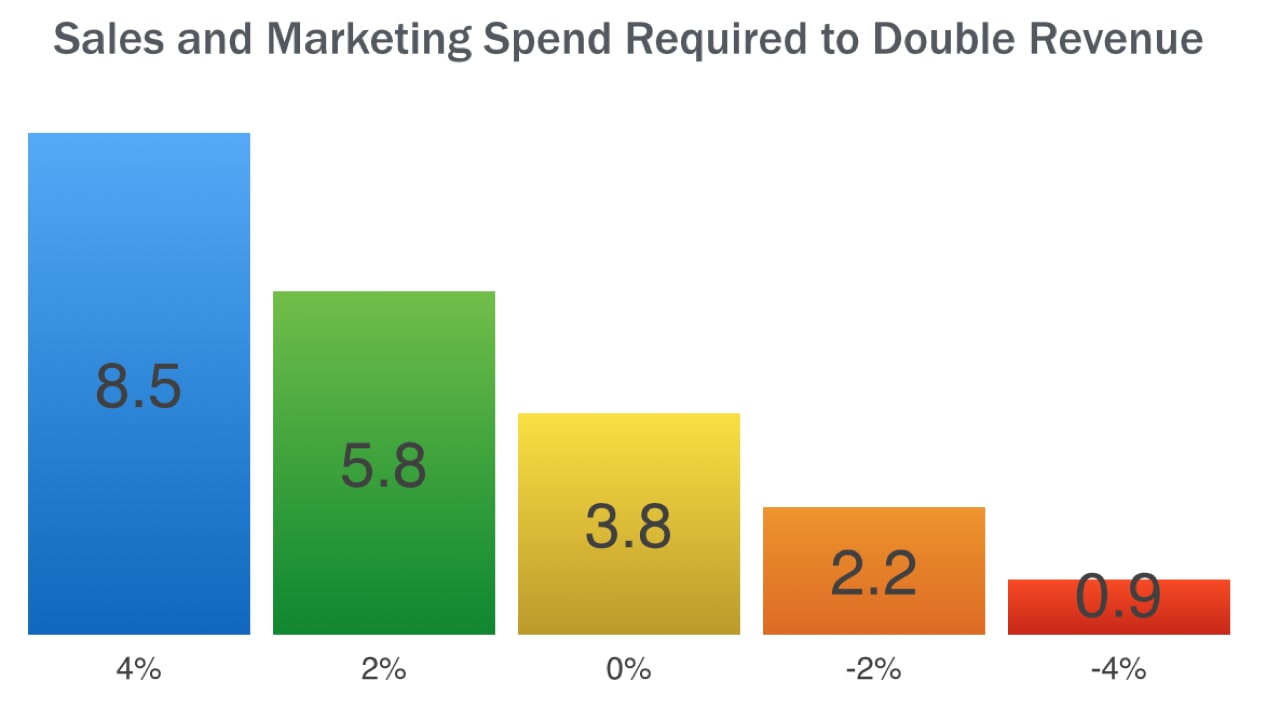
A terrific SaaS VP of Marketing once told me, “If the sales team is focused on hitting this quarter’s revenue target, then the marketing team ought to be focused on next quarter and the following quarter.” In SaaS companies, one of the marketing department’s primary responsibilities is generating sufficient customer interest to enable the company to achieve their revenue targets.

If that’s the case, determining how and when to scale a sales team in a SaaS company is contingent upon the marketing team’s metrics. It would be a mistake to hire a swath of salespeople, assign them quotas and then fail to provide them with enough inbound lead flow to succeed. In that case, marketing would be the limiting factor in the business.

Read more

The Insularity of Silicon Valley

image

Earlier this week, the Commerce Department announced US GDP in Q1 2014 fell by 3%, the most in a quarter since the recession. I’ve linked to the WSJ’s chart depicting the trend above. The decline was 3x greater than forecasted. Silicon Valley seems unfazed.

As I wrote about earlier this year, we’ve seen a decline in the public markets of about 25% in consumer stocks and 45% in enterprise stocks. But since that time, public tech companies have witnessed a small recovery. Both enterprise and consumer companies are up 18% from their 10 month lows.

Read more