Why Smart Watches Could be a Huge Trend in Mobile

Google revealed many novel projects and products at yesterday’s Google IO Conference. At the moment, I’m most curious about the development of Android Wear, in part because of the beautiful Motorola 360 watch and in part because I suspect connected watches bring substantial change to the mobile device market.

It’s easy to write off watches as a niche product. But the addressable market of Android users is now large enough that even a single digit market penetration means tens of millions of users and a potentially interesting new platform for startups to build applications upon. Android counts 1B monthly active users on the platform. A 5% marketshare implies 50M watch users. The total mobile market is now sufficiently large that even niche segments amass substantial user bases. For example, phablets, phones with 5 inch screens or larger which are frequently scoffed at, now represent 21% of Android sales.

Read more

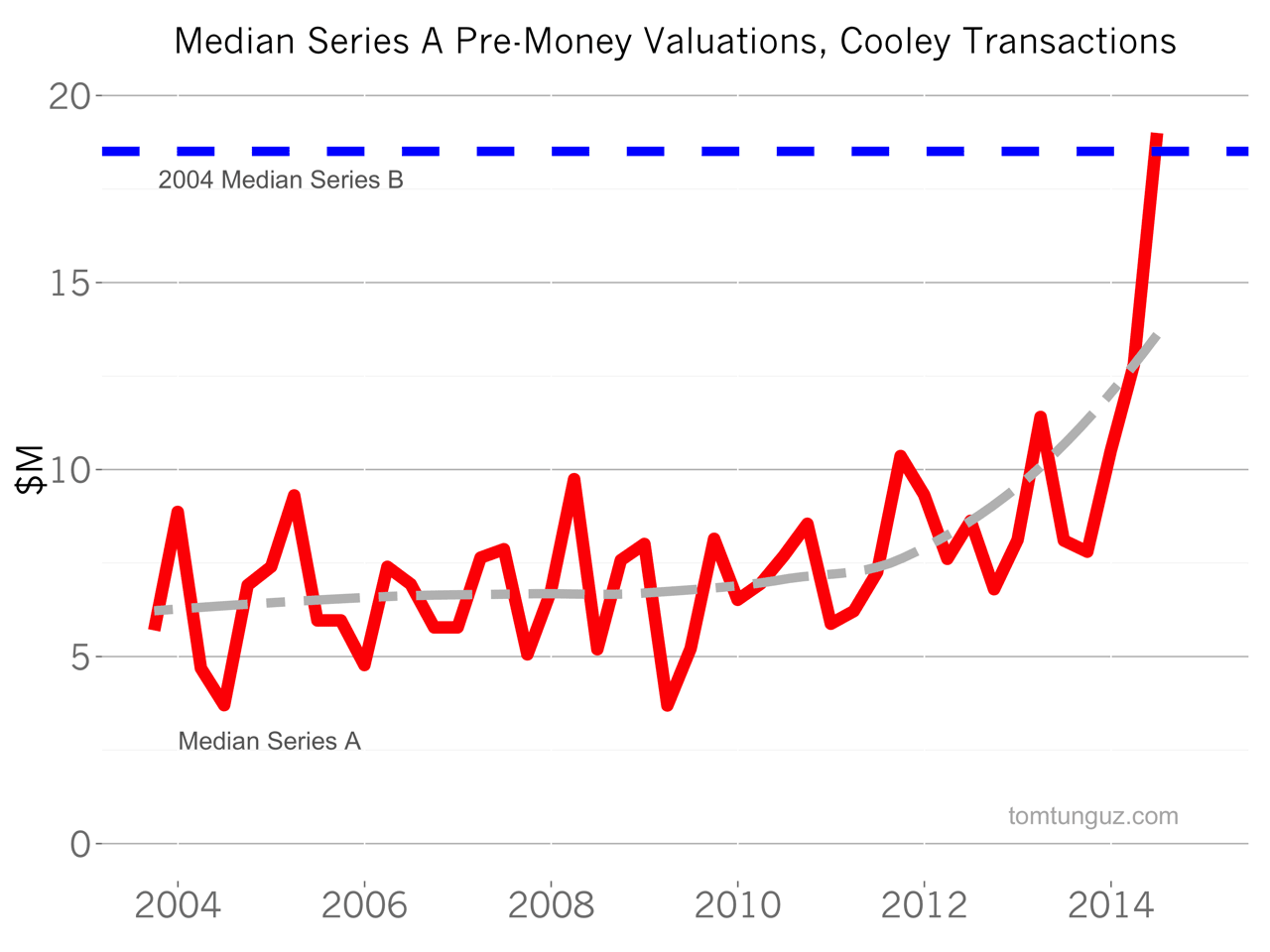
The Five Forces Shaping the Fundraising Market

Last week, the team at Wharton in San Francisco invited me to speak at the Entrepreneurs Workshop. I chose the topic of the “Five Forces Shaping the Fundraising Market” and prepared a Mary Meeker style presentation, with a chart and a bullet point on each slide, to illustrate the forces in tension. It was great fun.

I’ve embedded the slides from the presentation above and will link to the video once it’s live. To help provide some context to charts, I’ve summarized the five forces below. These are the five major forces shaping the fundraising market today:

Read more

The Hottest Startup Sectors

image

There’s a cyclicality to fundraising. Certain sectors rise quickly and become competitive while others decline. I’ve been wondering about the state of the market. First, which sectors are in vogue now in Seed investing and Series A investing? Second, is there a delay between the sectors attracting seed capital and Series A capital? In other words, do seed investors see trends before VCs do?

Read more

The Disruption Debate is Focused on the Wrong Ideas

Jill LePore’s New Yorker polemic “The Disruption Machine” attempts to debunk the incredibly popular Innovator’s Dilemma, a theory written by HBS professor Clayton Christensen. I’ve been reading the debate around it with some interest. It’s becoming a really interesting conversation but I think the debate is focused on the wrong thing - whether or not these ideas are absolutely correct, even axiomatic. They aren’t always true. But that doesn’t mean these concepts are useless. Quite the opposite.

Read more

The 3 Minute Technique for Brainstorming Your Startup's Product Roadmap

Recently I met a startup founder who explained a technique for building his product roadmap in a novel way. “We research what our users are doing three minutes before they start using our product and the three minutes after.” I like the idea because it is a simple and ingenious mechanism for brainstorming product ideas, and this type of product development exploration evokes empathy from a product team, which is a the first step of the Stanford d.School and IDEO’s Design Thinking Processes.

Read more

The Great Unbundling of Email

Since it was first written in 1982, the Simple Mail Transfer Protocol, the mechanism for sending emails, has remained largely remained unchanged. Today SMTP delivers 70 trillion emails to 5B inboxes each year. Overwhelmed by tens of thousands of emails, most of us can sympathize with Nick Bilton, who said:

There is no escape: Email is probably most invasive form of communication yet devised.

Unlike SMTP, email is changing very quickly. In particular, email is undergoing a great unbundling, similar to Craigslist’s, in which startups are seizing upon important use cases of a generic service and building a better, dedicated version of it as a stand-alone company/product. This is happening to a certain extent in consumer products like ephemeral messaging (SnapChat) and location sharing (Glympse).

Read more

How Much Should Your Startup Spend to Grow?

Several weeks ago, I wrote a post about the Optimal Contract Value for a SaaS company. I wondered whether startups serving enterprises might be more or less valuable than those serving small-to-medium businesses (SMBs). Interestingly, the data showed there was no optimal customer value to build a publicly traded SaaS company.

Having written that post, I began to wonder about other differences between different types of SaaS companies. In particular, do SaaS startups serving SMBs spend more or less than their counterparts in the mid-market and enterprise? And which type of SaaS startup grows the fastest?

Read more

The Optimal Seed Round Construction to Maximize Series A Success

Is it better to raise your startup’s seed round from only angel investors, or is it better to include a VC or two? Several founders on the precipice of launching their seed fundraising processes have asked me this question.

It’s a very difficult one to answer hypothetically because there are many different variables to balance. For example, VCs may invest larger sums than angel investors. The imprimatur of a VC’s investment in a company might help convince potential customers and recruits. But some might argue their money brings potential signaling risk.

Read more

The Impact of VCs in Seed Rounds in Seven Charts

image

For the past several years, early stage VCs have entered the seed market with vigor. VC’s entry has resulted five different important trends in the past five years:

  1. The total dollars entering the seed market has increased by 132%.
  2. The mean seed round size has increased by 114% to $1.4M.
  3. VCs’ typical seed investment has grown by 50%.
  4. Mega-seeds, those seed investments over $2M, have reached historic highs exceeding 80 instances in 2013.
  5. The mean mega-seed round is $2.26M during the past five years but in 2013 that figure reached $2.8M, which implies mega-seeds have replaced traditional early Series A.

Though total number of seed investments increased by 30% comparing 2013 to 2011, but astoundingly, the total dollars entering the seed ecosystem has increased by 132%.

Read more

The Riskiest Investment a Startup Can Make

Marketing investments are unlike any other investment a startup. They are the least-tangible, least-measurable investments and that’s why they are perceived as the riskiest investments.

After raising a round of capital, a startup’s management team has a pool of capital to invest. They can choose from different projects: growing the engineering team to build products faster, spending more on infrastructure to speed page load times, moving to a bigger office, adding salespeople to prospect more customers. All of the aforementioned products have long-term value and the benefit of the investment can be seen immediately. New hires are in the office every day and will remain with the company for years. The speed benefits of faster infrastructure accrue to the company daily and a better product engenders a happier customer base.

Read more