Choosing market segments on customer profitability

When serving B2B customers, your pricing will be dictated by your customers' margins. The more money they make, the more they can pay for new technology.

Most businesses fund new initiatives including marketing and technology projects from profits. The more profits a company generates the greater their willingness to pay for services and ultimately the larger the market size for a startup.

Let’s compare the margins of grocery stores to restaurants to software companies to prove the point.
Read more

Social network design and urban design

“Facebook has built the cities, they’ve built the town squares”

Dave Morin, founder of Path

Is building a social network is like building a city? I watched Urbanize, a documentary describing urban design and the affordances cities must make to cultivate vibrant communities. The words of urban designers echoed many of the challenges faced by networks as they grow.

First, both must balance growth and community. Growing a city from 1M to 10M is like adding 900 semi-close friends to your top 100. All of a sudden, the community has a different vibe - each person recognizes fewer and fewer other people (it’s an n-squared problem, after all). It’s challenging to maintain warmth and the closeness of a tight knit small town. This is the tension urban designers and product managers must manage.

Read more

Profitability and the IPO Market

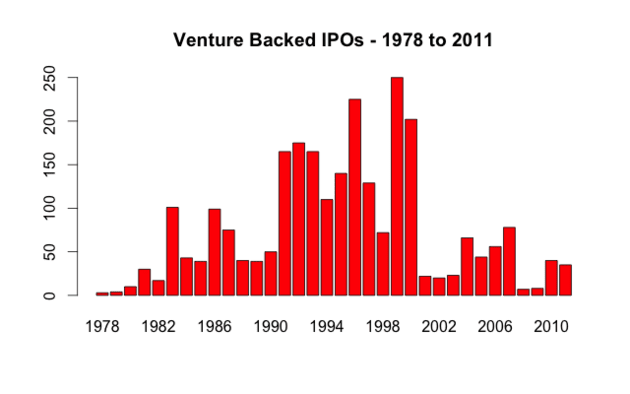
It’s a common refrain that venture backed IPOs have struggled in the past decade. For a long time, I believed and wrote supporting arguments underscoring the idea that the principal causes of this decline were Sarbanes-Oxley costs, decreasing equity coverage and decimalization of exchanges. But that’s wrong.

image

A paper published earlier this year uses statistics to debunk these hypotheses. In “Where have all the IPOs gone?”, a team of statisticians concludes small cap tech IPOs are struggling because today’s public candidates aren’t profitable when then file. Nor are they very profitable at all.

Read more

Using metrics to build communities

There is a Branch called Do platforms need to give users a number to optimize?

Most platforms do provide a number to optimize: Twitter followers, Facebook friends and so on. These metrics build liquidity in the platform as @satyap, @ev and @hunterwalk point out.

But there isn’t just one type of social metric. There are three. It’s important to distinguish the types of metrics a community can provide for users to optimize, because the community will rally around the metrics the community provides. The long term dynamics may not be the expected or desired behavior.

Read more

How the NYTimes avoided disruption

Over the weekend, I watched Page One, a documentary which chronicles the turmoil occurring within the New York Times in 2009 and 2010 when newspapers were going out of business all over the country. Many wondered if the Times would also file for bankruptcy.

Three confluent factors spelled imminent demise for the newspaper: the Internet cannibalized subscription revenue, advertising dollars evaporated and news distribution was in upheaval on account of Wikileaks, Twitter, and blogs. The scale of these shifts was enormous: advertising revenue had crashed to 1950 levels, eliminating five decades of growth in just a few years.

Read more

Building auction pressure in financings

The most effective financing processes, like the most effective auctions, create scarcity. Of late, many founders have been triggering pre-emptive financing processes for their raises. This is my interpretation of their playbook.

Strategy

First, founders build credibility with investors. This can be done in many ways like cultivating a long term relationship with a handful of VCs or in less direct ways like brand building through social media and blogging. Founders have established credibility through referrals from people-in-common. And of course, business performance is the trump card. Walk in with great numbers and you establish your company as an expert.

Read more

Death by a thousand small features

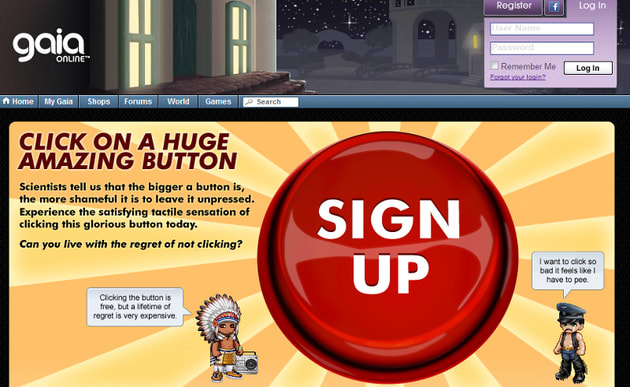
In 2010, Gaia Online started a user acquisition campaign to grow their user base. To simplify the on boarding process, they launched the Big Red Button home page below. It worked. Conversion rates from the home page spiked.

image

Simple user experiences, like this big red button, are effective because users understand what is expected of them. There is just one flow.

Read more

The tension between predictability and creativity

In every one of my conversations with Peter Lehrman, founder of AxialMarket, he always speaks about AxialMarket as “the business.” Never the company, the startup or any other word.

At first blush I thought it was a trivial semantic difference, a New York-ism, but over time I’ve come to realize this word choice marks a significant difference that manifests itself in culture, product and go to market.

Calling any company a business connotes a formality the word startup doesn’t share. A business is serious. A business is a stand-alone self sustaining entity. A business evokes thoughts of goals, revenue, profitability, execution and a performance mentality.

Read more

Consumer investment fatigue

Many of the promising marketing and media innovations of the past six years, daily deals, subscription ecommerce, social gaming and social media, have been struggling. This trend is plain to see from IPO performance and negative press cycles.

I’ve been asked a few times whether there is consumer investment fatigue as a result. Fatigue is too strong a characterization. It would be foolish for any investor to write off consumer investing as a category because of the massive opportunity consumer internet companies offer. The fastest growing and often the largest Internet businesses are consumer businesses: Google, Amazon, Facebook, Instagram, Pinterest, to name a few.

Read more

Simplicity. Quality. Inspiration.

Two weeks ago, James Reinhart, founder and CEO of ThredUp, led his company through a branding exercise. The team spent an afternoon comparing and contrasting the brand attributes of Starbucks and Peets, Whole Foods and Safeway and a few other competitive pairs. The team quickly distilled each company’s brand into one word.

Long ago, each of these brand selected the value that would define their brand. Every decision since that point had been made with that value in mind. Netflix: freedom. Apple: simplicity. Starbucks: quality. Nike: inspiration. Google: focus on the user. Zappos: service

Read more