Radio Ga Ga

Must content distribution platforms be reinvented every few years?

Left to its own devices, the mob will augment, accessorize, spam, degrade and noisify whatever they have access to, until it loses beauty and function and becomes something else.
Seth Godin

Given the noise and misinformation disseminated on Twitter both during the election and the Sandy disaster, I’ve been wondering how Godin’s thoughts apply to new information networks: blogs and feeds.

Sifting the feed in search of the truth

There is an undeniable early movement toward editorially curated publishing. The Twitter founders have launched the most visible response. Medium, a low volume, high quality content site is a direct (and opposite) reaction to the high volume, noisy Twitter feed.
Read more

On negotiation

We negotiate every day in almost every conversation and exchange, whether it’s rescheduling a flight, asking for a product return or responding to a term sheet.

I’ve been reading Getting More, a book by Stuart Diamond, who trains the military, Google and many others on negotiation. Everyone should read it.

This book is set apart because it recognizes the nature of relationships, emotion and human nature, forgoing concepts like ZOPA and BATNA. Instead, the book focuses on simple, tangible tactics:

Read more

How much is a social media click worth?

How much is a social media click worth compared to a email click or a search click for an eCommerce site?

Monetate, makers of optimization software for eCommerce landing pages released data answering this question

Channel Conversion Rates AOV CPC Relative Worth
Email 4.25% 90.4 $1.000
Search 2.49% 82.72 $0.536
Social 0.59% 64.19 $0.0986

Key: Conversion rates = conversion to order from click; AOV = average order value in $; Relative worth = indexed measure of click value based.

Read more

The most important question a startup can ask

At the center of every startup is a secret. A secret is not an unknown. Rather, it’s something just not widely believed to be achievable or feasible. In other words, it’s an insight. Exploiting that secret should be the aim of every entrepreneur. Leveraging the secret means disruption and ultimately success.

The genesis of every secret is the word why. “Why are things done this way? Why can’t we do better?” Why is the predecessor to change. It’s the progenitor of every great idea because the word why challenges the status quo.

Read more

The Freemium Game Plan

I love freemium businesses. I have met with many of them, work with one and if I were to start one, this would be my game plan, the characteristics of the product, market, distribution channels, conversion point and team.

Product Characteristics

The existing solutions are either email and spreadsheets or software architected before the turn of the century. In either case, the alternative is painful to use, so excruciating in fact, that individual employees are willing to circumnavigate IT’s policies in search of something better.

Read more

Segmenting the SaaS Market for Sales

Developing a sales strategy is critical for software-as-a-service (SaaS) startups. The first step in developing a sales strategy is to build a robust market segmentation. I’ve used data from the US Census to develop a segmentation that reveals some surprising facts about the SMB market and may help inform your startup’s sales strategy.

Chart 1: 98% of businesses in the US employ fewer than 100 people.

98% of businesses in the US employ between 1 to 4 people. This large segment of businesses provides ample testing ground for product development, market fit validation and creation of word-of-mouth marketing.

Read more

All Great Managers are Alike

Hollywood and Silicon Valley often seems worlds apart. While movie making and startup building may always be very different endeavors, great managers use the same techniques in every discipline to empower their teams, hire the right people, and change the world.

Over the weekend, I watched Woody Allen: A Documentary which profiles the great director through the words of his actors, editors and producers. Allen’s management ability shone through every interview.

Read more

The Path to Exponential Growth

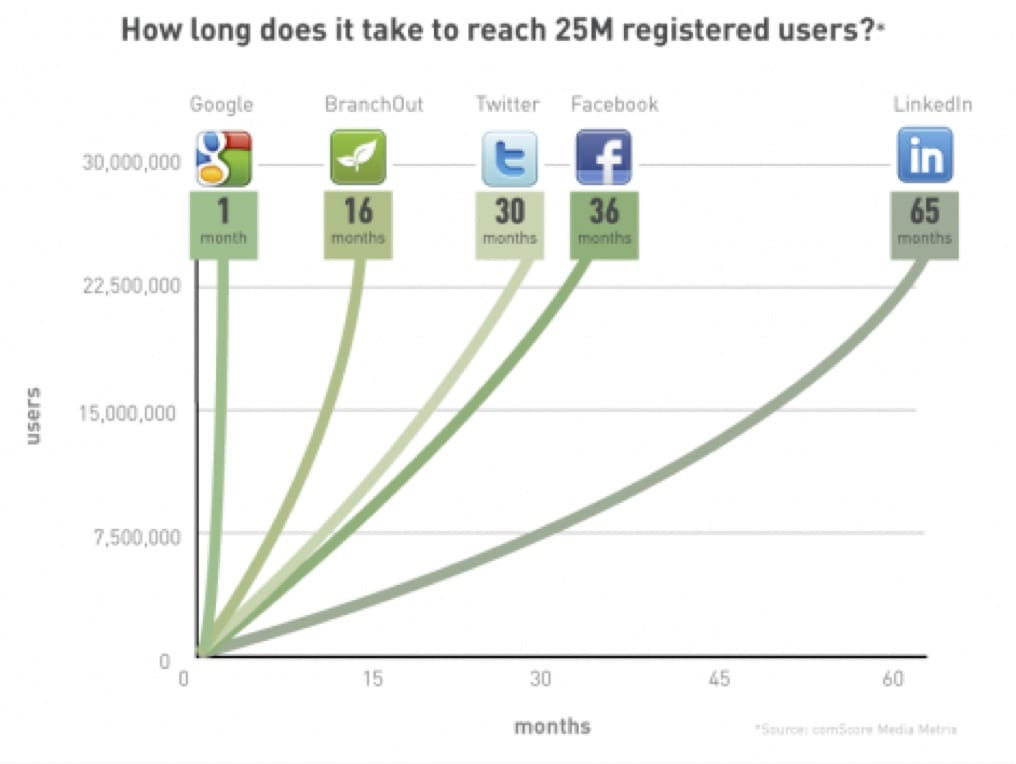
For years, a product can grow linearly before suddenly seeing compounding growth. Facebook is a great example. From 2004 to 2007, the company grew at a fairly linear rate. And then, the magic happened! The network effects kicked in and exponential growth ensued.

Linear growth always precedes exponential growth. For market places, in social networks or in advertising exchanges, the story is always the same. Linear, linear, linear. BOOM, exponential. One day, the magic happens.

image

Read more

Loyalty with a tinge of betrayal

Did you hear ‘em talkin’ ‘bout it on the radio

Did you try to read the writing on the wall

Did that voice inside you say I’ve heard it all before

It’s like Deja Vu all over again

- John Fogerty

I am emotionally attached to Android’s success. It’s the same loyalty I displayed when I campaigned for Apple in the mid-90s. But with a tinge of betrayal.

I reminisce about spending hours sifting through Zapf dingbats to transform PC Word files into usable Mac documents; choosing from a threadbare gaming library comprising three titles: Bungie’s Marathon series, SimCity and Civ; and waiting years for updates to Quicken and the Office Suite.

Read more

The 3 Kinds of Startup Metrics

Clarity is everything in a startup. That’s why metrics can be such a great help. But not all metrics are created equal.

One of my CEOs recently shared with me the way he thinks about metrics. I thought it was simple and brilliant. There are 3 kinds of metrics in a business:

  1. Vanity metrics are great indicators of momentum. These are useful for garnering press, investment and partnering interest. But they most often aren’t the end goal, the metrics that correlate to a business’s value.
  2. Business health metrics are high level metrics about the business. Revenue is a prime example. User activity is a second. Conversion-to-paid is a third. These metrics tend to be the ones shared with the board and leadership of the company. Goals can be established for these metrics and the health of the company’s initiatives can be measured in comparison to these goals.\
  3. Product decision metrics inform product, marketing, sales or other team level decisions. Examples include cost-per-customer-acquisition per channel, % of users using a particular feature, etc. Think through what kinds of metrics you and your team are focused on and run them through this filter. It will help you prioritize the right things.
Read more