From Hyper Growth to Hyperscale: What I Learned Managing Small and Massive Teams

image

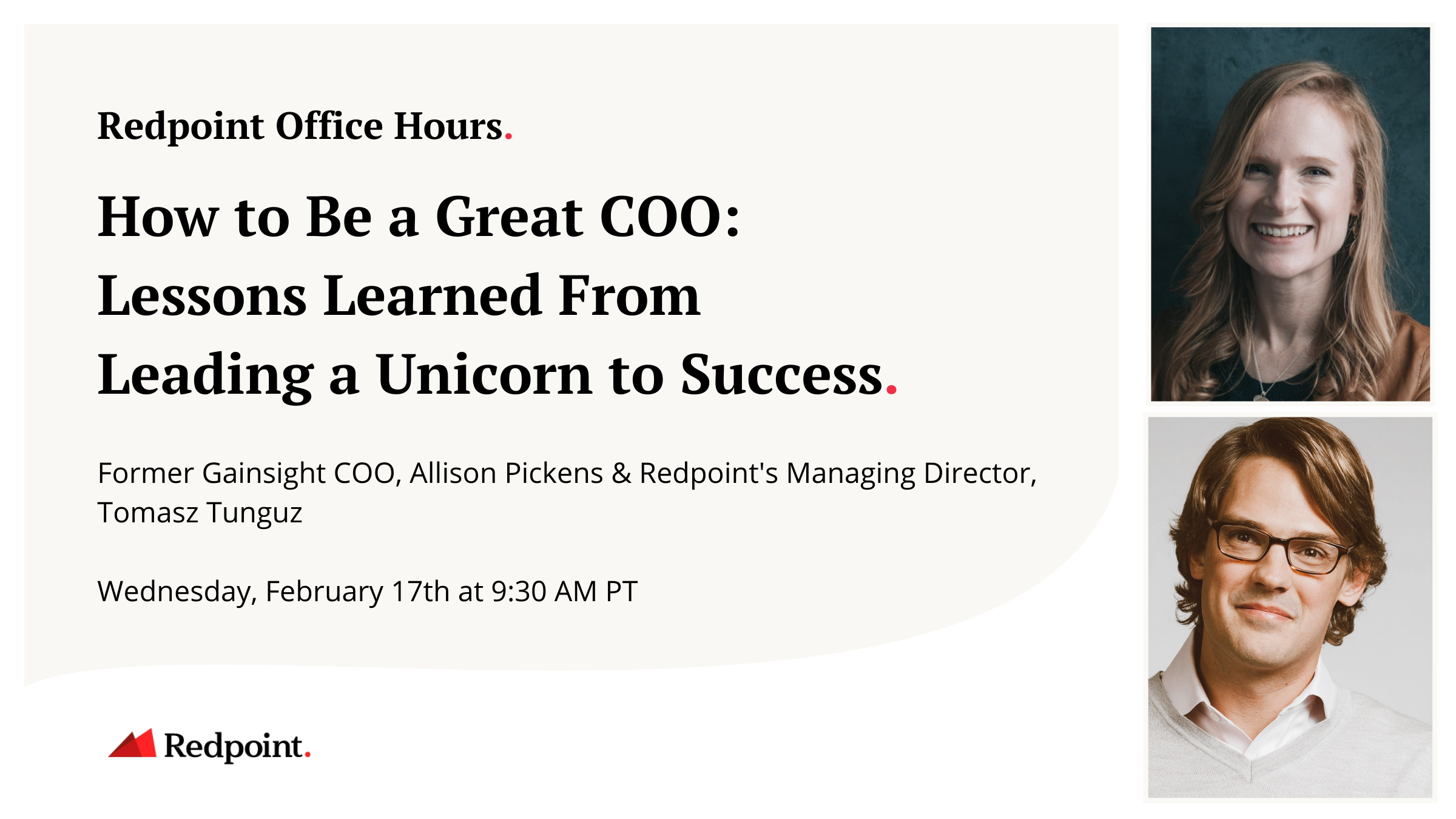
On Thursday, December 3rd at 11 AM PT, Redpoint Office Hours will welcome Linda Tong. Linda has lived an incredible path through startupland from Google, to startups, to the NFL, to AppDynamics. In some of our recent conversations, Linda has taught me about the differences in managing companies at radically different scales.

Let me tell you a bit more about Linda’s history. Linda and I worked at Google at the same time, which is when I first met her. From there, she worked for TapJoy, the predominant mobile marketing company as their Chief Product Officer. From there, she became COO at Nextbit, a startup founded by an ex-Android team working working on mobile devices. Then, she joined the NFL as VP of Product where she managed the product vision for the digital properties of all 32 clubs and the league. Today she’s general manager of AppDynamics.

Read more

More Activity Means More Business. Don't Overthink It.

“More activity means more business. Don’t overthink it, just act…The target is dozens of net new interactions per week, building many shallow relationships. They aren’t fake, just shallow.”

I have found this to be true. I like to think about it like Brownian motion: jiggle more atoms by talking to more people and there’ll be more activity all around you. Since sales is a funnel, the greater the activity at the top, the more sales.

Read more

How Developer Marketing Parallels Consumer Marketing

On the surface, B2B and B2C marketing may seem to be worlds apart. As open-source and developer-led companies become increasingly visible, important, and massive, we should draw the parallel between developer marketing and consumer marketing. They are much closer than it might seem.

First, developer marketing is influencer and brand-driven. In the consumer World, consumer companies use luminaries to support a product. Michael Jordan and Air Jordans. Oprah Winfrey and Weight Watchers. Matthew McConaughey and the Lincoln ads that SNL spoofed.

Read more

The Parallels in the Culture Between the Two Category Defining Companies

I remember reading the Netflix culture deck published in 2009 and feeling inspired. The words on the page resonated with me because they conveyed a logic and thoughtfulness not often underpinning cultural decisions broadly. They are brave because they don’t appeal to everyone.

Reed Hastings’ No Rules Rules delves one level deeper into the stories behind the deck. As I read the book, I was struck with the parallel Bridgewater’s values that founder Ray Dalio expounded in his book, Principles, and his memo to employees

Read more

How Many Technologies Can a Company Adopt at Once?

An IT executive recently asked me this question. How many technologies can a company adopt at once, successfully? It’s a question I hadn’t paused to contemplate before that moment. And if you are a vendor, it’s not one that you think about very often either. But if you are a member of the IT team, it’s top of mind every day.

There are two answers to this question. The first is my initial response to the asker: change management limits the pace. How quickly an IT team can train people, onboard them, and make them successful with all the different technologies procured by a central unit. How fast the company can change behavior.

Read more

Your Startup is a Series of Cycles

I used to think of a startup as a series of funnels. There’s the customer conversion funnel, the recruiting funnel, the customer success funnel. Funnels simplify metrics. Examine the yield from each stage to gauge success. Start to finish.

I’ve been preparing my session for the NY Enterprise Tech Meetup later this week on the Essential Guide to SaaS Metrics. Thinking through that presentation and reflecting on some recent conversations, I’ve changed my belief. The superior mental model is a cycle.

Read more

Why IPOs, Direct Listings, and SPACs Will Flourish in Startupland

Most high-growth software investors value public companies on enterprise value to forward revenue multiple. But investors in private companies use a different metric, enterprise value to forward annual recurring revenue (ARR).The private markets project the ARR a year from now. The public markets project revenue for the next 12 months

What if we could compare the relative valuation multiples of public and private high growth software companies? What conclusions could we draw? It’s possible with some estimation. To estimate ARR for a public company, we annualize the analyst consensus estimates for the revenue 4 quarters from today.

Read more

Just How Inaccurate are Quarterly Venture Capital Activity Reports?

Each quarter, a group of analysts, including me, publish analysis on the trends in the venture capital market. There’s a risk to those assessments: the data is incomplete since not all rounds founders close within a quarter are reported in that quarter. I was curious about how much variance exists in the data.

This retrospective analysis compares Crunchbase data from April 1, 2020 to data from October 10, 2020 across three dimensions: round counts, investment total, and median round size. The red lines show data from Q2 and the blue line Q4.

Read more

The Mispricing of Software Companies

Public software companies trade on forward revenue multiples. Investors contrast the relative value of one business by comparing the enterprise value divided by forward revenue (sum of the next 12 months’ revenue) of one business to another. Ten years ago, forward multiples remained in a tight band between 5-10x. Today, they span 2-60x+.

This novel dispersion provides us an opportunity to ask some interesting questions.

Let’s cover one today: does the market price efficiently? We know revenue growth rate correlates most with forward multiples. If we divide the forward multiple by the growth rate, we normalize it, which means we can compare them on a pineapples-to-pineapples basis

Read more

The 4 States of an Engineering Team

I’ve been steadily progressing through the excellent books in the Stripe Press catalog. First, I read High Growth Handbook. Most recently, I read An Elegant Puzzle: Systems of Engineering Management by Will Larson. It’s the best book I’ve read on engineering management.

Will has worked at Digg, Uber, Stripe, and is now at Calm and has seen many engineering teams endure and thrive through hypergrowth. The book abstracts out the wisdom of those times into theory abstracted from experience, not just hypothetical ideas. Will extends the concepts of systems thinking into engineering management.

Read more