Cloud Prem Architecture - The New Way of Serving the Enterprise with a Hub and Spoke Data Model

When we announced our investment in and partnership with Mattermost about a year ago, I wrote about a new architecture for SaaS. I’m starting to see that architecture more and more, but with a twist. The idea behind the new architecture is split a SaaS app into code and the data. The SaaS company writes, updates, and maintains the code. And the customer manages the data. Typically, the data resides in the customer’s cloud account.

Read more

Has VC Become So Big It Must Be Disrupted?

Nathan Heller published an article called Is Venture Capital Worth the Risk? in the New Yorker. It’s a well-researched critique of the venture industry. The key question he poses is: has the industry become so large that it needs to be disrupted?

It’s a thought provoking question and a good opportunity to ask for feedback on how we can imrove. If you have ideas for how to improve venture capital for founders, please tweet me or send me an email with the link above. I’d love to hear them.

Read more

Trust is at the Core of Software Marketing

Today, the world’s most valuable brand is Apple. Forbes estimates Apple’s brand is worth $205B. Why is Apple’s brand worth so much? It’s the trust the brand inspires in consumers.

Apple customers know Apple the company. They understand the product philososphy, the history, the quality of typical Apple products, and the reputation for quality. A strong brand is the lagging indicator of having built trust. We won’t buy from people or companies we don’t trust.

Read more

What is a Best in Class Payback Period for a Software Company in 2020?

Payback period is one of the best composite diagnostic metrics of product market fit. I’ve written before about the benefits of short payback periods. In short, startups with shorter payback periods require less capital and also grow more quickly. In 2020, what is an excellent payback period[1]?

image

Here is a group of publicly traded companies sorted by estimated payback period[2]. Zoom is at the top with a payback period of just over 3 months. DataDog, Slack, Crowdstrike, and Twilio round out the top 5 at 7 months or less.

Read more

Growing Product and Engineering Orgs from Zero to IPO

At this year’s Saastr Annual conference, I’m excited to interview Nick Caldwell. Nick has an incredible background. He started the PowerBI team at Microsoft and grew it from a small number of people to more than 300. He left to become VP Engineering at Reddit and tripled the size of the engineering team to 150 people in 18 months. And then he joined Looker as Chief Product Officer.

In short, Nick has helped grow engineering and product teams from very small to very big three times. In preparing for the session, I’ve learnt a lot about Nick.

Read more

The Redpoint 2020 Go To Market Survey

Go to market questions are some of the most common questions startups discuss in board meetings. This is especially true around the end of year because many companies develop their financial plans. To help startups understand how their go to market teams compare to peers, Redpoint has constructed a survey. You can find the survey here.

The survey will answer questions like:

  • How does the sales team structure differ by stage? by target buyer? by price point?
  • How do sales team compensate their account executives and their SDRs/BDRs?
  • At what stage do startups hire VPs and C-level executives in each go to market role?

Last year, we published the results on the Free Trial/Freemium survey and it was a huge success. We received more than 600 responses and the data was tremendously insightful. We hope to exceed those numbers this year.

Read more

The Health of the US Venture Market in 2020

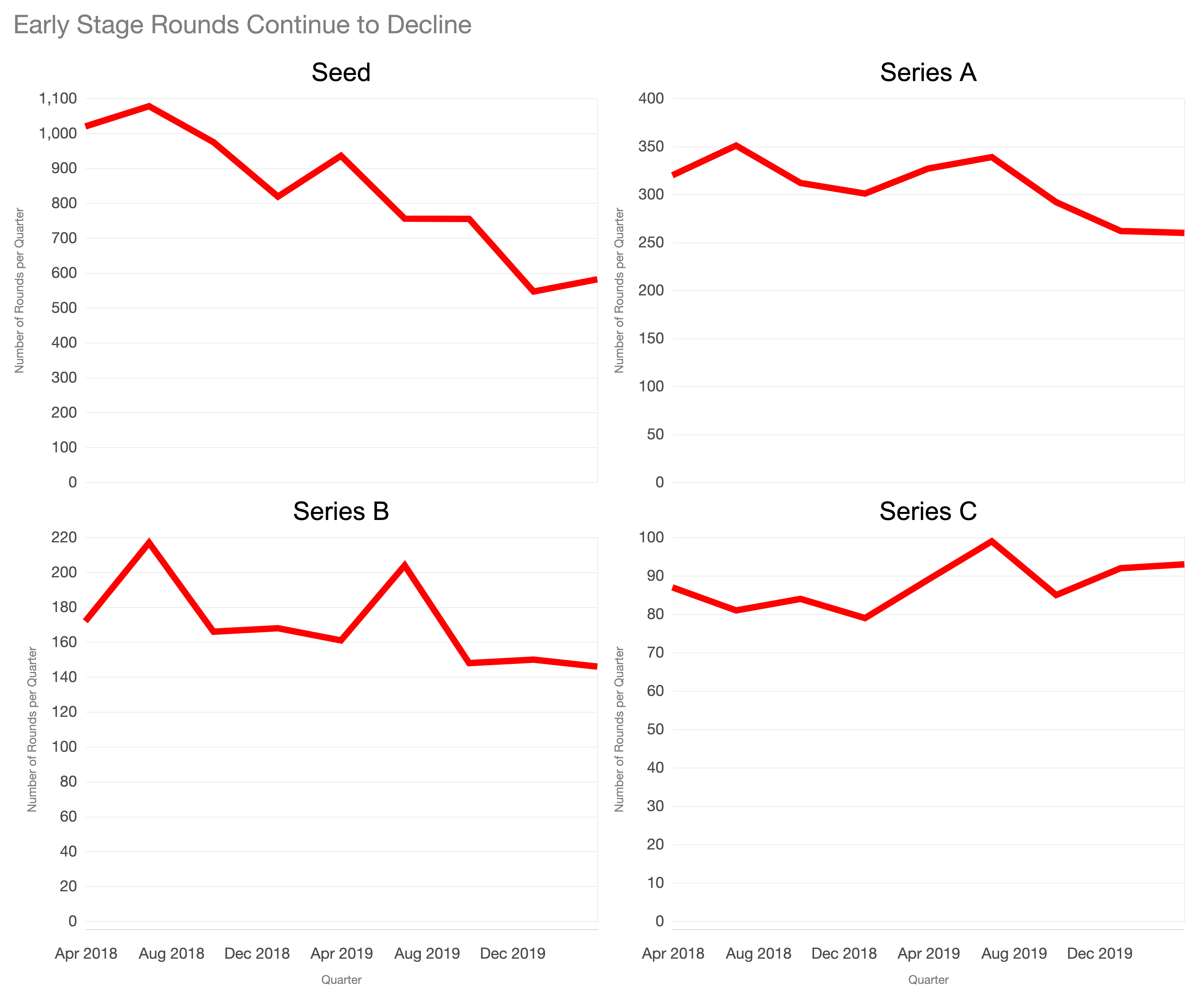
We are 12 years into the longest bull market in US history and this bullishness has powered the venture market. Investors deployed $117 billion in 2019 up from $106 billion in 2018.. This market has grown 20% over the last five years. It’s been go, go, go for nearly a decade.

However, Q4 2019 saw meaningful dip from Q3, but it’s too early to say whether it’s an aberration, or the beginning of a longer-term trend.

Read more

B2B vs B2C: How Should Your Sales Team Be Allocated to Maximize Success?

If you’re starting a SaaS company, should you prefer to sell to B2B or B2C companies? And if you would like to sell to both, how should you allocate your sales teams? If you were to hazard a guess about the share of B2C vs B2B companies, what would it be?

I often find myself wondering this question in a board room or reading through S-1s of soon-to-be-public companies. What are the demographics of the customer base and how are they reflected in the sales team?

Read more

5 Predictions for 2020

Here are my 5 predictions for 2020.

The direct listing becomes the standard way for startups to go public in 2020. The idea has been proven by Slack and Spotify, and many others will follow. Most startups at IPO have plenty of cash and don’t need to raise more in the public markets. The direct listing enables them to go public without raising capital.

The M&A market continues to surge. Software M&A in 2019 reached about $170B up from $136B in 2018, up 25%. With SaaS penetration roughly 20-30% by our estimates, there’s several hundred billion in market cap to be created in the next few years. And incumbents desire as much of that as possible for themselves. I’ll guess a 15% increase from here or about $200B.

Read more

The Top 10 Posts of 2019

It’s been an incredible year and one I’m grateful for. The most gratifying thing writing this blog is the feedback from readers who say the content is useful. That’s the goal. Thank you for making this so much fun and deeply rewarding.

These are the top posts of 2019 with some commentary and behind the scenes notes on each.

  1. 1.01^365 = 37.7 - The idea behind this post is that small, daily improvement leads to huge compounding gains. A 1% daily improvement yields a 37x improvement in a year!
  2. Setting the Salesforce/Tableau Acquisition in Context - A wave of consolidation swept the BI industry. Salesforce bought Tableau. Google bought Looker for $2.7B and I was so lucky to have a front row seat. This article talked about the sizes of these acquisition relative to history.
  3. Mattermost’s $50M Series B - We are big believers in open source. We’ve invested in more than 15 open source companies over the last 15 years (eg, Hashicorp, Cockroach Labs, Dremio…). Less than 9 months after leading the A, Mattermost raised a large B to push forward open source chat and chatops.
  4. The 37% Rule: How to Decide When to Stop Wondering and Start Deciding: I read Algorithms to Live By, which was terrific. And then I listened to a podcast from the author who reminded me about this simple math principle that gives me confidence about making quick decisions.
  5. What a Valuation Implies About a Business: I’m curious about the way different investors value different businesses. And for a long time, I wondered how to translate the valuation multiples of a company into a more tangible concept. This is my mental model.
  6. A Clever Hack to Reading More Books: There’s so much knowledge in books, and as a society we’re spending less and less time with books. It’s a format that is in slow decline. One way of reading more books is to reduce the cost of them. Here’s my hack to do exactly that!
  7. The SaaS Valuation Environment in Mid-2019: 2019 saw the highest valuation environment for SaaS companies for the last 15 years. This chart documented the rise from about a 3.3x EV/forward rev to a 9.5x. A few months later, the market would hit 10.5x forward. Now we’ve regressed a bit, which is good thing.
  8. Observations from the Enterprise Tech 30 List - Wing.vc ran a coaches poll of the most promising startups. I broke down the buyers, the layers of the stack they belong to, and the customer size segment to see if patterns exist. Redpoint invested in 8 of the 30, more than any other venture firm.
  9. A Random Walk Down Sand Hill Road - Mental models are supremely powerful. There’s a book called The Model Thinker that delves deep into the topic, showing you the math of why you should play basketball faster if you shoot better; and the implications of different types of social networks.
  10. The Fundraising Environment in 2019 - Three Major Shifts - At the beginning of the year, the ICO was a thing, and that’s gone for now. But the broader trend is financial products aren’t discrete any more. They are continuous. And the monikers no longer carry meaning. A $7m round might be a seed, a series A or a Series B. Time to jettison the labels and just use the numbers.
  11. Before You Raise a Round of Funding, Ask Yourself This Question - Make sure you do plan your options grants for key hires and employees before raising a round of capital.
  12. Why Product Innovation Slows After the Series A - The transition from finding product market fit to scaling has real costs, and they appear in the product innovation cadence.
  13. That Will Never Work - The history of Netflix is a fascinating adventure. Marc Randolph, the founder who is also part of Looker’s board, narrates the wild ride.
  14. Why Churn Rates Can Spike When Your SaaS Startup Experiences Hypergrowth - An important nuance when evaluating churn for your company.
  15. The Benefits of and Questions Facing Remote and Distributed Startups - One major trend for 2019 and for 2020 is the rise of distributed companies. I explored the pros and cons of this corporate structure. Regardless of the cons, distributed teams are an inexorable force in startupland, analogous to globalization in the the broader economy.
Read more