A New Axis of Competition

Would you choose one software over another because it has a proprietary model with better performance?

Two companies shipped custom AI models today (three in a week counting Cursor!1), raising that question. Intercom launched Apex 1.0, a model for answering customer support tickets.2 Chroma released Context-1, a model for multi-hop agent search.3

Apex 1.0 beats GPT-5.4 & Claude Opus 4.5 on customer service tasks.2 Context-1 scores 97% on agent search benchmarks.3 One Intercom gaming customer saw resolution rates jump from 68% to 75%.2

Read more

AI's Bundling Moment

The SaaS era was defined by unbundling : find a workflow, optimize it, own it. Salesforce chose sales automation. Slack chose chat. Dropbox chose file sharing. Point solutions won by perfecting single workflows. The playbook : own one pain point, expand from there.

AI is moving faster than anyone predicted. When models change every 42 days, buyers can’t assemble a best-of-breed stack. They want a platform they can trust for three to five years.

Read more

Cursor, Kimi & the Open Source Imperative

Last week, Cursor launched Composer 2 to over one million daily active users.1 Within hours, a developer discovered Cursor had built its flagship model on top of Moonshot AI’s Kimi K2.5, a Chinese open-source model.2

Moonshot AI’s response? “This is the open model ecosystem we love to support.”3

Cursor’s model is at near parity with state-of-the-art at one-eighth the price.4 It’s also no coincidence the editor powering Cursor is open-source, VS Code.

Read more

The Pricing Power of Agents

In 2025, we predicted that 2026 would be the year agents would earn as much as a person.

It’s already happening.

In markets where there’s a labor shortage and an urgent need to hire people, we are seeing agents command 75%, 85%, even 100% of a human equivalent salary. This is faster than we were anticipating.

The first-order benefit is completing the work.

But there are second-order benefits that are now starting to appear. Training agents is significantly faster since all materials can be presented at once & in parallel to the AI.

Read more

The Robotic Tortoise & the Robotic Hare

I set up a race today between two robots.

My Mac on the left vs Claude Code on the right. Both tasked with building a payment app on Stripe’s new Tempo blockchain. Same prompts, same task, side by side.

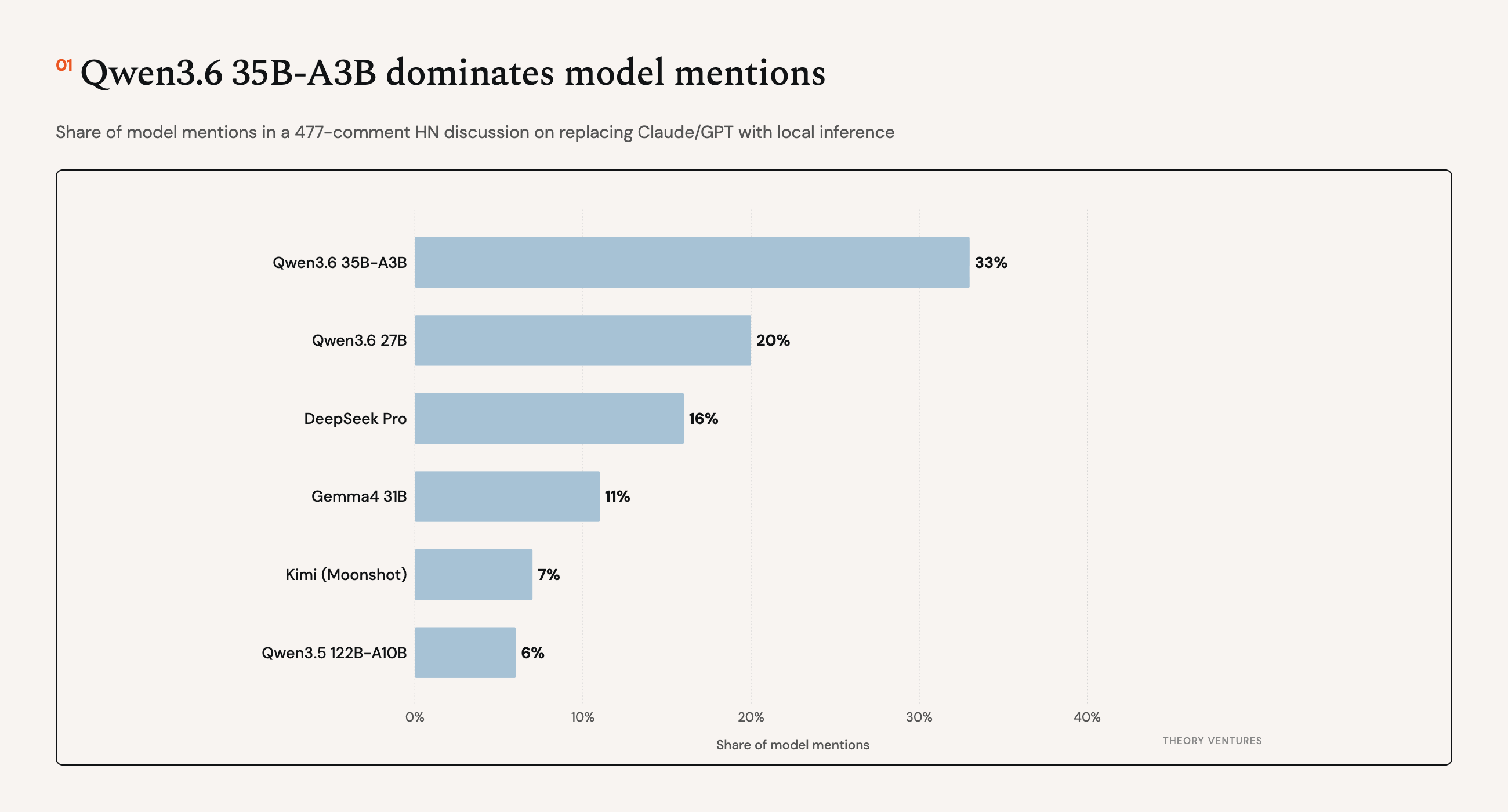
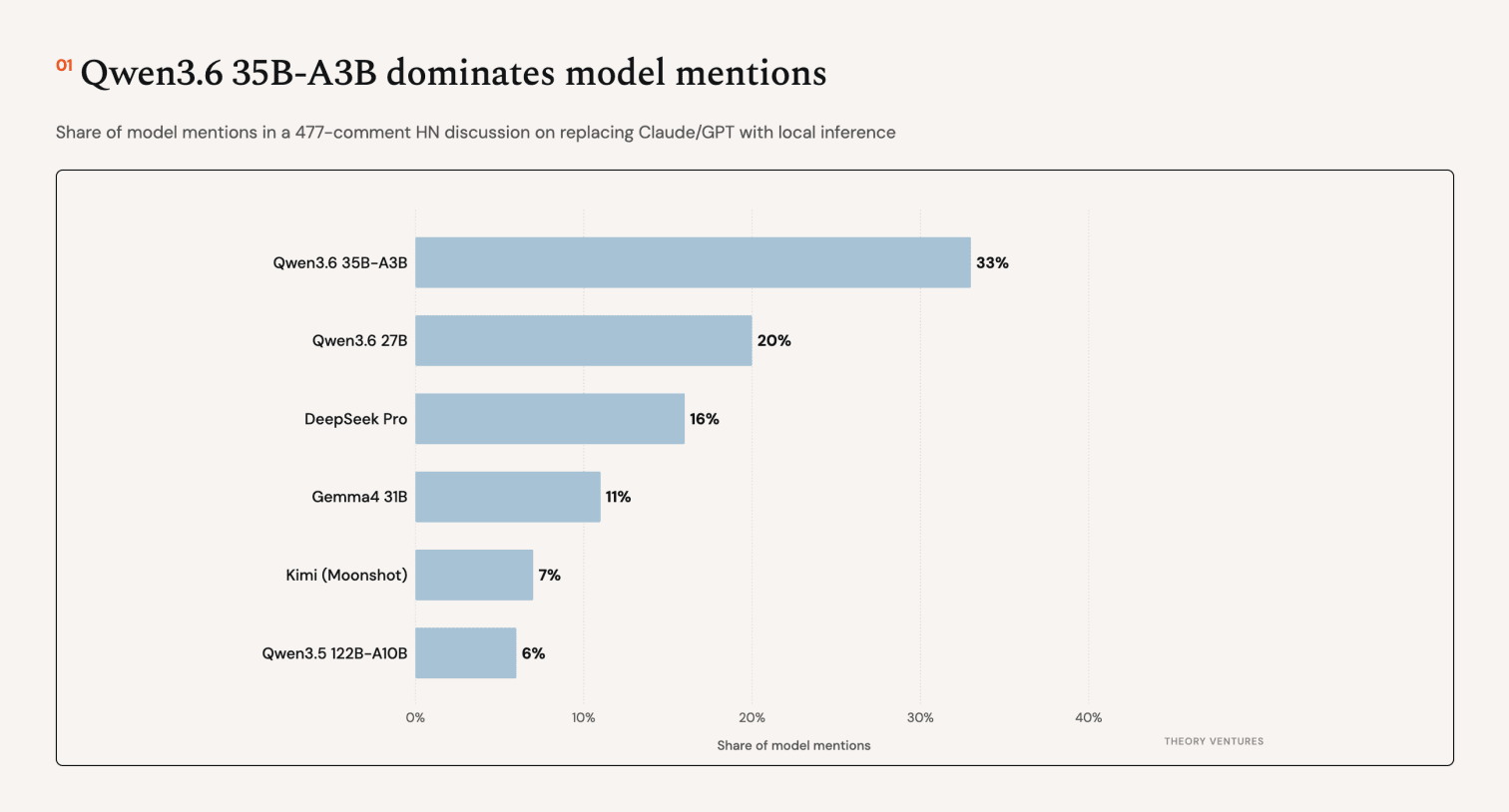
Opus 4.5 is about 20% smarter than Qwen 35B on benchmarks. And it’s likely 50x larger. The hare should have won. It didn’t.

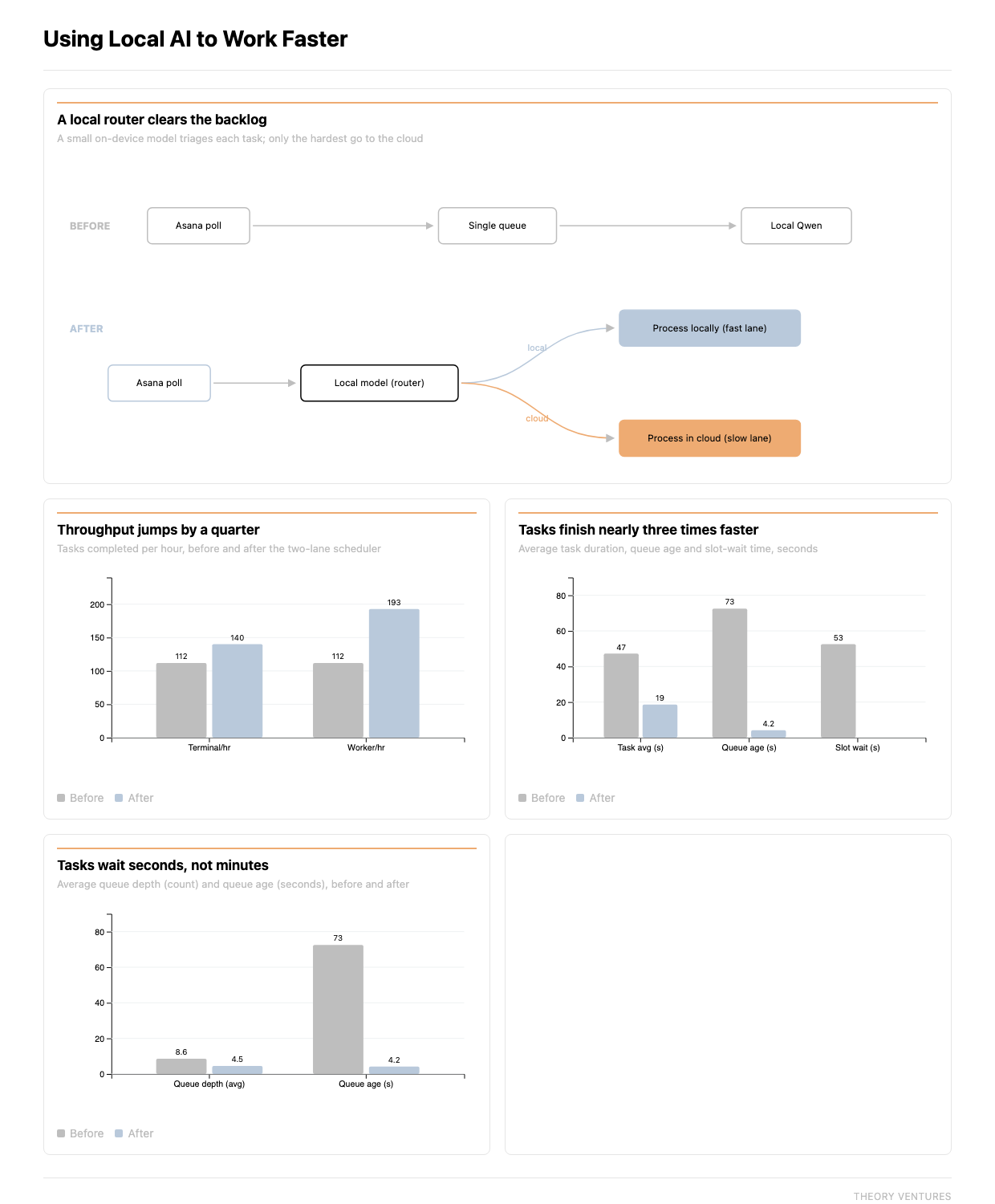
The local model finished in 2 minutes. Claude took over 6. I asked Claude to score both outputs : local model 6.5, Claude 4.5.1

Read more

The 12x Bet on AI

For every dollar hyperscalers earn from AI today, they’re spending twelve dollars to build more capacity.1 That’s the bet embedded in $575 billion of capital expenditure this year.2

How fast does AI revenue need to grow to pay back this data center mortgage?

Hyperscaler CapEx vs Cash from Operations 2016-2026

From 2020 to 2024, hyperscalers issued an average of $20 billion in bonds annually.3 In 2025, that jumped to $96 billion. In 2026, it will reach $159 billion.3 Morgan Stanley projects $1.5 trillion over the next few years.4

Read more

Hello, Claude? Are You There?

Feb 2025
"We've been growing a lot and are out of GPUs."
Sam Altman, OpenAI CEO 1
Mar 2025
"We are still waving off customers or scheduling them out into the future. This is a situation that we have not seen in our history."
Safra Catz, Oracle CEO 2
Oct 2025
"You may actually have a bunch of chips sitting in inventory that I can't plug in. I don't have warm shells to plug into."
Satya Nadella, Microsoft CEO 3
Feb 2026
"What keeps us up at night… The top question is definitely around capacity. All constraints — be it power, land, supply chain constraints — how do you ramp up to meet this extraordinary demand?"
Sundar Pichai, Alphabet CEO 4
Feb 2026
"There's no relief as far as I know. No relief until 2028."
Lip-Bu Tan, Intel CEO 5

What happens when your AI doesn’t answer?

Read more

One Billion Lost Packages

In September 2024, Hurricane Helene flooded Baxter International’s plant in Marion, North Carolina, which produced 60% of the nation’s IV fluids. Within a week, more than 80% of U.S. healthcare organizations reported shortages. One plant, one flood, one week.

That disruption made headlines. Most don’t. Eighty-five million packages arrived damaged in the U.S. in 2024, up 30% from the prior year, costing businesses $4 billion.

Sean McCarthy saw those failures accumulate during his years at Amazon Shipping, where he was one of the early hires. The investigation process never varied. Query the warehouse management system, often two decades old. Cross-reference the carrier portal. Call the driver, who doesn’t pick up. File a claim: seventeen fields. Four hours pass. Sometimes the problem gets solved.

Read more

The Marginal Hire

AI eliminates the marginal hire.

Tech job openings are down 45% from the 2022 peak, but up 16% since the start of 2026 - from 227k to 264k. Why the narrative violation?

Open tech jobs from TrueUp showing 45% decline from peak but 62% recovery from low

Companies are hiring again, just fewer people than before. A reset to a lower baseline.

Read more

The Org Chart Math Behind AI-Native Speed

“Since last November, 100% of my code has been written by Claude Code. I have not manually edited a single line, shipping 10 to 30 PRs per day.”

Boris Cherny, creator of Claude Code, ships 20-30 pull requests per day. Major code changes, not typo fixes. He runs five parallel AI instances, each on a separate branch.1

Compare that to a traditional engineer : 3 PRs per week.2 Cherny isn’t 10% more productive. He’s 30x more productive.

Read more