The GPU Revenue Ladder
Yesterday brought two data points about the health of inference businesses : SpaceX’s third-quarter report1 & DeepSeek’s inference post.2
Overall, they demonstrate that inference businesses can be quite healthy even at current prices & efficiencies. Plus there is a tremendous amount of upside assuming demand persists at higher prices per card hour.

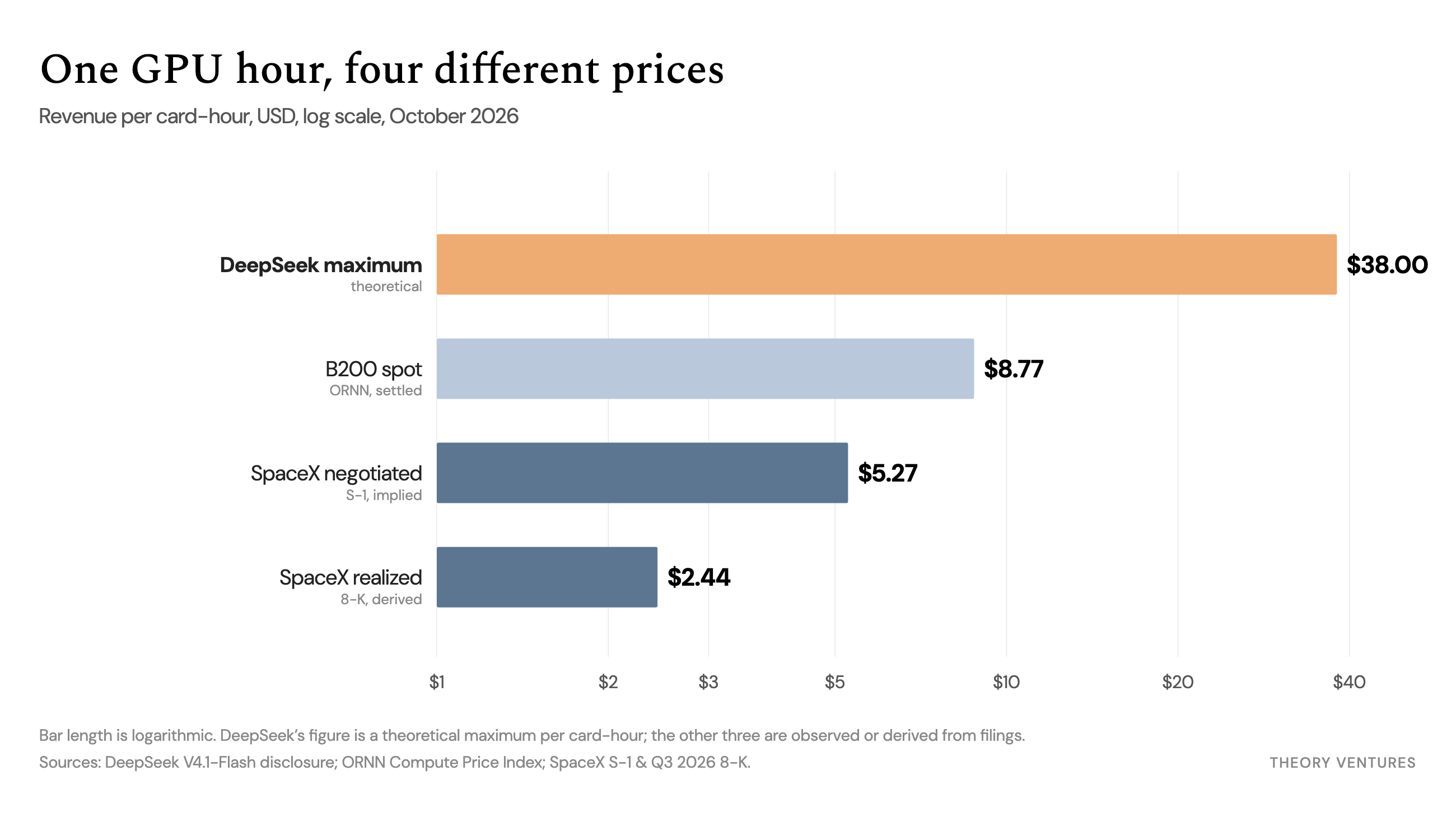
| Rung | $/card-hour | Change from above | Provenance |
|---|---|---|---|
| Theoretical maximum revenue, DeepSeek | $38.00 | — | company claim, theoretical |
| Spot price, B200 | $8.77 | −77% | ORNN, settled 2026-10-20 |
| Negotiated price, SpaceX | $5.27 | −40% | S-1, implied |
| Realized revenue, SpaceX | $2.44 | −54% | 8-K, derived |
DeepSeek calculates a $38 maximum per GPU card-hour.3 It describes a GPU running under optimal conditions : maximum utilization for external customers rather than internal work, & 100% of its output usable & billable, sold at full list price.