For the past four years, Jensen Huang ran the Central Bank of AI. Today he resigned as chief executive of Nvidia.1
What are the implications for the AI economy?
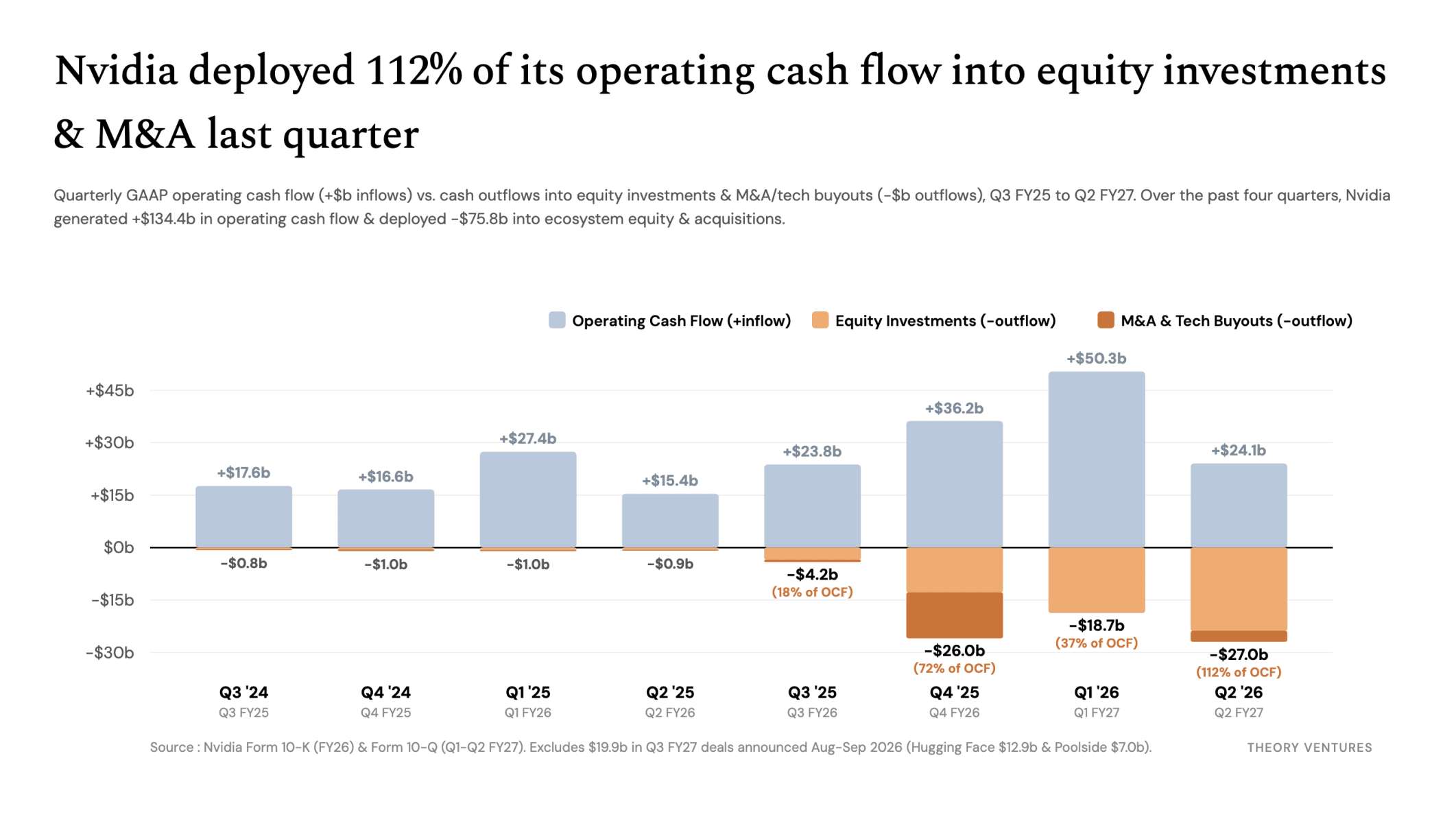
1. If the Central Bank of AI tightens policy, the AI economy slows. Over the past two years, Nvidia committed $42b to M&A & technology buyouts,2 invested $61b of cash on a cost basis into equity stakes across 229 startups & 13 public companies,3 & extended $164.5b in lease guarantees & cloud capacity backstops that require capital reserves alongside $63.1b in customer receivables, where payment terms now stretch up to a full year.45 Under a more financially disciplined regime facing heightened board scrutiny, any tightening of those equity checks, payment terms or lease backstops will slow AI buildouts just as the broader economy slows when the Federal Reserve tightens credit.
2. Nvidia fused the startup & chip ecosystems in a way we have never seen. Under Huang, Nvidia acted simultaneously as chip supplier, lead venture investor, anchor cloud customer & lease guarantor across more than 200 startups. Those deals ran on Huang’s personal conviction & relationships. Nvidia now needs a leader who can sustain these founder partnerships without the co-founder who built them.
3. Open-source startups lose their primary patron & buyer. Nvidia has been the single largest buyer & financier of American open-source AI companies, committing $22b to its Nemotron stack across Hugging Face, Poolside & Essential AI : no other company has bought open-source teams at scale.6 Meta, Google & at least eight US startups that have raised $100m or more continue to train open-weight models,7 & they will now have to carry more of the American open-source mantle themselves.
4. Tighter export controls. The episode likely increases pressure in Washington for stricter semiconductor export controls & compliance rules.
5. An opening for custom silicon. Custom AI ASICs already account for 28% of AI server shipments & 15% to 20% of accelerator revenue in 2026, led by Google’s TPUs at 65% of the custom silicon market alongside AWS’s Trainium3, Meta’s MTIA & Broadcom’s custom XPUs.8 Leadership turbulence at a single-source supplier accelerates that shift.
The change of leadership at the Central Bank of AI is a pivotal moment for the industry. It is hard to overstate how central Nvidia has become to startup financing, M&A exits & policy across the fastest-growing segment of the US economy. A sudden transition at the top introduces real uncertainty into the market & especially in startups.
-
Nvidia Newsroom, NVIDIA Announces CEO Transition, November 12, 2026 : Jensen Huang resigned as President, CEO & member of the Board effective immediately ; EVP & CFO Colette Kress was appointed Interim CEO & Harvey C. Jones was appointed Chair of the Board. ↩︎
-
Nvidia 2025 & 2026 M&A & strategic technology buyouts ($42b total) : Groq ($20.0b LPU technology license & engineering acqui-hire, December 2025, with $13.0b paid in Q4 FY26 & $2.94b in Q2 FY27 per SEC filings), Hugging Face ($12.93b acquisition announced September 3, 2026), Poolside ($6.0b Model Factory non-exclusive license & transfer of 109 Laguna engineers into Nemotron, August 2026), Enfabrica ($900m networking license & team, September 2025), Run:ai ($700m), Gretel ($320m), Deci ($300m), Shoreline ($100m), Brev, SchedMD, CentML & Essential AI (June 2026). ↩︎
-
Nvidia Form 10-K (FY26) & Form 10-Q for the second quarter ended July 26, 2026 (filed August 26, 2026) : cumulative cash paid for purchases of equity securities over the last eight quarters totals $60.8b on a cost basis ($1.49b in FY25, $17.50b in FY26 & $42.40b in 1H FY27, with an additional $25.0b in pending equity commitments). Including $34.3b of cumulative unrealized mark-to-market gains ($10.6b in FY26 & $23.7b in 1H FY27), the carrying fair value on Nvidia’s balance sheet reached $94.0b to $99.0b across 229 private companies & 13 public companies. Disclosed stakes include $30.0b in OpenAI, up to $10.0b in Anthropic, SpaceX/xAI, CoreWeave, Safe Superintelligence, Intel, Nebius, Synopsys & Poolside. ↩︎
-
Nvidia Q2 FY27 Form 10-Q off-balance-sheet commitments ($530.5b total across supply, cloud & guarantee obligations) & Note 7 (Supplemental Financial Statement Information) : contingent credit & capacity backstops total $164.5b, comprising $108.5b in lease & debt default guarantees (led by an up-to-$105.0b backstop on OpenAI’s Ohio data center leases with SB Energy), $36.0b in multi-year neocloud take-or-pay capacity agreements (including CoreWeave’s $6.3b residual capacity guarantee through 2032 & Lambda’s $1.5b agreement) & $20.0b in 15-year data center leases signed by Nvidia for reassignment to neocloud partners. While off balance sheet unless triggered, these guarantees require Nvidia to maintain substantial liquidity reserves. On the balance sheet, accounts receivable jumped from $38.5b at FY26 end to $63.1b in Q2 FY27 (consuming $24.6b of operating cash flow in six months), with five customers representing 70% of receivables (22%, 14%, 13%, 11% & 10%). Days sales outstanding (DSO) stretched from a 47.8-day 10-year historical average to 60 to 65 days as Note 7 disclosed extended payment terms ranging from 90 days up to one full year to finance customer data center builds. ↩︎
-
Over the past four quarters, Nvidia generated $134.4b in operating cash flow & put $75.8b straight into equity stakes & acquisitions : peaking last quarter at $27.0b, or 112% of operating cash flow. Nvidia Condensed Consolidated Statements of Cash Flows (Form 10-K for FY26 ended January 25, 2026 & Form 10-Q for Q1 & Q2 FY27 ended July 26, 2026). Quarterly operating cash flow vs. cash outflows into equity securities & acquisitions/Groq buyout : Q3 FY25 (+$17.63b OCF vs. -$0.76b deployed, 4%), Q4 FY25 (+$16.63b vs. -$1.02b, 6%), Q1 FY26 (+$27.41b vs. -$1.03b, 4%), Q2 FY26 (+$15.37b vs. -$0.89b, 6%), Q3 FY26 (+$23.75b vs. -$4.15b, 18%), Q4 FY26 (+$36.19b vs. -$25.97b, 72%), Q1 FY27 (+$50.34b vs. -$18.67b, 37%) & Q2 FY27 (+$24.08b vs. -$26.98b, 112%). ↩︎
-
Nvidia’s $22b open-source & Nemotron commitments combine the $12.93b Hugging Face acquisition (September 2026), the $7.0b Poolside deal ($6.0b Model Factory license + $1.0b equity round, August 2026), the acqui-hire of Essential AI (founded by Transformer co-authors Ashish Vaswani & Niki Parmar, June 2026) & $2.0b in Nemotron Alliance open-weight model & dataset grants. ↩︎
-
US startups that have raised at least $100m to train open-weight models include Thinking Machines Lab ($2.0b seed at $40b valuation, shipping Inkling open models), Poolside ($1.6b+ raised at $12b valuation), Together AI ($530m+ raised at $7.5b valuation), Liquid AI ($250m+ raised at $2.3b valuation, Liquid Foundation Models), Arcee AI ($150m+ Series B in September 2026 at $1b valuation), Reflection AI ($130m+ raised, shipping the 501b-parameter open-weight Beam model in October 2026), Prime Intellect ($130m Series A in July 2026 at $1b valuation, INTELLECT models) & Deep Cogito ($100m+ raised, Cogito-v2.1-671B open-weight model). ↩︎
-
TrendForce & Tom’s Hardware (May 2026) : custom AI ASIC server shipments reached 27.8% of the AI server market in 2026 (growing 44.6% YoY vs. 16.1% for merchant GPUs), representing 15% to 20% of data center AI accelerator revenue. Within custom silicon, Google TPU holds 64.8% to 65.1% share, followed by AWS Trainium & Inferentia (14.6%), Meta MTIA (8.7%), Microsoft Maia (6.4%) & OpenAI/emerging programs (5.5%). ↩︎