GPU prices have doubled in the last six months, from $4.40 to $8.08 per GPU-hour. But AI prices are falling. How can that be?
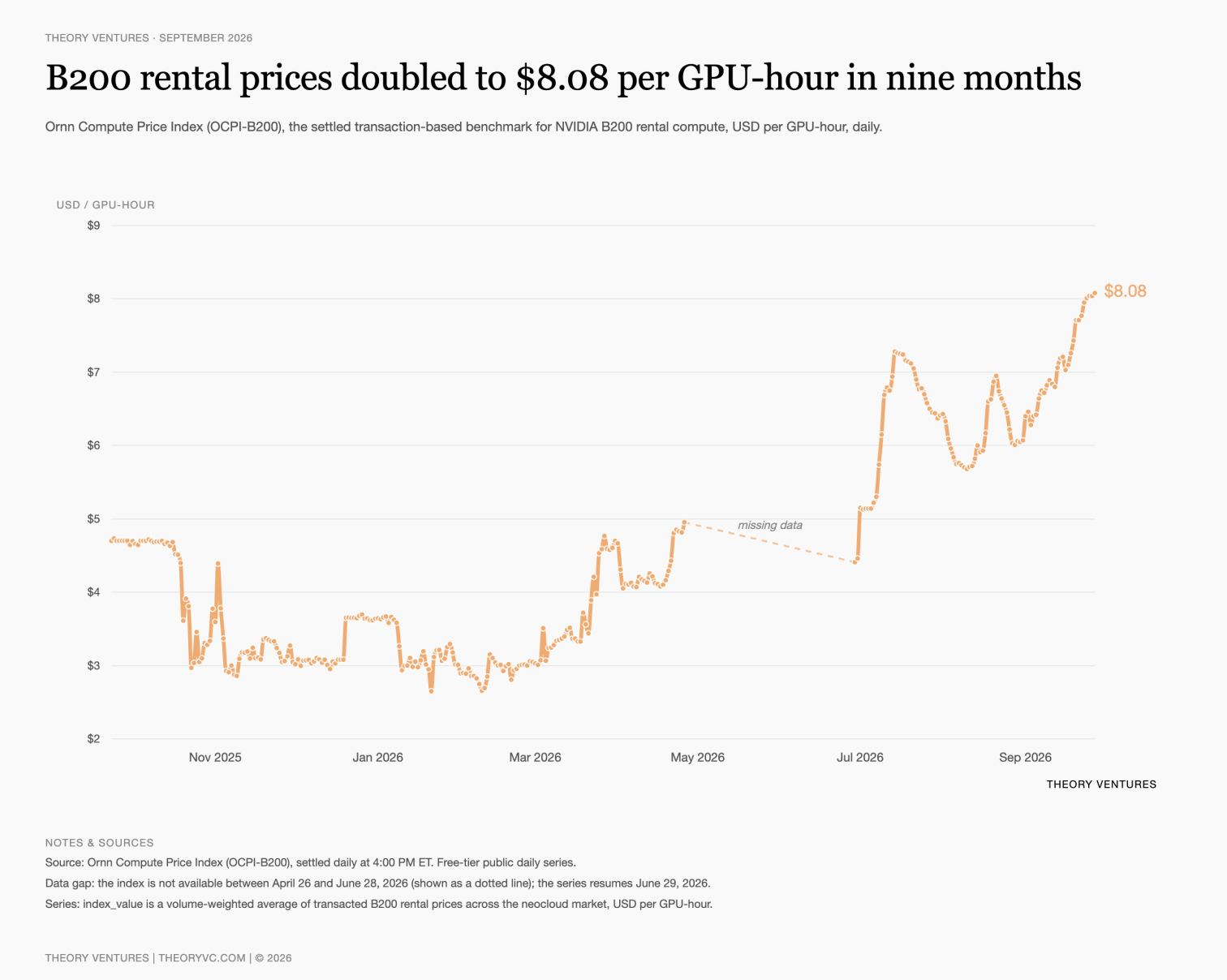
It is not a simple answer. Higher GPU costs are likely to remain while the industry races to build out new data centers. Every component of the buildout is increasing in cost, from concrete to copper to credit.1 Above all, electricity remains the limiting factor, which Oracle is experiencing : last week it invoked force majeure on its New Mexico campus after the natural-gas pipeline feeding it slipped by six months.2
Demand continues to explode. Inference companies & model companies are posting record-setting growth, which emboldens investors to value them more richly, provide them more capital, & up the bidding on those limited GPU-hours, to generate more revenue. The flywheel spins.
Meanwhile, AI efficiency is improving just as rapidly. Claude Opus 5.5 costs 40% less to run than the previous model.3 OpenAI cut Luna 80% in July, then another 50% in September, presumably powered by margin innovation.4 The same benchmark threshold that cost $0.55 eighteen months ago now clears for $0.0015, a 377x reduction.5
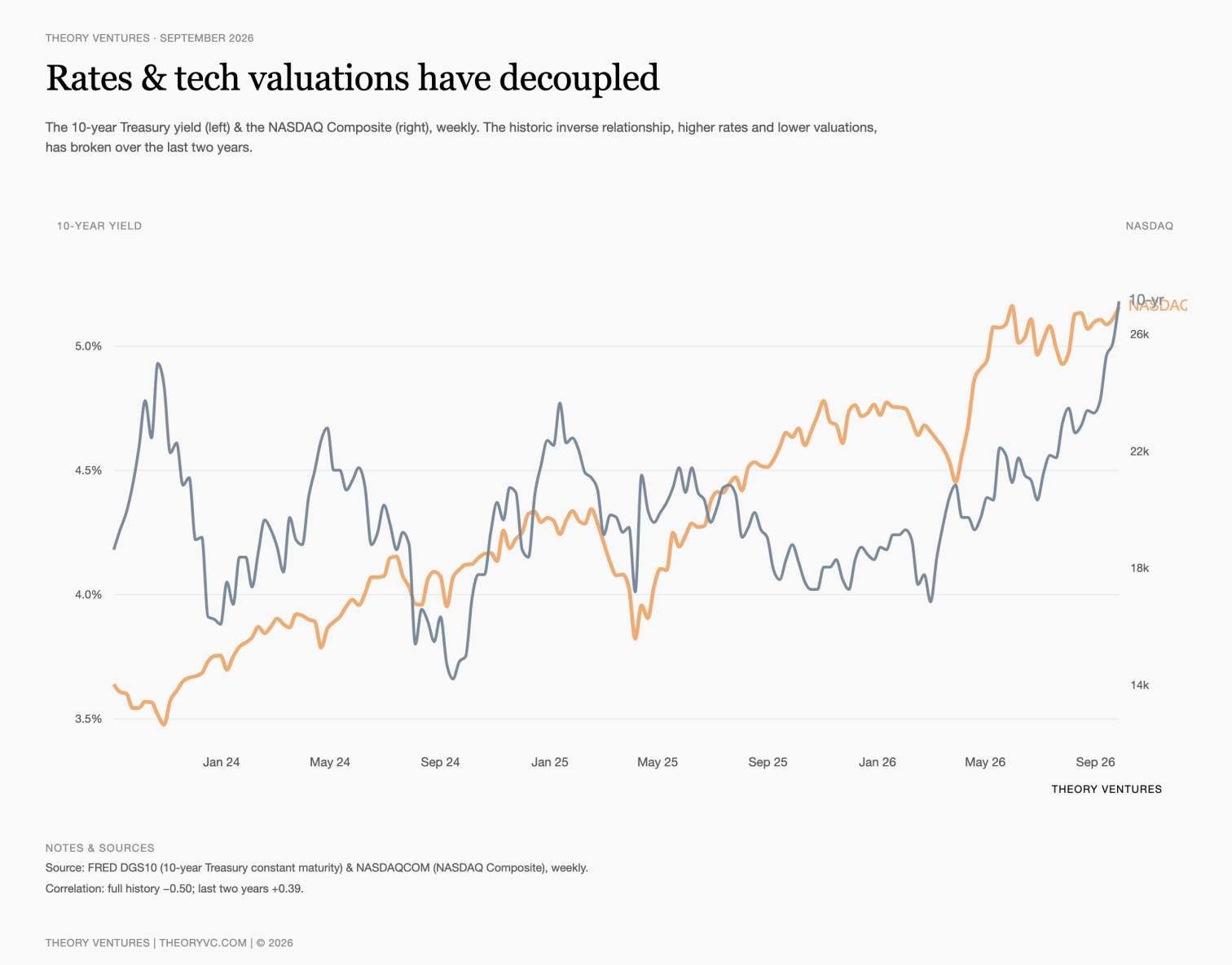
But capital is more expensive. As rates have risen, the relationship that governed tech multiples has come undone. The 10-year Treasury has been the strongest historical predictor of tech valuations : higher rates, lower multiples. Over the full history the correlation runs −0.50. Over the last two years it has flipped to +0.39.6 Rates climbed from 3.63% to 5.18% while the NASDAQ rose roughly 78%. The market is no longer repricing tech on the cost of money. It is betting the growth math works out.
Today, the capital markets are fueling this torrid growth, betting the math works out positively. The metric that will ultimately matter is gross profit dollars per GPU-hour.7 As GPU costs increase, are efficiency gains outpacing them? Microsoft says it generates 90% more tokens per GPU year over year, concentrated in its smaller models.8 If that pace continues, the two curves are at least running neck & neck.
So for now, the industry seems to be holding both forces in balance.
-
Claude Opus 5.5 is built for coding sessions that use more context ↩︎
-
FRED DGS10 vs NASDAQ Composite, 1971–2026. ↩︎