2024 Theory Ventures Go-to-Market Survey: Optimism Rises Amid Changing Market Dynamics

Last week at SaaStr, we unveiled the results of the Theory Ventures 2024 Go-to-Market Survey. This annual survey shines some light into the state of SaaS sales & marketing, offering a glimpse into how founders & companies are navigating the current business landscape.

Here’s a breakdown of the key findings:

  1. Increased Optimism & Steady Fundraising Expectations

Despite the challenging economic environment, founders are more optimistic than 2022. The average outlook score has risen from 6.1 in 2022 to 6.7 in 2024.

Read more

The New Software GTM Playbook

The first version of the SaaS GTM playbook was written twenty years ago. Salesforce championed it. Mark Roberge published The Sales Acceleration Formula about Hubspot’s journey.

Over the next two decades, we analyzed, quantified, instrumented, & optimized many aspects of the SaaS GTM. Account executive to SDR ratios, sales cycle lengths, conversion rates, customer acquisition costs, customer lifetime values, net dollar retention.

The new software GTM playbook has yet to be written. But the companies who figure it out will become the next wave of massive businesses.

Read more

The Rarity Shibboleth

Large language models are wonderful at ingesting large amounts of content & summarizing. Uploading an academic paper and I can pester it with an infinite list of questions & it will respond with equally infinite patience.

In comparing the two most recent Microsoft earnings calls, Claude highlighted:

  • faster than expected Azure growth (29% vs 27%)
  • AI contributing 8% of Azure revenue up from 7%
  • higher CapEx spending & greater capacity constraints for data centers
  • much better commercial bookings growth : 17% vs 13%

Excellent analysis.

Read more

The Challenge of the AI Demo

The AI Demo isn’t easy. Many of the major AI companies have demoed their AI systems, first starting with pre-recorded, & now pushing into live demos. They don’t always work.

Multiply Murphy’s Law by a non-deterministic system & it’s not unreasonable to expect AI demos to nearly always hiccup.

Demo disruptions aren’t disaster. These systems are early & changing rapidly. They might suggest the system requires work & tuning, not a fundamental challenge.

Read more

Which Design Era Are We In?

When the internet became popular in the 1990s, websites were static & adopted the design language of their creators : blue links & images.

image Then, we added interactivity with Javascript. In 2005, Gmail claimed the title of most sophisticated app. Soon there after, Google Maps enabled interactivity in the browser for 2D maps.

image Next, the first mobile apps were launched. FourSquare introduced real-time location, which persists as a feature in Snapchat & Uber

Read more

The Dislocation Between Public & Private Web3 Markets

With the rise of AI, web3 has become a quieter part of the venture ecosystem. I was curious about the current state of affairs.

The launch of the Bitcoin ETF has amassed roughly $58b. Meanwhile, the Ethereum ETFs has about $500m, two orders of magnitude smaller.

The some major Web3 tokens have done pretty well in 2024 ; others have underperformed the Nasdaq (+19% YTD).

Token / Index YTD Performance, %
BTC 37
SOL 36
QQQ 19
DOGE 11
ETH 9

Series A valuations have increased through 2022 and since have seen a much higher variance, with both meaningfully higher & lower prices than the trend line.

Read more

Higher Levels of Abstraction

Over the weekend, Andrej Karpathy shared this tweet & it inspired me to conduct the 2024 GTM Survey Analysis this way.

image

I use a language called R to analyze data because of its ability to generate pretty charts & the depth of its statistical analysis tools. Within 90 minutes I had found 9 key data points in the data that were statistically significant & runs more than 50 analyses. In the past this kind of work would have taken me 30 to 40 hours.

Read more

What Has Your GPU Done For You Today?

A year ago, enterprises balked at the prospect of deploying AI. The dominant blocker : security. By using AI, would my company lose its data as employees passed sensitive queries to large language models?

Today, buyers are more familiar & have security options : deploying AI on virtual private cloud architectures, tools to delete data from cloud AI vendors, dedicated security tools for AI, & a panoply of open source alternatives.

Read more

AI Public & Private Premia for AI Companies

We’ve been tracking the performance of publicly traded AI companies since the beginning of the year. Publicly traded companies with AI products or strategies trade at about twice the forward multiple of non-AI peers.1 image

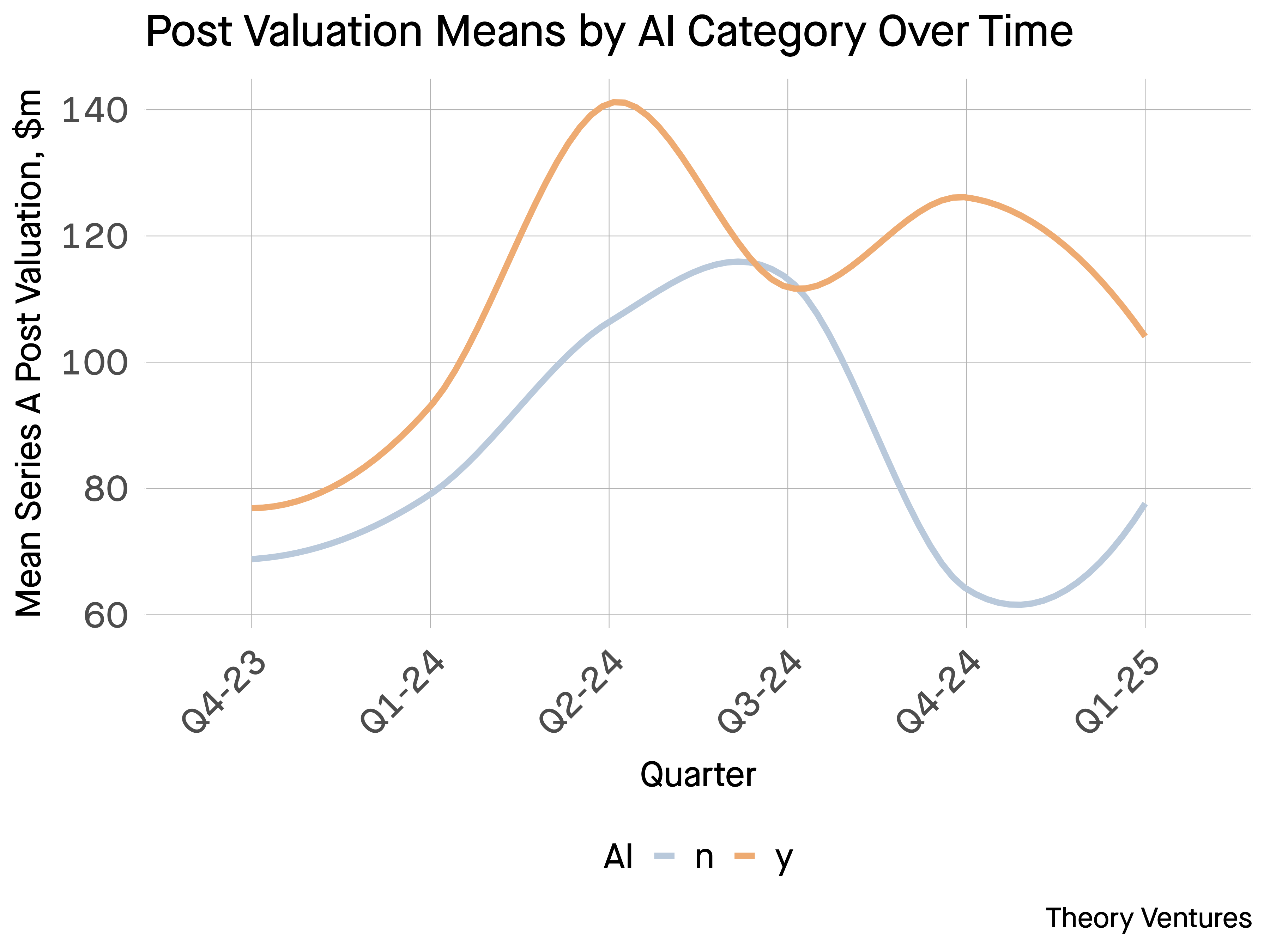
Within the private markets, the same is true within the Series A. GenAI startup companies raise at about 1.5-2x the post-money valuations of all software companies.2 These businesses represent about 30% of Series As in 2024.

Read more

Things that Used to be Impossible, but are Now Really Hard

Kevin Scott, CTO of Microsoft, framed the opportunity in AI this way : work on problems that used to be impossible, but are now really hard.

My immediate reaction : what technical problems are now possible but still hard? What can computers achieve by themselves that two or three years ago would be intractable?

But, this point isn’t purely about technical innovation.

What business problems are newly solvable?

Nearly 10 years ago, I wrote a post about the minimum viable average contract value to justify a sales team. Most companies typically hire account executives & development reps at $15k or greater in contract value because the economics of lower ACVs aren’t viable for most.

Read more