From a $200k Annual Burn to Raising $80m+ : Notes from Office Hours with Fredrik Haga

image

In November, Office Hours welcome Fredrik Haga, founder & CEO of Dune. Dune dashboards provide the most incisive views into what’s happening in crypto. Dune counts more than 50k dashboards using 300k+ different queries & executes more than 10m queries a month across those assets. I learned a lot from the session.

The video is here & the podcast here.

I learned that Fredrik and his co-founder Mats spent a cumulative $600k getting the business off the ground in the first 3 years. Fredrik shared his perspective on navigating a fund raising winter & what it means to search for product-market fit without much runway. 18 months after splitting hotel rooms with Mats, the Dune founders had raised close to $100m. It’s an incredibly inspiring founder story that resonates during the current part of the economic cycle.

Read more

Five Predictions for 2023

Every year I make a list of predictions & score last year’s predictions.

Here are my predictions for 2023.

  1. ML propels SaaS into a massive second wave that increases workers’ productivity measurably. Machine learning models predict code, synthesize images, author blog posts reducing composition time by a factor of 2 or 3. Users grow accustomed to this very quickly & ML becomes a requisite feature in most workflow SaaS.

  2. The hangover from web3’s raucous 2022 extends into 2023. Most categories slow down meaningfully, including Defi. More than 100 web3-enabled games launch. Virtual wallets ensconce themselves into web2 applications. Marketing becomes the first broad use case of web3 after Defi, catalyzed by the death of the third-party cookie.

Read more

A Funny Thing Happened on the Way to Sand Hill Road

A funny thing happened along the way to Sand Hill Road in the last decade : startups stopped talking about how much runway a Series A would buy them.

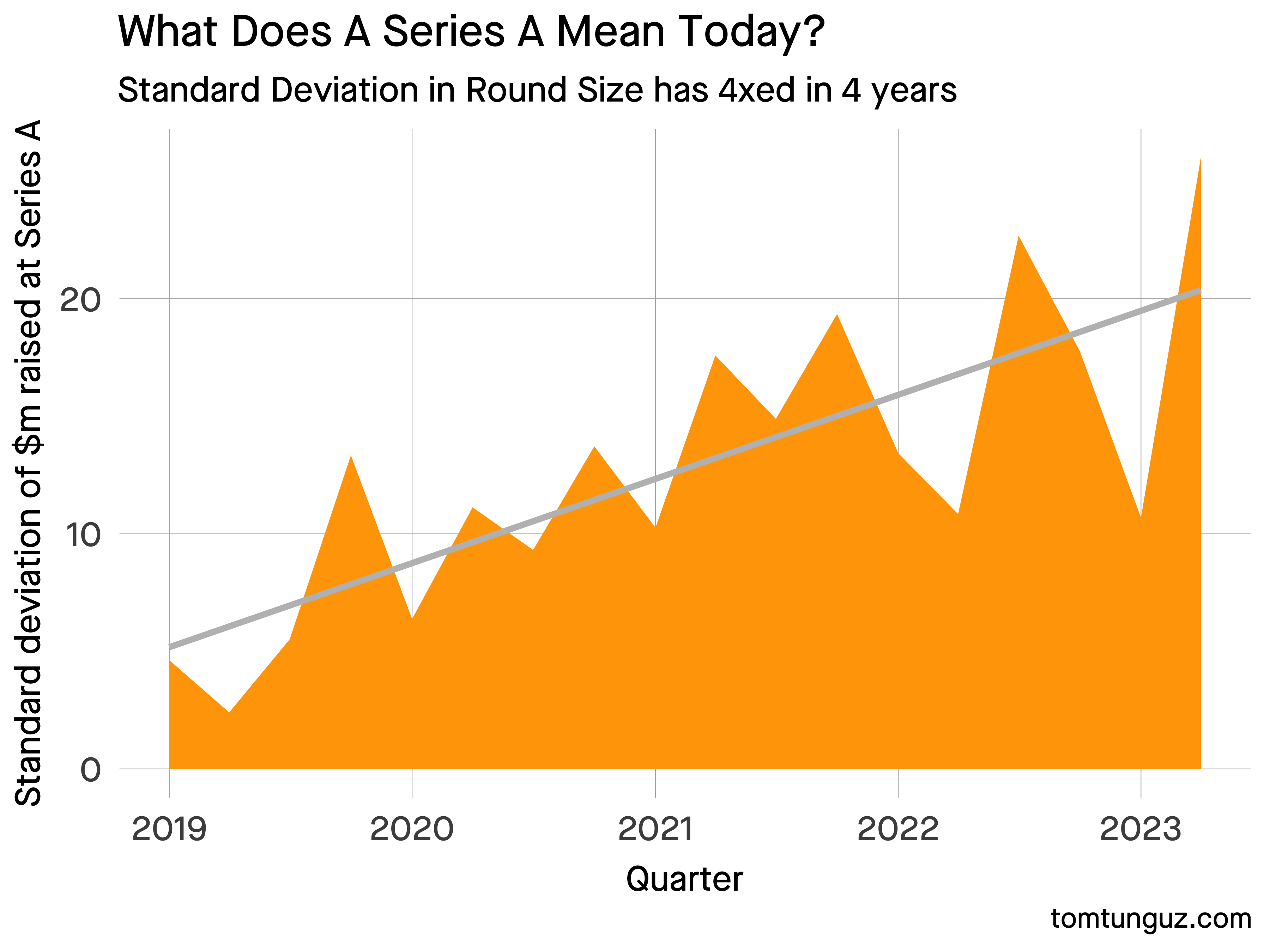
In the 2000s, when capital was scarcer, founders & VCs would derive round size by debating the quantum of money required to achieve Series B milestones.

When capital is scarce, it’s rationed.

In the 2010s, US venture capital grew 40x in 10 years. More capital meant the constraints of yester-decade no longer applied. Founders declared a maximum acceptable dilution instead.

Read more

My Favorite 10 Books of 2022

These ten were my favorite books of 2022. I was seeking parallels or theories to frame a mental model which explains why economics & history dominated the list.

  1. The Man from the Future. My favorite biography of the year, The Man from the Future begins in Budapest, the center of the financial & intellectual world circa 1900 profiling John von Neumann. von Neumann is the consummate polymath. He started his career by pushing pure mathematics forward with key papers, then moved into physics working on the Manhattan Project, developed the von Neumann computer architecture (most modern computers are still built this way), then developed game theory & wrote the seminal work on the topic.
  2. Bond King : Bill Gross, the Bond King, started a multi-trillion dollar asset management business with innovation. Working as a coupon-collector at an insurance company, Gross began to trade those coupons, previously illiquid instruments & pushed Pimco to preeminence.
  3. The Future of Money : A history of currency from barter to paper specie, this book pushes into the world of digital government currency called Central Bank Digital Coins & provides a multi-thousand-year perspective on currency that hint at web3’s potential impact on money.
  4. Amp It Up : Frank Slootman, CEO of Snowflake, imbues this book with the focused intensity that has propelled his companies to the zeniths of their respective industries.
  5. Statistics & data analysis for Financial Engineering : Luna, 3Arrows & FTX’s implosions dominated the web3 market this year. All were failures of risk management. This book uses R code to illustrate how to manage & calculate risk with techniques like multivariate statistical models, copulas (which define how various assets correlate - important in a bear market when most assets become highly correlated) & Markov Chain Monte Carlo analysis for scenario analysis using state machines. A technical but worthwhile read.
  6. The Man who Solved the Market : A history of the most successful quantitative trading shop in history, The Man who Solved the Market details the life of Jim Simons & the turbulent creation of Renaissance Technologies. RenTech hoarded trading data to leverage as a competitive advantage & has produced returns north of 50%+ for many year. That’s after a 4% annual management fee & 44% share of the profits.
  7. Silverview : Spy novels spice up my predominantly non-fiction diet. John Le Carre is a favorite of mine. So is Mick Herron & his Slow Horses series. Silverview is Le Carre’s last novel published posthumously & a novel whose suspense builds throughout, cresting to a satisfying crescendo.
  8. Physics for Future Presidents : If you became President tomorrow, you would need a deep enough understanding of science to ask trenchant questions about energy policy, climate change, space, & dirty bombs. After 384 pages, you’ll know enough to be commander-in-chief.
  9. The Lessons of History A husband & wife, both career historians, who have published many books & won the Pulitzer, collaborate for one hundred pages to summarize everything they’ve learned about humanity. A colossal undertaking & success.
  10. The Changing World Order : Ray Dalio’s book on the evolution of the financial markets draws on ideas from the Fourth Turning to explain the difficult economic future facing the United States in the next decade, and the sunny future after GDP levels rise enough to offset the inflation caused by the money printing machine of the last decade.
Read more

What the $6B Coupa Acquisition Means for Software Startups

This morning, Coupa announced its sale to Thoma Bravo for $6.2b. The acquisition is notable for three reasons.

First, the premium to the public price is 31%.

Second, the multiple is 8.4x NTM revenues.

Both of these data points imply public multiples have room to grow.

Third, it’s the most substantive acquisition to announce this year after Figma’s announced its sale to Adobe. The M&A market may be thawing a bit.

Metric LTM Value Average Software Public Value
Revenue, $m 787 n/a
Revenue growth 22% 31%
Gross margin 60% 72%
Net income margin -44% -19%
Cash flow margin 22% 10%

Comparing it to other public SaaS companies, Coupa grows revenue 9 percentage points more slowly, operates with lesser gross margin of about 12 percentage points, generates twice the loss as a fraction of revenue, but produces twice the cash flow from operations as a percentage of revenue.

Read more

PLG & Profitability : More Product Doesn't Necessarily Mean Greater Profits

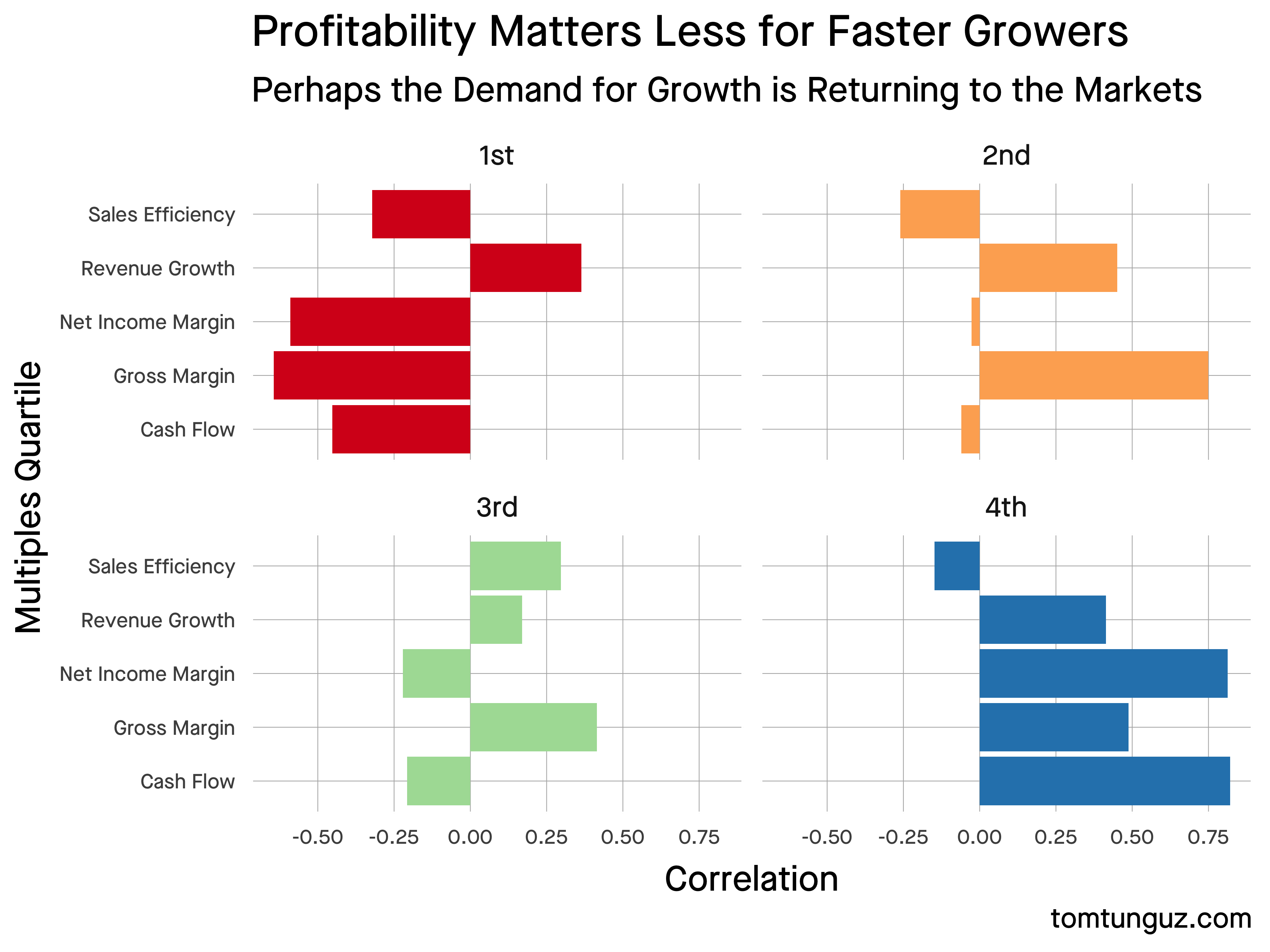
Profitability or net income margin has become the most important correlate to public software company valuations. But public companies are less profitable today than a year ago. Surprisingly, PLG companies’ profitability has suffered more than sales-led businesses.

image

Across every quartile, public software & infrastructure companies have seen a 5 percentage point drop in net income since Covid.

image

Product-led growth (PLG) companies - those who educate & convert buyers with product rather than sales & marketing (SLG) - operate at about 5% to 10% less profitability than sales-led motions.

Read more

Top 10 Posts of 2022

These are the top 10 posts by engagement for 2022 at tomtunguz.com.

Reflecting on them, I see they clustered on web3 & the fundraising market, both of which experienced a tumultuous year. Selling in the pandemic & post-pandemic also drew a lot of interest.

I’m grateful to everyone who read them, commented, debated, & shared them.

  1. The Web 3 Marketing Stack: The Next Big Wave in Crypto. I wrote about my thesis that web3 technologies will underpin both a fundamental change in web2 ads by replacing the cookie with an NFT & the tools web3 startups will need to pay for growth during the current winter.
  2. The State of Web3 in 2022 through Data. Delivered at DuneCon, this presentation provides an aerial view of the state of web3. About 2.5m active users, about 5k developers committing code, & 70-90% drops in activity from the beginning of the year.
  3. Figma’s 50x ARR Multiple & What it Means for Startup Fundraising. Adobe’s acquisition of Figma at the highest ARR multiple ever for a company-at-scale stunned the market that was reeling from the macroeconomic shock.
  4. Deliberately Underselling as Sales Strategy Borne from a series of Office Hours with Lee Kirkpatrick & Bill Binch, this post advocates for quicker sales cycles with smaller ACVs to drive more predictability & superior NDR. Also, this strategy minimizes pipeline supply shocks.
  5. Growth is No Longer the Best Predictor of a Software Company’s Value. After a twelve-year long bull run, investors no longer value growth at-any-cost. Efficiency matters just a bit more in the public markets. A watershed change that cascaded into the private markets that has led to a significant bid/ask spread between founders & investors.
  6. 9 Predictions for Data in 2023 Delivered at Monte Carlo’s IMPACT summit, I touched on the evolution of the decade of data. More than half of analytics workloads reside in the cloud in ten years.
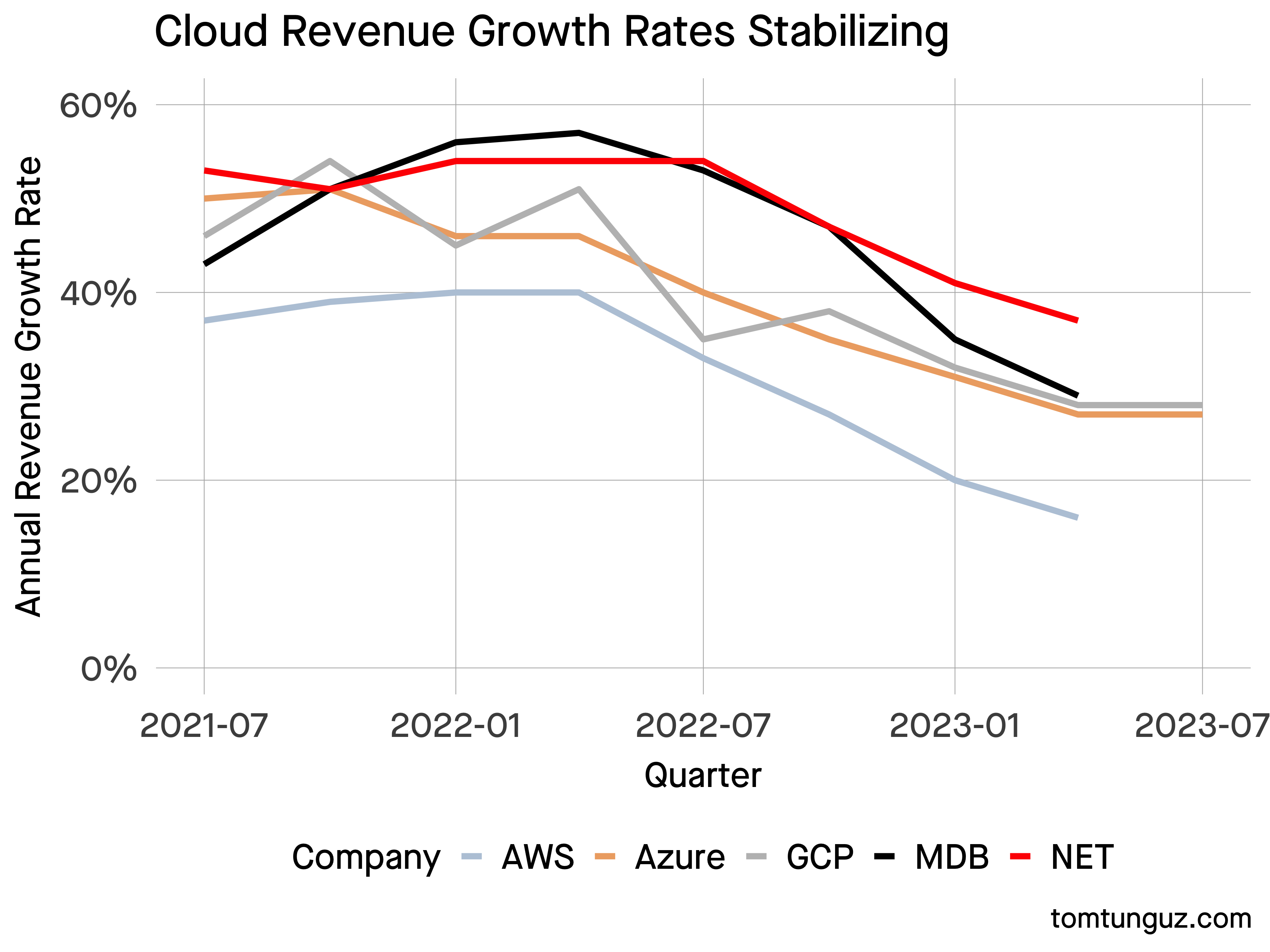
  7. Grey Skies in Cloud Earnings I charted the earnings reports of the three largest cloud infrastructure companies as an index of software buying behavior. Growth rates for these behemoths have fallen in half from 44% on average to 22% in two quarters, underscoring the lengthening sales cycles of enterprise software.
  8. Fundraising 2022 Where We Are & Where We’re Going From Traction in Vancouver, these slides demonstrated the bid/ask spread between VCs & founders. Investors saw the public markets fall 70% & surveyed founders replied they expected a 10% decline in valuations. Where those two meet will determine the environment for 2023.
  9. Imagine You’re a Venture Capitalist. This posts questions how to manage a venture fund: whether to double down on companies during a changing valuation environment.
  10. $112m of Market Cap per Engineer. I calculated the total value creation in web3 & divided by the active number of developers to estimate this statistic. The figure has fallen by 80% or so since I wrote it. Regardless, I still believe in the potential of web3 technologies.
Read more

Napoleon's Influence on the Modern Data Stack : hyperdimensional Analysis with Malloy

image

Data visualization is a passion of mine. I remember reading Edward Tufte’s book The Visual Display of Quantitative Information & stumbling across Charles Minard’s “Napoleon’s March.”

Most visualizations plot 2 dimensions. Napoleon’s March encodes 6 : the geography of the terrain, the route & the direction of the army, the headcount of the troops, the temperature of the battlefield, & the time of year of Napoleon’s doomed quest to conquer Russia. Click to enlarge it.

Read more

The Uniswap Token Launch : Tokens as CAC Part II

Airdrops may be one of the most prevalent forms of marketing in web3. Airdrops reward users who have helped the project & generate awareness of the token by depositing free tokens into their wallets.

Recently, Dune Analytics published an analysis of the Uniswap UNI token airdrop.

Some background on the UNI airdrop: To be eligible, users must have transacted on Uniswap before September 1, 2020. Uniswap distributed 150m UNI tokens - about half went to insiders (investors, employees, etc.). Uniswap gave 400 tokens to each eligible user, worth about $1200 at the time. Today, UNI tokens’ market cap tops $5b.

Read more

The Most Successful Web3 Launch in 2022

What was the most successful launch of web3 in 2022? I think it’s a project that deserves more visibility than it has received.

image

Reddit’s Collectible Avatars launched in August 2022. Collectible Avatars allow users to buy profile pictures. They can sell these to other users if they like. Blockchain powers the experience.

The avatar trading subreddit has an active dialog of current collections.

The marketplace supports artists. Creators pay Reddit 5% for minting costs, but retain the remainder of the earnings, less payment fees from Stripe or Apple or Google. Plus, creators receive 5% royalties on every subsequent trade.

Read more