The Decline of Venture Debt at the Early Stage
image

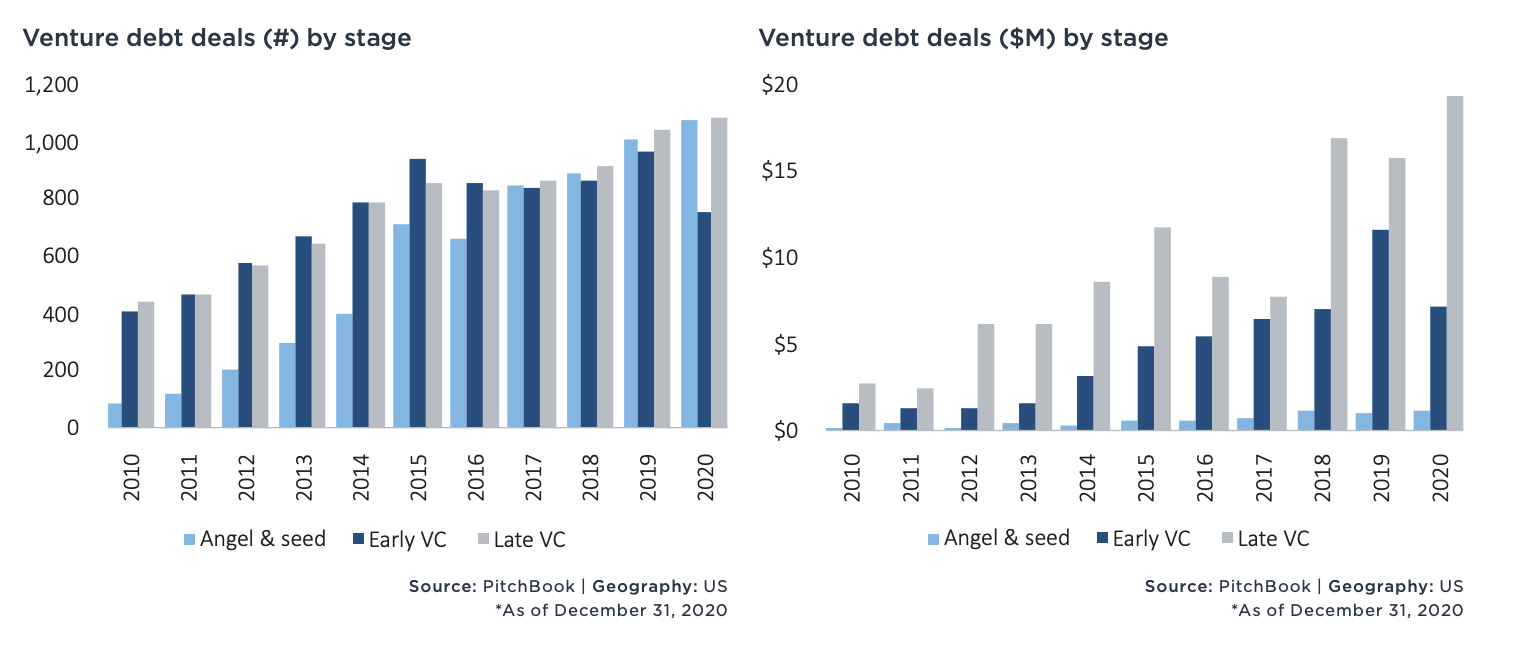
A few years ago, when a startup raised a Series A or Series B, founders would bolster the round with venture debt: a term loan and/or a revolving credit line. However, equity dollars are replacing those debt dollars in the last 18 months in the early stage.

Meanwhile, venture debt dollars have migrated to later stages. Early stage debt origination and round counts peaked in 2019, while later stage debt has increased quite nearly every year. In the later stages, debt is often used to finance acquisitions, and perhaps this is occurring more for venture backed companies.
Read more

Data Meshes, Apache Iceberg & Project Nessie - Novel Ideas in the Data World

One of the most exciting trends in data, during this Decade of Data, is the evolution of the open ecosystem. Around the new Cloud Data Lakes an ecosystem is blossoming, bursting with new concepts for the future of data. The third Subsurface conference takes place this week, July 21-22, to delve into some of these topics.

Here are some of the highlights:

  • Zhamak Dehghani invented the concept of the Data Mesh. Data meshes recast data teams inside companies; instead of a single team producing data for a company, decentralized teams publish and consume data from other teams, paralleling the move to microservices from monoliths in infrastructure software.
  • Novel data management projects like Apache Iceberg and Project Nessie are fundamental advances in how to manage, control, and serve data in the data mesh architecture. Ryan Blue and Ted Gooch will share the story behind Apache Iceberg at Netflix and Ryan Murray, one of the creators of Nessie, will announce some new advances that enable Git-like functionality for data.
  • Amazon’s S3 stores and Azure’s data stores provide the infrastructure for teams to maintain and control data. Amazon S3 GM Kevin Miller and Microsoft VP PM of Azure Storage will share the future of cloud storage

If you’re interested in how Cloud Data Lakes and Data Meshes are evolving, and in the future of data, register for Subsurface here

Read more

The Journey From Fortune 100 Executive to Startup Entrepreneur

image

It’s not very often one meets someone with Padmasree Warrior’s story. Formerly the CTO at Motorola, she left to co-lead Cisco’s engineering organization worldwide. Next, she took the helm at NIO, a manufacturer of automonous vehicles that went public in 2018. She serves on the boards of Microsoft and Spotify.

On Wednesday, July 28 at 12pm PT, Redpoint Office Hours welcomes Padmasree, who is current the CEO of Fable,the social reading platform that brings stories for everyone, anywhere.

Read more

The Next Step Forward for Conversational Intelligence - Chorus & ZoomInfo

image

Today, Jim Benton, CEO at Chorus announced the company has agreed to a merger with ZoomInfo for $575m.

I remember meeting Roy Raanani, Chorus’ founder, more than 5 years ago, when he demoed the company’s ability to analyze voice conversations in real-time, extracting words, detecting inflections in speakers’ affects, and synthesizing understanding from sine waves to assist account executives.

It was revolutionary. We connected on a shared interest in speech recognition technologies and decided to partner over a dinner at a steakhouse in the Union Square neighborhood of San Francisco.

Read more

My Mental Model for the World of Crypto

How does crypto work at the highest level? This is the mental model I’ve been using.

There are six key categories of players.

Asset acquirers - these include brokerages, custodial and non-custodial wallets, banks, asset managers, hedge funds, market makers, and lenders. They aim to acquire assets to plunge into the crypto ecosystem. Each acquirer offers a unique value proposition, tempting investors to park cash with them.

These companies might target retail or institutional investors, hawk loans, offer trading of varied assortments of tokens, compete on lower trading fees, share better market information, or reward loyalty with their own token. Many in this group attract investors/users with high interest rates for deposits, which are funded by lending assets to other market participants. Then they plan to cross-sell other financial products, much like a modern bank or brokerage.

Read more

Innovation in the Financial Markets: Seventy Years of Hedge Funds

Alfred Winslow Jones created the first hedge fund in 1949. He pioneerd the idea of hedging to maximize gains, trading based on stock movements which he called velocity, paper portfolios and a competitive multi-manager model in which individuals ran their own books.

Since that era, hedge funds have innovated roughly every decade or so. More Money than God illuminates each epoch.

In the 1960 post-war boom, pension funds entered the primarily retail-driven market. Bigger orders created inefficiencies in the market, and a fund named Steinhardt, Fine, Berkowitz arbitraged the illiquidity created by big blocks to great success by buying large share blocks at discounts.

Read more

The Great Game of Risk Played in Category Creation, and Why the Winning Strategy is Aggression

Suppose you’ve started a company that’s creating a category. Most buyers in your target market haven’t heard of your business or the kind of software you sell. There’s no budget line item, no Magic Quadrant, no G2 High Performer Award, no conference.

You have an idea, a vast blue ocean in front of you, and a pile of greenbacks stashed in a bank account from your last financing. Do you spend aggressively to create the category or conserve capital, knowing education will take time?

Read more

The Productivity Implications of Working from Home Across 150,000 Employees

Are we more productive at the office or at home? Researchers from the University of Chicago published data on the productivity trends across 150,000 employees of a large IT services company to answer that question. It’s the first time I’ve seen analysis on the same business through the period. The business had deployed software to monitor employee behavior before COVID and used it throughout.

Quoting from the paper: WFH reduced total commuting time among US workers by more than 60 million hours. So, did we accomplish more by commuting to our kitchen counter instead of the office park?

Read more

The Figures that Will Move the Venture Capital Market in the Next 3-5 Years

This weekend, Janet Yellen said the US economy would benefit from an increase in interest rates. The Fed has been struggling to combat historically low inflation. The combination of both the 25% increase in the money supply from last year’s stimulus plus the proposed infrastructure spending should trigger inflationary pressures. What does it mean for venture capital and Startupland?

In short, we should expect some cooling.

image

Read more

Executive Recruiting as Competitive Advantage - The 3 Knock-On Effects of Failed Executive Hires

The cost of a failed account executive hire is about 8 months of lost productivity. A three month initial search, three months of ramp time, the termination, and then another two to three months of ramp for their replacement.

That’s at the individual contributor level.

What does it cost the organization to hire the wrong executive? In terms of time cost to the startup, a failed executive hire is roughly similar, 9 months. But knock-on effects hinder the organization.

Read more