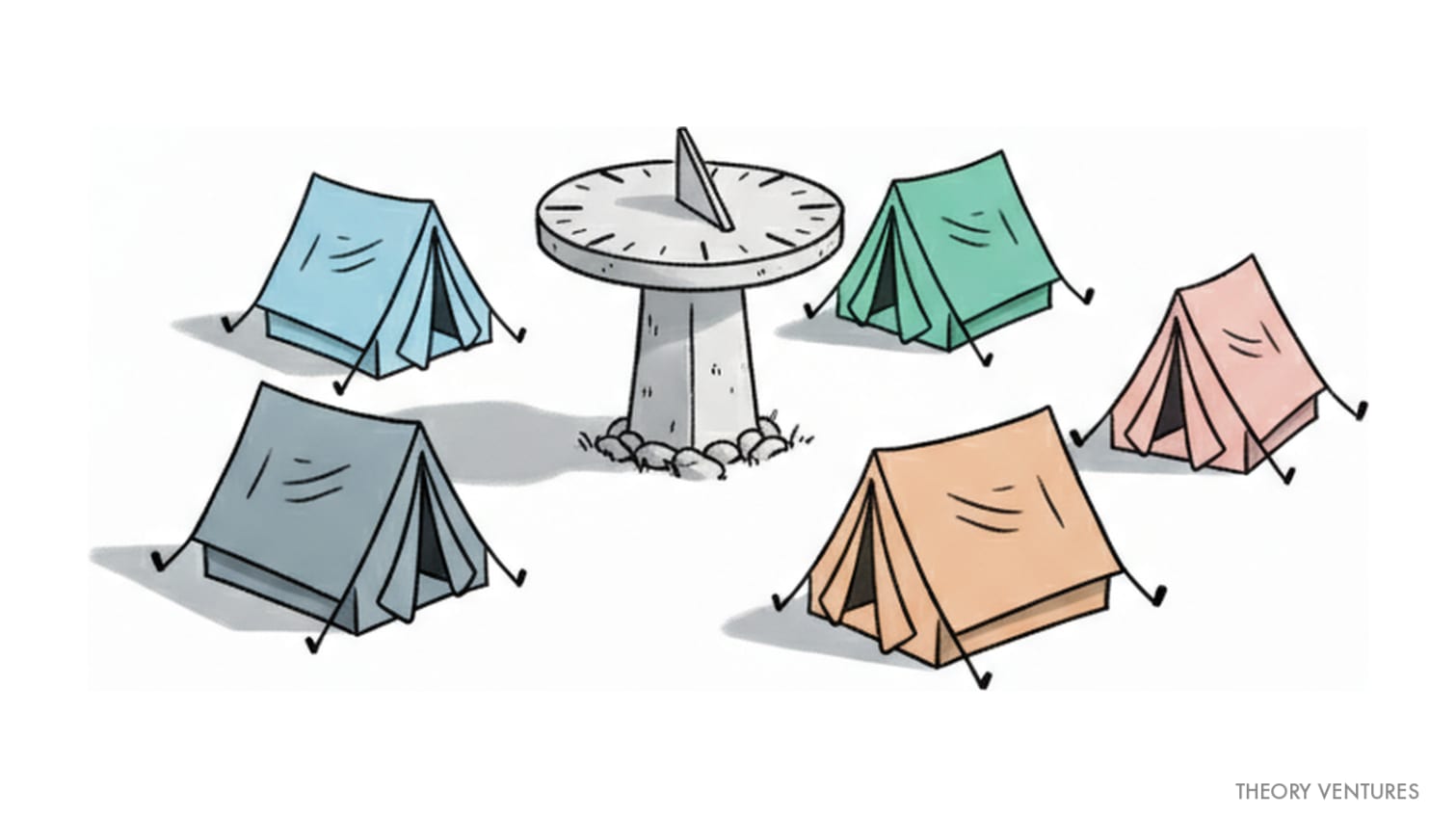
Dario Amodei asked the industry to pace itself on a Saturday1. But what does that word mean?
The proposal promises auditors examining AI closely, collective action in the industry to meter the pace of innovation, & international coordination across allied countries. Pacing is a policy question. Five camps priced the consequences & none named a speed.
- The interpretability camp wants time. Evan Hubinger, who leads alignment science at Anthropic, puts the odds that AI goes catastrophically wrong for humanity above 10 percent within a decade & says there is no plan for it2. Interpretability, the science of understanding what happens inside a model, “doesn’t always produce clear & reliable results,” Amodei wrote. “We still only understand a tiny fraction of what goes on inside these models.”1
- The labor camp wants time for workers, not for researchers. Bernie Sanders has introduced a federal moratorium on new AI data center construction until safeguards are enacted.3
- The economic camp sees AI’s contributions to GDP as the path to managing the national debt.45 “The world is awash in debt,” Bessent said at the G20, “& the only way for us to get out of this is to grow our way out of this… This CapEx will turn into productivity, & that will be extremely disinflationary,” he said. “I would guess that in the next six months we will start seeing the benefits of that.”6 It is the only dated prediction any camp has made.
- The geopolitical camp seeks to sustain strategic advantage in the AI race. “We’re leading China in AI,” Trump said Sunday. “Whoever wins AI wins.”7
- The regulatory capture camp wants no new rules at all. Write the rules & your rivals pay to obey them. David Sacks, who chairs the President’s Council of Advisors on Science & Technology, put it to Amodei & Altman directly : “Stop pretending you need anyone else’s permission. Stop pretending antitrust law has to be suspended so you can form a cartel.” If the labs will not slow down on their own, he wrote, “we’ll know this was just another bid for regulatory capture.”8 Lina Khan, who chaired the FTC until 2025, arrives at the same place from the opposite direction. “We shouldn’t let discussions about new legal regimes distract from the fact that there’s no AI exemption from laws already on the books.”9
These perspectives still do not answer the question : what does pacing mean?
In January 2025 a rival matched the frontier in 41 days.10 Today the lead lasts months, & the gap between open & closed models has widened from three months to four.11 Should the interval be 60 days? 160? 600?
Can we really control the speed of innovation to that level of precision?
Amodei is specific about the lever. He would limit the ingredients that go into frontier models, training compute & the nature of training runs.1 Compute thresholds have been tried. A 2023 executive order required reporting above 10^26 FLOPS, & was revoked shortly thereafter.12 No model had crossed that line while the rule stood. The first, Grok-3, shipped weeks later, & roughly ten will clear it this year.13 Training compute grows about fivefold a year. A fixed number is a ceiling the floor reaches on its own.
The question is more than how fast. It is who decides.
-
Dario Amodei, We Must Pace the Frontier, September 2026. ↩︎ ↩︎ ↩︎
-
Evan Hubinger, @EvanHub, September 9 2026, as reported by CNBC. ↩︎
-
Bernie Sanders, Artificial intelligence is coming for the working class. We must fight back, April 16 2026. The employment figure is Sanders citing Stanford research on programming & customer service roles. ↩︎
-
Congressional Budget Office, The Budget and Economic Outlook: 2026 to 2036, February 2026. Debt held by the public passes its previous high of 106 percent, set in 1946, by 2030. ↩︎
-
CBO’s long-term sensitivity analysis, as summarized in Gale & Auerbach, The Federal Budget Outlook. A 0.5 percentage point rise in nonfarm-business total factor productivity leaves debt-to-GDP 43 percentage points lower by 2055. ↩︎
-
Scott Bessent, G20 press briefing, Asheville, North Carolina, September 2 2026, full transcript ; also reported by the Straits Times. ↩︎
-
Donald Trump to reporters at Doonbeg, Ireland, September 13 2026, via the Associated Press. ↩︎
-
David Sacks, @DavidSacks, September 13 2026. ↩︎
-
Lina Khan, @linamkhan, September 13 2026. ↩︎
-
Tomasz Tunguz, Darwin’s Finches in AI, January 2025. The interval measures how long a frontier model holds the lead before a rival matches it. ↩︎
-
Open models lag state-of-the-art closed models by 4 months, Epoch AI, May 29 2026. Epoch also finds no model since GPT-4 has led for a year ; the second-longest reign, o1’s, lasted barely three months. ↩︎
-
Executive Order 14110, October 30 2023, which set a 10^26 FLOPS reporting threshold under the Defense Production Act ; revoked January 20 2025. ↩︎
-
Epoch AI, How many AI models will exceed compute thresholds?, May 2025. Grok-3, released February 2025, was the first model estimated above 10^26 FLOP ; Epoch’s median projection is roughly ten by 2026 & thirty by the start of 2027. Frontier training compute has grown about 5x per year since 2020. ↩︎