The Four Factors to Consider When Developing Your Startup's Pricing Strategy

What is the optimal pricing strategy for a start up? That depends. It depends on at least three other variables: the product, the placement, the positioning. Combined with price, these are the four 4Ps of marketing created by Dr. E. Jerome McCarthy, former professor of marketing at Michigan State and Notre Dame. Also called the marketing mix, these four variables need to be aligned when determining pricing for your startup.

Apple serves as a great example of a company whose marketing mix is aligned and consistent. The company positions itself in the market as a premium brand. It builds products of the highest quality often with innovative and novel manufacturing techniques. Apple sells its products in glorious, well lit and modern stores. And it’s price points top the market.

Read more

Mitigating Myopia in SaaS Marketing

image

As a SaaS startup scales from finding initial product market fit to building its go to market organization, one of the most important goals in building that go to market organization is developing a multifaceted marketing team. Marketing’s role in SaaS sales has expanded to the success of SaaS companies as customers prefer to educate themselves more than they have in the past.

Read more

The Impact to Startups of the LinkedIn Acquisition

image

The acquisition frenzy continues in SaaS. This morning Microsoft announced it would acquire LinkedIn for $26.2 billion, which prices the business at 8 .1x trailing 12 month revenues and 6.7x next 12 month revenues. In addition, Symantec announced that it would acquire Blue Coat for $4.7 billion, a 7.7x trailing multiple. In the 2016 acquisition market, the median acquisition multiple is 7.8x trailing 12 month revenue and 6.4x next 12 month revenue.

Read more

The Key Ingredient to Disrupting with Machine Learning

Which are the ripest areas for startups to disrupt using machine learning? At the core, machine learning/artificial intelligence relies on two key ingredients: advanced algorithms and data sets to train those algorithms. Novel algorithms are increasingly making their way into the public domain in the form of open-source libraries. So, the key differentiator for startups and ultimately long-term competitive advantage is access to proprietary data sets.

In the consumer world, there are natural and intrinsic monopolies at play. Google’s search has a natural feedback mechanism of users clicking on the best search results that results in Google continuing to have the best search. Facebook’s network effects of it social network, in combination with its strategic acquisitions of other fast-growing social networks like Instagram and WhatsApp, reinforce its natural monopoly.

Read more

Subverting Systems of Record with Chat Bots

How does a chat bot company transform a technology advantage into a distribution advantage? This is the key question facing startups in this part of the ecosystem.

Deep learning is advancing at an incredible rate. Google has released TensorFlow and Parsey McParseface. These advances will improve natural language understanding, enabling chat interfaces to amaze and delight users.

So let’s assume that the technology works. Let’s take for granted that despite the myriad ways a human can ask a question, the computer will understand the query. And let’s also assume that on top of the messaging platforms, these chat services flourish. Distribution resembles that of the early days of the iTunes Store, when users were rapt to try out new products and startups aggregated massive user basis overnight. Then what?

Read more

When to Scale Sales for Your SaaS Startup

image

When is the right time to increase sales headcount for a SaaS startup? It is one of the most strategic decisions for early-stage business to make given the amount of effort and expense involved in building, managing and scaling a sales team.

While there is no single absolute sign, neither qualitative nor quantitative, these are some of the signals I have found indicate it might be a good time to scale sales.

Read more

Comparing Two Ways to Build a SaaS Sales Team

image

There are two main ways of building a SaaS sales team: top down or bottoms up. Top down SaaS sales organizations start with a VP of Sales who often hires senior account executives. Bottoms up sales teams hire the first account manager and promote from within. Which is better?

Let’s create a framework to compare the bookings capacity, the ramp period and the cost for three levels of sales hires. These figures will vary by company and sales team.

Read more

The Beginning of Consolidation in SaaS

Three billion dollar SaaS acquisitions were announced this week with Salesforce paying $2.9B for DemandWare, an eCommerce platform provider, Vista Equity Partners paying $1.8B for Marketo, the marketing automation company, and Thoma Bravo buying Qlik, a business intelligence companies for $2.9B. In addition to the absolute size, the first two trans transactions distinguish themselves high valuation multiples of 12x and 8x on trailing revenues.

CompanyPriceRevenue $MAnnual Growth RateGross MarginNI MarginFCF MarginTTM/Rev
OPower55214916%62%-30%-12%3.6x
Textura6839235%82%-16%-16%7.7x
Marketo179522638%66%-32%-5%7.9x
Demandware285823743%71%-17%5%12.1x
Qlik286563111%85%-5%13%4.5x

Marketo generates more revenues is growing faster and burning less cash than OPower and Textura. Presumably, these three factors and the market opportunity afforded to a horizontal SaaS company led to a greater multiple.

Read more

Start with the Premise that Everything is Noise

image

We each know that focus is the most effective way to work, but hearing the mantra to focus doesn’t help narrow our scope. What’s the best way to focus? Start with the premise that everything is noise and then work to find the exceptionally valuable or important things for each day and for each project. That’s the thesis of a book called Essentialism.

Read more

The 3 Types of Channel Strategies for SaaS Startups

image

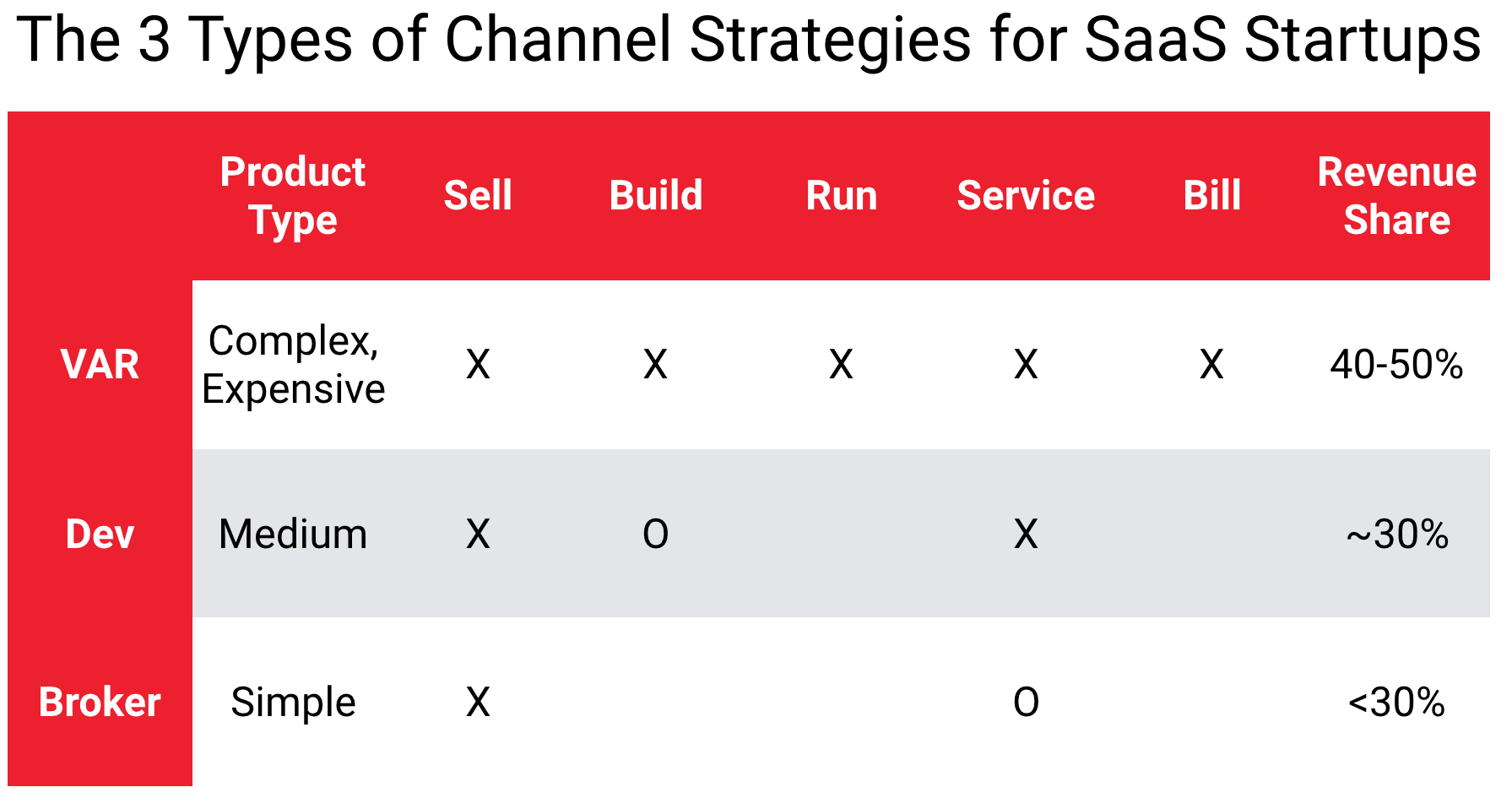
“There are three different types of channel relationships for SaaS companies,” a seasoned executive told me recently. Which is the right one for your SaaS startup?

In a classic reseller relationship, the value-added reseller sells, builds, services and operates a solution to a customer. After signing the deal, the VAR crafts and customize the software to the needs of the customer, invoices the customer and supports the customer. The VAR pays some royalty or license fee back to the vendor. Most of the time, when companies say they sell through the channel, they refer to this type of arrangement.

Read more