10 Lessons Learned after $5B of M&A

Over the last few years, I’ve been lucky to work with founders and management teams to sell about $5b of startups. During that time, I’ve observed a few things about M&A. Here are 10 of my learnings:

  1. Most acquirers have built a relationship with the acquisition target. Suitors introduced during a sale process wrestle with doubts of understanding what they don’t know about the space, the team, and the business. Leaders should build relationships with partners and potential buyers if M&A may be in the company’s future.
  2. Startups are sold to individuals, not to companies. The champion - often a product leader, the CEO, or a general manager - risks their career by buying a startup. The deal sponsor must construct a business case, forge trust with the startup’s team, and amass enough conviction to overcome inertia and internal friction to consummate the sale.
  3. Be wary of first-time acquirers. They may lack the internal know-how to complete a transaction. Acquisitions require significant cross-functional alignment. Mustering consensus can be problematic during the ordinary course of business, and it’s even more challenging under duress.
  4. The deal isn’t done until the money is in the bank. I’ve seen acquisitions fall apart the day of close, out of the blue.
  5. There are three types of sales: team, team & tech, and team, tech, & traction. Each one is more valuable than the last, provided the company grows. The greater the revenue, the more likely the acquirer prices a target on a revenue multiple.
  6. Should a management team and board decide to sell, they should understand the buyer’s motivation. As Simon Sinek would say, start with the why. It will inform how to weave the most compelling vision of a union.
  7. The startup can exert maximum leverage immediately before signing the term sheet. Once the term sheet is signed, the startup’s leverage vaporizes. The startup must plod through the days or months of maximum weakness: the exclusivity period between the term sheet signing and the definitive agreement. Negotiate the crucial points before signing the term sheet.
  8. The essential components of a merger term sheet often include:
    • price: the amount and the structure (cash vs stock; merger or asset purchase)
    • executive compensation: especially equity revesting
    • escrow terms: percent of the consideration in escrow, length the escrow, insurance
    • net-working capital: is the purchase price cash-free/debt-free?
    • no-shop period: how long is the exclusivity?
    • fundamental representations and warranties: the key assertions the target makes about itself and its business. Best to talk to your friendly company counsel on this one.
    • break-up fee: if the transaction is large enough to warrant one
  9. Regulatory delays have become more common recently when selling to a large technology company. Most mergers close on time. But should a transaction be subject to review by the US, the EU, the UK, or other jurisdictions, the closing period can take many months, a year, or longer.
  10. Referencing a buyer paints a picture of the company and teams’ future post-sale. How does the acquirer integrate a company? Treat founders throughout their vesting period? What will it be like to work there next year?

Sales processes are convoluted and complex. There are some parallels to raising capital in that success rates improve by building auction pressure. But the mananging the nuances are critical should you decide to pursue a merger.

Read more

Will Your Startup Borrow More in 2022?

In 1968, Milton Friedman argued “In the Price of Money,” that higher interest rates don’t mean less borrowing. He would echo this sentiment in an article Reviving Japan.

“After the U.S. experience during the Great Depression, and after inflation and rising interest rates in the 1970s and disinflation and falling interest rates in the 1980s, I thought the fallacy of identifying tight money with high-interest rates and easy money with low-interest rates was dead. Apparently, old fallacies never die.”

Read more

The New Discipline Web3 Software Companies Must Develop

Suppose you launch a web3 company tomorrow. The business builds software to help other crypto companies grow. Perhaps you’ll sell infrastructure to help other startups scale or software to manage internal operations. After you’ve launched the product, you’ll encounter a new phenomenon. Your customers prefer to pay you in crypto.

Fast forward three years, your business thrives. The customer roster brims with the best names, each client increases their spend every year, and the sales team outpaces its quota handsomely.

Read more

If You Had $10k to Invest, Which Stock Would You Buy?

If I gave you $10,000 to invest in one company today among the following four software businesses, which would you pick?

Company Growth Rate ARR Multiple (ARR/EV)
1 100% 100 50x
2 125% 950 25x
3 71% 2800 20x
4 65% 2960 10.5x

The first company is a $100m ARR business growing at 100%, trading at 50x ARR, a $5b enterprise value. The fourth company grows 65% on $7b in ARR, implying a $29b EV.

Read more

Intensity Oozes from these Pages

I remember the first time I spoke with Frank Slootman. Beforehand, I read his book Tape Sucks, watched some of his videos on YouTube, and read his blog posts. After few minutes, I couldn’t deny his unique passion for growth and scale.

I called him on a Sunday in the summer. Frank told me most companies don’t focus enough; that there’s only one priority for him: growth. He said if he were to join a startup’s board he would push the business very hard - very, very hard. The company and the board needed to sign up for exactly that.

Read more

How Much Money is Flowing into Crypto?

How much money flows into crypto each month?

There’s the headline figure $1.7T which is the aggregate market cap of crypto. But how about the volumes of US dollars being exchanged into crypto each month? Sometimes this is called fund flows.

I’ve learned calculating this figure is tricky because there’s no centralized reporting for it. But we can get a sense of it via stablecoin minting patterns.

Stablecoins are tokens that are backed by a fiat currency. Each time a marginal dollar buys a stablecoin, a new stablecoin must be minted. Sometimes these stablecoins are burned (destroyed). The net amount of stablecoin creation over time should provide us a directional sense of dollar flow.

Read more

Why You Should Expect Your VP Product to Sign Up for a Lead Quota

image

Pocus and First Round Capital published the 2021 Product-Led Sales (PLS) report earlier this week. Product-Led Growth (PLG) and PLS are important advances in SaaS growth that have existed for a while, but are coming to the fore more recently because startups who master PLG/PLS enjoy terrifically capital efficient growth because technology supplies leads rather than human effort.

PLG/PLS motions typically couple three things:

  1. Free-trial/freemium product to attract a large top of funnel (TOFU)
  2. Product analytics to monitor prospects through their customer journey in the middle of the funnel (MOFU), and predict the best time to contact the user to sell them, at which point they are product-qualified leads (PQL).
  3. Sales-assisted close to maximize the conversion rate (yep, you guessed it - BOFU).

The Pocus/FRC survey highlights three revealing developments in the SaaS landscape.

Read more

Dremio - A Foundational Component of the Modern Data Stack

In 2015, Dremio started in our offices. Today, the company announced its Series E at $2 billion valuation. The business has cemented itself as a foundational component of the Modern Data Stack.

About seven years ago, Dremio’s founder Tomer envisioned a product that would enable customers to manage data and compute separately. Today, we call this idea the data lakehouse and a query engine. Dremio enables Amazon, FactSet, Goldman Sachs, Microsoft, NCR, and Nutanix, amongst others to query oceanic volumes of data at comparable speed to data warehouses.

Read more

How Will the 52% Correction in the Stock Market Impact the Startup Fundraising Market?

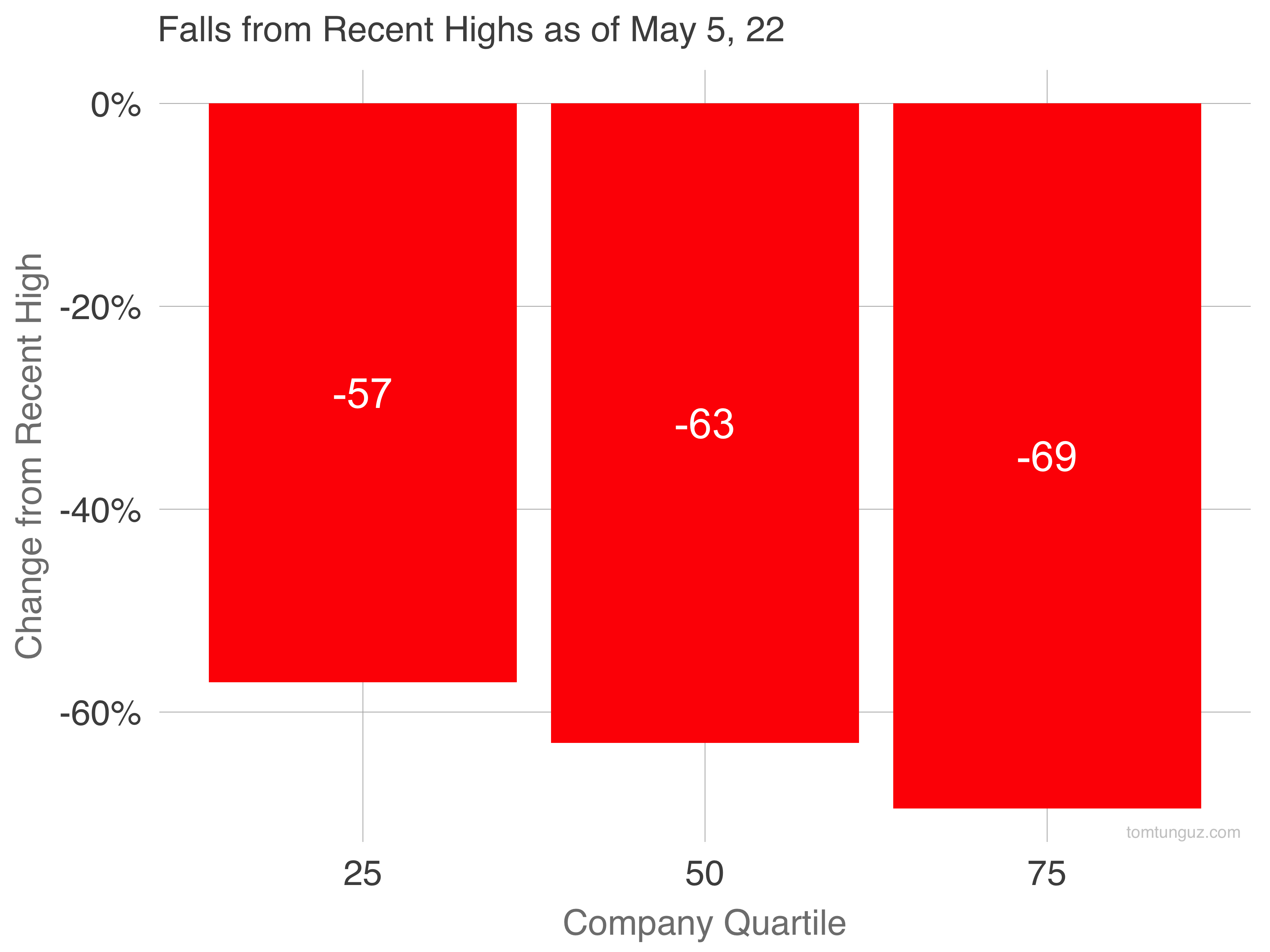
The public software sector is weathering the second deepest multiple contraction in the last decade. Only the 2016 reduction of 57% surpasses it. Public market investors are rotating out of high growth technology companies as the Fed’s policies of quantitative easing, asset purchases, and low rates abate.

image

The question on every software founder’s mind today must be, how will this affect the private financing markets? As a company’s scale approaches that of a public company, the greater the impact on their fundraising.

Read more

Is Compensation Stagnation to Blame for the Great Resignation?

The Great Resignation has rippled across headlines and boardrooms as employees’ values and priorities evolve. Has the Great Resignation been caused by a silent stagnation in compensation?

Let’s compare data from 2010 and 2021 to understand the longitudinal trends in cash and equity compensation. The cash compensation of three executive roles at early-stage companies has increased faster than inflation.

Role 2010 Cash 2021 Cash Cash Change
VPE 219 256 17%
VPM 220 250 14%
VPS 320 404 26%
CPI 217 262 21%

A VP of Engineering in a Bay Area startup that has raised less than twenty-five million dollars earned 17% more in 2021 than 2010. In constant dollars (correcting for inflation, which is listed here as CPI), a 2021 VPE took home 4% less. VPs of Marketing saw similar raises across their salary and bonus, and small loss to inflation. On the other hand, heads of sales’ pay appreciated 5 percentage points more than inflation.

Read more